



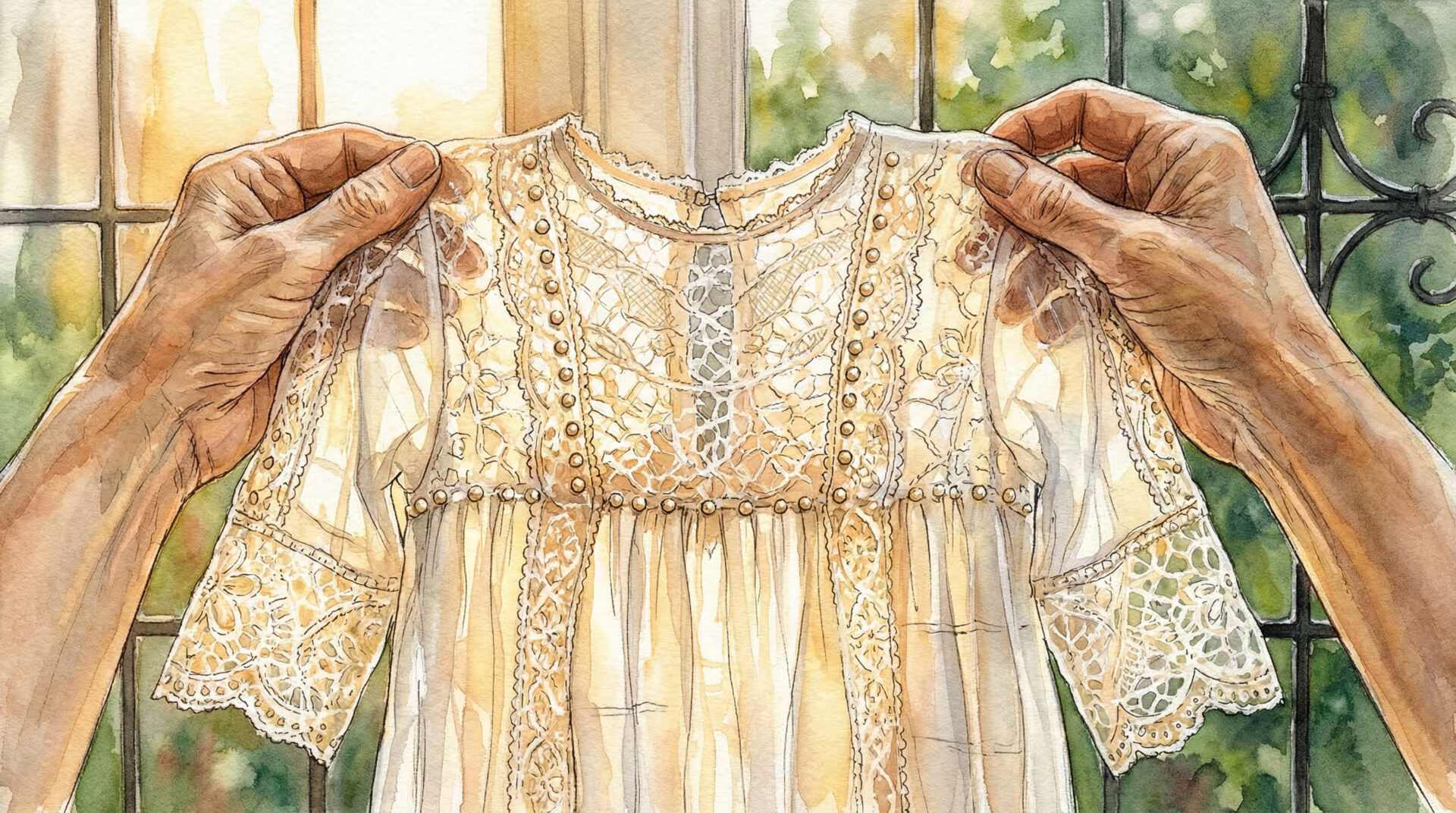
The gown needed pressing.
Vivian held it up to the light in the conservatory, turning it slowly, checking the lace at the hem. Eighty years old. Handmade Brussels lace, Irish linen, seed pearls along the bodice that had yellowed to the color of old piano keys. Four Ashworth babies had worn it. Oliver had worn it, thirty-six years ago, in the chapel at All Souls when his face was red and furious and his fists were clenched against a world he had not asked to join.
There was a crease along the front panel. The dry cleaner had pressed it wrong, folded it at the waist rather than hanging it, and the linen had taken the crease and held it. Vivian set up the ironing board in the conservatory because the light was best there, and she pressed the panel with a damp cloth over the linen, the iron on its lowest setting, moving in slow strokes the way her mother-in-law had shown her. Old linen was not forgiving. It remembered what you did to it.
She held it up again. The crease was gone. The gown hung straight, the lace falling in the pattern it had held since 1986. She draped it over the back of a chair and covered it with tissue paper.
The conservatory was ready. She’d been preparing since Thursday. The flowers from the garden, arranged in the blue-and-white vases Charles’s mother had collected. The champagne glasses on the sideboard. The canapé trays polished. The caterer would arrive at noon. Father Marsh from All Souls at one. The photographer at one-thirty. The guests between two and two-thirty.
She checked her phone. 10:14. No messages from Oliver. She’d called him at nine to confirm the arrival time, and he hadn’t answered, and she’d called again at nine-twenty, and he’d answered on the fourth ring with the voice of a man who had been woken by his second alarm.
“We’ll be there at twelve-thirty,” he’d said.
“Father Marsh is coming at one. You’ll need time to change Margot into the gown. It buttons at the back, small buttons, so don’t rush it.”
“We’ll manage, Mum.”
“And the gown needs to come off before the party. She can’t wear it for hours, Oliver, the lace is eighty years old.”
“I know.”
“Is Sophie —”
“We’ll be there at twelve-thirty.”
He’d hung up. Not rudely. Oliver was never rude. But with the efficiency of a man ending a conversation that could, if allowed, continue until noon. Vivian had set the phone down and gone back to the gown.
She walked through the house now, checking rooms. The drawing room: curtains tied back, the afternoon light on the carpet that needed replacing but wouldn’t be, not when the roof over the east wing needed work and the estate’s income was a third of what it had been when Charles was alive. The dining room: the mahogany table polished, the chairs arranged, the backup plan in case the afternoon turned. September in Vesper was unreliable.
The garden was adequate. The head gardener had left in March and the replacement came only once a week, which meant the borders were thinning and the hedges were past their line. But the section nearest the conservatory was tended, the roses were in their second bloom, and the lawn had been cut yesterday. From a distance it looked right. Vivian was experienced with distance.
In the kitchen, Mrs. Lennox was setting out the plates. Mrs. Lennox had worked at the estate for eleven years and had outlasted two gardeners, a cook, and Charles.
“The caterer called,” Mrs. Lennox said. “They’re bringing the smoked salmon, not the gravlax.”
“I ordered the gravlax.”
“They said they couldn’t source it.”
“They couldn’t source gravlax. In Vesper. In September.”
“That’s what they said.”
Vivian considered. The salmon was not the gravlax. The gravlax was lighter, subtler, appropriate for a christening afternoon. Smoked salmon was a lunch item. But arguing with a caterer three hours before a party was not efficient, and Vivian was always efficient.
“Fine. Arrange it on the oval plates, not the round. Smoked salmon looks better on oval.”
She went upstairs. Changed into the navy dress. Not too formal, not too casual. Appropriate for a grandmother at a christening in her own home. The pearl earrings Charles’s mother had given her. A touch of scent. She looked at herself in the mirror on the dressing table, the one that had been in this room since before Charles, since his parents’ time, and she saw what she always saw: a woman who was presentable, maintained, holding.
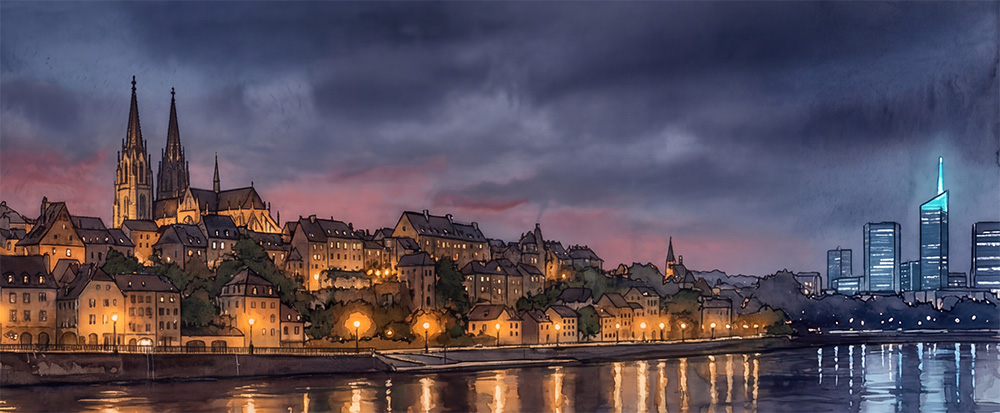
Through the window, the drive was empty. The gates were open. The Meridian’s towers caught the midday light in the distance, glass and steel rising above the treeline.
She went downstairs and waited.
They arrived at twelve-forty. Ten minutes late, which was Oliver’s version of on time. Vivian saw the car from the conservatory. The gray estate car turning through the gates, slowing on the gravel. Sophie was driving. Oliver was in the passenger seat. The baby seat was in the back.
Sophie parked slightly too close to the steps, which meant the passenger door opened onto the lavender border. Vivian noticed this and noted it. She went to the front door.
Oliver got out first. He was wearing the navy blazer she’d suggested and a pale blue shirt she hadn’t seen before. No cufflinks. The collar open. He looked tired. Not ill, but the kind of tired that lived behind the eyes and didn’t leave.
“Darling,” Vivian said. She kissed his cheek. Held his arm for a moment. He smelled of coffee and something she didn’t recognize. Sophie’s washing powder, probably. “You look well.”
“Thanks, Mum.”
She looked past him. Sophie was getting the baby out of the car seat, the movement awkward because the car was too close to the border and she was reaching across at an angle. The nappy bag was on the front seat. A second bag, larger, canvas, was in the footwell.
“Sophie,” Vivian said. “You found the house.”
Sophie straightened. Margot was in her arms, wrapped in a white blanket, face pressed against Sophie’s shoulder. Her hair was pulled back. She was wearing a dark green dress, simple, bought rather than made.
“Hello, Vivian.” Sophie shifted the baby higher. “The traffic was fine.”
“Come in. You’ll want to get her settled before the photographer.”
Vivian turned and walked into the house. Oliver followed. Sophie followed Oliver, carrying the baby and the nappy bag and the second bag, and Vivian held the door and did not offer to take any of them because offering would imply that Sophie couldn’t manage, and Vivian was careful about implications.
In the hallway, Vivian reached for the baby.
“Let me take her. You must be exhausted from the drive.”
“I’m fine. She’s just fallen asleep.”
“She’ll sleep better in the nursery. I set up the old crib, the one Oliver used. It’s in the blue room.” Vivian’s hands were already on the blanket, adjusting, her fingers near the baby’s back. “She likes being on her left side, doesn’t she?”
“She sleeps on her back,” Sophie said.
“On her back? Oliver always slept on his side. Babies sleep better on their side.”
“The guidelines say back.”
Vivian looked at Oliver. Not a look that said anything. That was the point.
“Mum, the guidelines have changed since I was a baby,” Oliver said.
“Of course they have. Everything has changed.” She smiled. “The nursery is ready whenever you want it. I put out extra blankets, the cashmere ones from the linen press.”
She touched Oliver’s arm and guided him toward the conservatory. “Come see the flowers. The roses were extraordinary this week.”
Sophie stood in the hallway with the baby and the bags. After a moment, she followed.
The conservatory was bright with afternoon light. The vases were arranged. The champagne was on ice. Through the glass, the garden showed its best angle.
“Beautiful, Mum,” Oliver said. He was standing at the glass, looking out. His hands were in his pockets. He did this when he was thinking about something he wasn’t going to say.
“The roses are Edmund’s variety. The same ones Constance grows at Harwick House. I got the cuttings from her years ago.” She adjusted a vase. “Did you speak to Thomas?”
“About what?”
“About the Foundation quarterly. He called me yesterday to say the board had questions about the Vandermeer allocation.”
“Mum, it’s Margot’s christening.”
“I know it’s Margot’s christening. I’m simply telling you Thomas called. You can deal with it on Monday.”
“I will.”
“He sounded concerned.”
“Thomas always sounds concerned. It’s his resting state.”
“Call him on Monday, Oliver.”
“I’ll call him Monday.”
Sophie had put the baby in the hallway, in the car seat, and come into the conservatory. She was standing near the door. Her arms were empty. She looked at the flower arrangements, the champagne, the crystal.
“Can I do anything?” she said.
“Everything’s done,” Vivian said. “Though if you’d like to put the gown on Margot before the ceremony, it’s on the chair. The buttons are at the back. Small ones. Eighteen.”
“I can manage buttons.”
“Of course you can. I’m just mentioning it because the lace is delicate. My mother-in-law always said the trick is to start from the bottom and work up, so the weight of the fabric doesn’t pull on the buttons above.”
Sophie looked at the gown. At the tissue paper. At the eighty years of Ashworth christenings.
“It’s lovely,” she said.
“It’s been in the family since 1986. Charles wore it. Oliver wore it. All the Ashworths.” She paused. “It means a great deal to me that Margot will wear it.”
“It means a great deal to us too,” Sophie said.
Vivian let this pass. Some things were better left unadjusted.
The guests arrived between two and two-thirty. Twelve people, not counting Father Marsh, who had performed the christening in the conservatory an hour earlier with quiet competence and a homily about new beginnings that managed not to mention drift, which Vivian appreciated. He was staying for a glass of champagne. Thomas Ashworth, who was eighty-one and walked with a cane and had the family jaw. Margaret Chen, who came to everything now because she was afraid of staying home. David and Caroline Hartwell-Price, who were Oliver’s age and who had a daughter six months older than Margot. Two couples from the Foundation board. And Sophie’s mother, Ewa, who arrived last, in a coat that was too heavy for September and shoes that were too new for comfort.
Vivian received them at the conservatory entrance. She had been receiving guests for thirty-eight years and she knew how to hold a door.
“Thomas. How wonderful.”
“The garden’s holding up,” Thomas said. He said this instead of hello. He was an Ashworth, and Ashworths noticed property before people.
“Barely. Mr. Croft left in March and the replacement doesn’t know a peony from a pansy.”
“My mother would have sacked him by now.”
“Your mother would have done the gardening herself and sacked the rest of us.”
Thomas laughed. He moved into the conservatory with careful steps. Margaret Chen followed, holding his arm. They’d arrived together, which meant Margaret had called Thomas for a ride, which meant Margaret didn’t want to arrive alone. Vivian understood this and seated them together.
The Hartwell-Prices came with their daughter, Alice, ten months old and mobile, which meant Caroline spent the party on her knees following Alice while David talked to Oliver about a fund that wasn’t performing. Sophie’s mother came through the door with the expression of a woman entering a building she was not sure she was permitted to be in.
“Ewa. How lovely.”
“Thank you for inviting me,” Ewa said. She was holding a gift wrapped in paper that was slightly too festive for a christening, with a ribbon tied correctly but with effort. She’s Polish, Vivian thought, though she’d lived in the Warrens long enough that the accent had flattened. A handsome woman, dressed carefully.
“Of course. You’re Margot’s grandmother. There’s champagne on the sideboard, and the canapés will come around. Make yourself comfortable.”
Ewa went to find Sophie, who was in the garden with Margot, standing near the roses, slightly apart from the group that had gathered around the drinks table. Vivian watched Ewa reach her daughter. Watched Sophie’s face change, the tension loosening, just slightly.
The photographer arrived. He was young, efficient, and worked quickly. Family portraits in the garden. Vivian with Oliver and Sophie and Margot, then Vivian with Oliver and Margot, then Oliver and Sophie and Margot alone. For the second grouping, Vivian held the baby. She positioned herself between Oliver and the rose border, the light behind her, the house in the background. The photographer said “Beautiful,” and took thirteen exposures.
“Now one with Sophie’s family,” the photographer said.
“Of course,” Vivian said. She handed Margot to Sophie. “Ewa, come stand with your daughter.”
Ewa came forward. She stood beside Sophie, a head taller, and she didn’t know what to do with her hands. The photographer took four exposures.
“Lovely,” Vivian said. “Oliver, remind me to wrap the gown in the tissue before you leave. It’s Margot’s now.”
She moved the party to the champagne.
Vivian raised her glass. The guests gathered. Sophie was holding Margot near the roses, the baby awake now, blinking at the light. Ewa was beside her.
“Thank you all for being here,” Vivian said. “A christening is a welcome. And today we welcome Margot Eleanor Ashworth.”
She looked at Oliver. He was standing near the drinks table, his glass raised.
“Thirty-six years ago, I held a boy in this gown, in this garden, and I wondered what kind of man he would become.” She smiled. “Oliver has become a man his father would be proud of. A wonderful husband. A devoted father already, though he’s only had four months of practice. He has always been kind and steady and present, and I am proud of him every day.”
She raised her glass higher.
“To Margot. An Ashworth. Ours.”
The guests drank. Thomas nodded. Margaret Chen touched her napkin to her eye.
Sophie stood near the roses with the baby in her arms.
Ewa was looking at Vivian. She was still looking when Vivian turned away. Ewa drank her champagne. She drank all of it.
Caroline Hartwell-Price leaned toward Ewa. “You must be so proud,” she said.
“Very proud,” Ewa said.
“Of Sophie. She’s doing so well.”
Vivian turned. “Ewa, there’s more champagne on the sideboard. Help yourself.”
Ewa looked at Vivian. Something moved in her face. Then she went to the sideboard.
The afternoon settled into the rhythm of a Greenvale gathering, careful and warm, lubricated by good wine and better manners. The canapés circulated. The conversation flowed along safe channels: the Foundation’s autumn benefit, the Greenvale Club’s new hours, the school Alice Hartwell-Price would attend. Thomas told a story about Charles at a regatta in 2038 that Vivian had heard seven times and laughed at for the eighth, because Thomas needed the story and laughter was a kindness she could afford.
Oliver was doing his job. He talked to the board members with the focused attention of a man who understood that charm was a professional skill. He complimented Margaret Chen’s scarf. He asked David Hartwell-Price about the fund without revealing that the Foundation had already declined to participate. He did all of this well, and Vivian watched him do it, and felt the particular warmth she felt when Oliver was being the person she had raised him to be.
Sophie was talking to Caroline Hartwell-Price about sleep schedules. Vivian caught fragments. “She wakes at five now.” “Alice was the same, it passes.” Sophie was animated, her hands moving, her face open. She looked different when she talked to someone her own age. Less guarded. Vivian noticed this and thought: she has friends. She simply doesn’t bring them here.
The thought was not a comfortable one. Vivian set it aside.
Margot began to fuss. Sophie moved toward the carry cot, but Vivian was closer.
“I’ve got her,” Vivian said. She picked up the baby, settled her against her shoulder, and began the small rocking motion she’d used with Oliver. “She just needs a walk. Oliver, darling, tell Sophie the gown needs to come off before the canapés. I can’t have anything on the lace.”
Sophie was standing beside the carry cot.
“The gown needs to come off,” Oliver said to Sophie.
Sophie took the baby from Vivian. She unbuttoned the gown, all eighteen buttons, working from the bottom. Her hands were steady. She didn’t look at anyone.
“Oliver, darling,” Vivian said. He was near the drinks table with David. “Come and say hello to Margaret properly. She was asking after you.”
He came. He always came when she called. Sophie watched him cross the room and then turned back to Caroline.
Thomas Ashworth was sitting in the garden chair nearest the conservatory door, his cane between his knees, a glass of champagne he was nursing. Oliver sat beside him after speaking to Margaret.
“The estate looks well,” Thomas said.
“Mum works hard at it.”
“She does. Your mother was always a worker. Even when your father was here, she ran the house. Charles provided the money and the name. Vivian provided everything else.”
“That’s one way to put it.”
“It’s the Ashworth way. The men in this family have always been better at starting things than at staying in them. Your grandfather built the Foundation. Your father expanded it. Neither of them could sit still long enough to enjoy what they’d built.” He drank. “The women did the staying.”
Oliver looked at his hands. “And the women were all right with that?”
“The women were Ashworths. They were all right with whatever needed doing.” Thomas set down his glass. “Your Sophie. She’s not an Ashworth.”
“No.”
“Good. One per family is sufficient.”
He said this with the dry finality of a man who had been married to an Ashworth for fifty-three years and survived it. Oliver looked at him. Thomas looked at the garden.
“I need another drink,” Thomas said. “This champagne is barely alcoholic.”
Oliver went to get it. Sophie was still with Caroline. Margot was asleep in the carry cot near the roses, wearing the cotton onesie Sophie had dressed her in that morning. Ewa was standing by the sideboard, holding her champagne glass with both hands, watching the party the way a person watches a film in a language they almost understand.
The older guests left first, the coats collected, the compliments paid, the understanding that an hour and a half was the appropriate length for an afternoon party and that staying longer implied you had nowhere else to be.
Father Marsh left first, shaking Oliver’s hand, kissing Sophie on the cheek, touching Margot’s forehead one last time. “She was very well-behaved,” he said to Vivian at the door. “That’s the Ashworth temperament.” Vivian thanked him and watched him walk to his car.
The Hartwell-Prices left next, Alice asleep on David’s shoulder, Caroline promising to send Sophie the name of a sleep consultant. The board couples left together, their cars already at the gates. Margaret Chen left with Thomas, who walked her to his car with the careful attention of a man who understood that walking a woman to a car was sometimes the only useful thing he could do.
At the door, Thomas turned to Oliver.
“Call me about the quarterly,” he said. “Monday. Before the board does.”
“I will.”
Thomas looked at Sophie, who was in the hallway with Margot. “Take care of your family, Oliver.”
He said it the way old men say obvious things, as though stating the sky was blue. He walked to his car.
Sophie’s mother was the last to leave. She hugged Sophie in the hallway for a moment longer than Greenvale considered standard. She touched Margot’s cheek.
“She was good today,” Ewa said. “She was perfect.”
“She was perfect,” Sophie said.
“You should eat something. You didn’t eat.”
“I ate.”
“You didn’t eat enough.”
Ewa kissed Oliver on the cheek. A quick, efficient kiss. She looked at Vivian.
“Thank you,” she said. “Everything was beautiful.”
“It was our pleasure, Ewa.”
Ewa left. Her coat was too heavy for September and her new shoes would have blisters by tonight and she held herself like a woman who was aware of both and hadn’t mentioned either.
The house was quiet. The caterer’s trays were stacked in the kitchen. Mrs. Lennox had gone. The conservatory still held the warmth of the afternoon, the light turning amber as the sun moved west.
Vivian poured herself a glass of champagne from the open bottle. There was enough for three.
“Stay for a drink,” she said. “Before you drive back.”
“We should get Margot home,” Sophie said. “Her routine—”
“One drink. It’s her christening day. Sit.”
Oliver looked at Sophie. Sophie looked at the car keys in her hand. She set them on the sideboard.
They sat. The three of them, in the conservatory, the party’s remnants around them. The emptied trays, the used glasses, the flower arrangements beginning their slow decline. Margot was in the carry cot, asleep. The light was golden and fading.
Vivian poured champagne for Oliver and for Sophie. She raised her glass.
“To Margot,” she said.
“To Margot,” Oliver said.
Sophie raised her glass. She didn’t drink.
“It went well, I think,” Vivian said to Oliver. She crossed her legs, adjusted the pearl earring, settled into the chair. This was the part she liked. The two of them reviewing the afternoon.
“Margaret was emotional but that’s expected. Thomas was himself. The Hartwell-Prices were fine, though I wish Caroline wouldn’t bring Alice to everything. A christening is not a playdate.”
“Mum.”
“I’m not criticizing. I’m observing. David was useful. I saw you talking to him about the fund. Did he mention Vandermeer’s position?”
“Can we not talk about the Foundation tonight?”
“I’m asking one question.”
“You’re asking six questions that sound like one. You want to know about Vandermeer, about the quarterly, about whether Thomas is going to push for an audit, and about whether I’ve spoken to the board about the shortfall. The answer to all of them is Monday.”
Vivian looked at him. He was sharper than usual. The tired was still behind his eyes, but something else was there too. Something tighter.
“Fine,” she said. “Monday.”
She drank. The champagne was excellent. A blanc de blancs from the cellar, the last case of the 2051 vintage Charles had bought. Twelve bottles. She’d opened the first on Margot’s birth and this was the second.
“Sophie, you looked lovely today,” she said. “The green suits you.”
“Thank you.”
“Is it new?”
“I’ve had it for a while.”
“It’s a good color on you. I always think green is kind to fairer skin. My mother-in-law used to say you should dress for your complexion, not the occasion.”
“Your mother-in-law sounds like she had a lot of rules,” Sophie said.
“She had standards. There’s a difference.” Vivian smiled. “She would have adored Margot. She was very particular about babies. She thought they should be dressed simply and held often. She held Oliver for the first six months. Barely put him down.”
“That must have been hard for you,” Sophie said. “Not being able to hold your own baby.”
Vivian’s glass paused on the way to her mouth.
“It was a different generation,” Vivian said. “We managed.”
She set her glass down. Picked up the bottle. Topped up Oliver’s glass without topping up Sophie’s.
“The gown looked wonderful on Margot,” she said. “I was worried about the length, she’s smaller than Oliver was, but it draped beautifully. Though I think next time we should use the smaller bonnet. The one she wore kept sliding.”
“There won’t be a next time,” Sophie said. “It’s a christening gown. You only get christened once.”
“I meant for other occasions. There’s a family portrait tradition. The Ashworths have the gown photographed on every baby at six months. My mother-in-law started it.”
Oliver opened his mouth. Closed it. Picked up his glass.
The conservatory was quiet. The amber light had deepened. Through the glass, the garden was going blue at the edges, the way Greenvale gardens go in September when the light gives up early.
“I should check on Margot,” Sophie said. She stood.
“She’s sleeping,” Vivian said. “Leave her.”
“She’ll need feeding soon.”
“She’s fine. She only just ate before we left.”
“She feeds when she’s hungry.”
“Babies do better on schedules. Oliver was on a schedule from the third week. Four hours between feeds. He thrived.”
“Margot isn’t on a schedule.”
“I know, darling. I’m just sharing what worked for us.” She looked at Oliver. “Didn’t you thrive?”
Oliver was looking at his champagne. He was turning the glass the way his father used to turn a glass, slowly, the stem between two fingers, the wine catching light that was almost gone.
“Mum,” he said.
“What?”
“She feeds when she’s hungry.”
“Of course,” Vivian said. She smiled. “I’m old-fashioned. Sophie knows best.”
Sophie looked at Oliver. Oliver looked at his glass.
Sophie went to check on Margot. The baby was awake, blinking, her small fists opening and closing against the blanket. Sophie picked her up. Held her. Sat down in the garden chair nearest the conservatory, where the last light was warm and the roses were going dark and the baby could see the sky.
Vivian watched them through the glass. Sophie and Margot. The baby’s hand on Sophie’s collarbone. Sophie’s mouth at the baby’s temple, not quite kissing, just resting there.
Vivian turned away. Picked up her glass. Drank.
“Oliver,” she said. “I’ve been thinking about the flat.”
“What about the flat?”
“The Terraces are fine for two people. They’re not ideal for a family. Margot’s room is the size of a closet and the kitchen doesn’t have a proper oven. I’ve been looking at something in the New Quarter, a property that came on the market in June. Three bedrooms, a garden.”
“Mum.”
“I’m not pressuring. I’m presenting an option. The trust could cover the deposit. It would be an investment for the estate, technically. Property in the New Quarter is holding its value.”
Oliver’s jaw tightened. She saw it. The small contraction of muscle that Charles used to make when she raised money, when she mentioned the trust, when she introduced the subject of what they could afford by way of telling him what he should want.
“We’ve talked about this,” he said.
“We haven’t talked about it properly. You said ‘not now’ in July, and ‘not now’ in August, and it’s September and the flat is still the flat and Margot is getting bigger.”
“Sophie and I will work it out.”
“I’m trying to help.”
“I know.”
“Do you? Because when I try to help, you say ‘not now’ as though helping were an imposition. I’m your mother. Helping is not an imposition.”
“It’s not an imposition. It’s —” He stopped. His hand was on the stem of the glass. He let go. “We’ll talk about it.”
“We’re talking about it now.”
“We’ll talk about it, Mum. Sophie and I.”
“Fine,” she said. “But the property won’t be on the market forever. The agent called me this morning.”
“You’ve already spoken to an agent.”
“I made an inquiry. That’s not a commitment. It’s information.”
“You made an inquiry about a house for us. Without asking us.”
“I asked you. In July. You said ‘not now.'”
“I said not now. Not ‘go ahead and call an agent.'”
Vivian looked at her son. He was sitting forward in his chair, his elbows on his knees, and his face had the expression she knew, the one that came before the concession, the “Fine, Mum” that would close the conversation and leave the arrangement exactly as she’d designed it. She waited for it.
Sophie came back into the conservatory. Margot was in her arms, awake, looking around with the unfocused attention of a four-month-old encountering light. Sophie sat down. She held the baby in her lap, one hand on Margot’s chest.
“Vivian, we should talk about something,” Sophie said.
Vivian looked at her. Sophie’s voice was different. Not louder. Steadier.
“I’m pregnant,” Sophie said. “Six weeks. We haven’t told anyone.”
Vivian set down her glass.
“We found out two weeks ago,” Sophie said. “It’s early. There are risks — I had complications with Margot. But we’re —” She looked at Oliver. “We’re keeping it.”
Oliver was looking at Sophie. Not at Vivian. At Sophie.
“Congratulations,” Vivian said. “That’s wonderful news.”
“Thank you,” Sophie said.
“When are you due?”
“Late April.”
“April.” Vivian’s mind was already working — the flat, the two bedrooms, the closet that was Margot’s room. Two children in that space. “Well. That changes things.”
“It changes some things.”
“It changes the flat. You can’t raise two children in the Terraces, Sophie. The kitchen alone—”
“We’ll figure it out.”
“I’ve been talking to Oliver about a property in the New Quarter. Three bedrooms, a garden. The trust could—”
“We know about the property,” Sophie said. “Oliver told me.”
Vivian looked at Oliver. He had told Sophie. The conversation she’d had with Oliver, the private conversation about money and property and what the trust could provide, he had repeated to his wife. Which was, of course, what a husband should do. Which felt, to Vivian, like finding a letter opened.
“Good,” she said. “Then you know it’s a reasonable option.”
“We’re not sure we want to live in Greenvale,” Sophie said.
“Not in Greenvale,” Vivian said.
“We’ve been looking at places in the Warrens. Near my mother. There’s a flat on Lê Lợi Street, above the market. It’s not — it’s not what you’d choose. But it’s three bedrooms and the price is right and Margot would be near her grandmother.”
Margot would be near her grandmother. Her other grandmother. The one in the Warrens who wore too-heavy coats and held champagne glasses with both hands.
“The Warrens,” Vivian said.
“It’s a good neighborhood.”
“I’m sure it is.”
“The school is—”
“Sophie, I’m sure the Warrens is perfectly adequate. But the Ashworth Foundation is in Greenvale. Oliver’s work is here. The estate is here. The family is here.”
“My family is there.”
Vivian looked at her. Sophie was sitting straight in her chair, the baby on her lap, and her hands were steady and her eyes were steady and her voice was steady. She had come to the christening knowing she would say this.
“Oliver,” Vivian said. “You’ve discussed this?”
He nodded. “We’ve looked at places.”
“In the Warrens.”
“Yes.”
“Without mentioning it to me.”
“We’re mentioning it now.”
“At Margot’s christening. In my house. You chose to tell me that you’re taking my granddaughter to the Warrens at Margot’s christening.”
“Mum—”
“I hosted this party. I pressed the gown. I arranged the flowers and the photographer and the champagne, and now you’re telling me—”
“Vivian.” Sophie’s voice. Quiet. “We’re not taking Margot anywhere. We’re moving. Twelve minutes by car. You could see her every week.”
“Every week.”
“As often as you like.”
“As often as I like. Thank you, Sophie. Thank you for offering me visiting hours with my granddaughter.”
Sophie’s hands, on the baby’s chest, tightened.
“That’s not what I said,” Sophie said.
“I know. I’m sorry. I didn’t mean—”
“Vivian.” Sophie’s voice was soft. “I have sat in this house for five years. I have eaten your canapés and admired your roses and dressed my daughter in your gown. I have listened to you call my husband every morning and every evening and I have watched him get off the phone looking like he’s been emptied out and I have said nothing.” Her voice was shaking now. “I am saying something now. We are moving to the Warrens. Near my mother. And you are welcome to visit. Any time. But it will be our home. Mine and Oliver’s. Not yours.”
Vivian looked at Oliver.
It was automatic, the look, the seeking of her son’s face. Oliver was looking at Sophie.
“It’s fine,” Sophie said. To Oliver. Quietly. “Don’t.”
Oliver was very still.
“Oliver, I—” Vivian said.
“Is she not here?”
Vivian blinked. “What?”
“Sophie. She just spoke to you. She’s sitting right there. And you turned to me.”
“I turned to you because you’re my son and I—”
“You told me to tell her. About the gown. This afternoon. She was standing next to you and you told me to tell her, like she wasn’t right there.”
“I was holding the baby. I simply—”
“And the toast today. You talked about me and about Dad and about the gown and the family. And you didn’t even say her name.”
“Oliver, that’s not—”
“You talking about what a great husband I am,” he said quietly. “A husband who takes your call, every morning, and every evening, and for an hour listens to you talk about the house and the garden and the Foundation and the surveyor and what Thomas said and what Margaret wore. And I listen. Because that’s what I’ve always done.” He looked down at his hands. “I listen and I listen and I put the phone down and I can’t even look at her.”
He stopped. His hands were on his knees.
Vivian’s mouth was open. She closed it.
Oliver stood. He went to Sophie. He took the baby from her arms, and Sophie let him, and her arms stayed where they were for a moment, in the shape of holding, before she lowered them.
“We’re going,” he said. Not to Vivian. To Sophie.
Sophie stood. She picked up the nappy bag. The car keys from the sideboard. The canvas bag from the hallway.
Oliver walked to the door. He stopped. Turned.
“The gown,” he said. He looked at the christening gown on the chair, the tissue paper, the eighty years. “It should stay here.”
He went out. Sophie followed. The baby was quiet in Oliver’s arms.
Vivian heard the front door open. Heard it close. Heard the car start. Heard the gravel. Heard the gates.
Heard nothing.
The conservatory held the evening light. The champagne was flat in the glasses. The flower arrangements had begun to soften.
Vivian sat in her chair. She was holding her glass. She had not drunk from it.
She stood. She collected the glasses. Carried them to the kitchen. Washed them one by one. Dried them. Set them in the cabinet.
She collected the trays. Stacked them. Wiped the counter.
The toast had been lovely. Thomas had nodded. Margaret had cried.
She went to the conservatory. She picked up the christening gown from the chair. Held it. The lace was soft against her fingers. The seed pearls caught the last light.
She folded it. Carefully. Starting from the bottom, the way her mother-in-law had taught her. She laid it in the tissue paper. She carried it upstairs.
Sophie was tired. The pregnancy, the early weeks. People said things they didn’t mean when they were tired.
She came back down. She went to the garden. Brought in the chairs. Covered the table. The roses were dark shapes against the tree line. The Meridian’s towers were lit and distant.
She went inside. The kitchen was dark. She stood at the counter for a moment, then picked up her phone. The screen lit.
It was a misunderstanding. That was all.
She opened Oliver’s number. Her thumb hovered.
She pressed her lips together.
She put the phone down.
She picked it up again.
She put it down.
She stood there for a long time. Then she turned off the kitchen light.
She went to the conservatory. She sat in the chair. The glass walls showed her the garden and, beyond it, the city. The glass also showed her reflection: a woman in a navy dress, pearls, her hands in her lap, sitting in a room full of flowers that would need throwing out in the morning.
She sat with it.
The house breathed around her. The heating, the pipes, the particular creak of the east wing settling. She’d been hearing these sounds for thirty-eight years. They used to mean the house was alive. Now they meant the house was empty. The difference was not a sound. It was who was listening.