



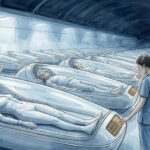

Note: "Graduated" is the Bliss corporate term for a person dying in their pod.
The widower cried, which was on schedule.
They always cried. The sample was ten minutes and the engineers had calibrated it to peak at minute seven — just enough warmth, just enough presence, just enough of whatever the client was missing — and then a gentle taper so the return to gray wasn’t a cliff but a slope. A kind slope. A slope that said: *This is what you could have. All the time. For a very reasonable monthly fee.*
Yara handed him a tissue. The tissue had the Bliss logo on it, a small sun with radiating lines, because the branding team had determined that even grief should be on-message. She’d raised this in a meeting once. “Do we need the logo on the tissues?” Graham had looked at her as if she’d suggested they stop oxygenating the building. “It’s part of the client journey, Yara.”
The client journey. From the front door to the pod to the contract to the monthly debit to the increasing hours to the transition to full immersion to the degradation to the graduation. Client journey. Like a cruise.
“Take your time,” Yara said. “There’s no pressure.”
The widower — Peter, seventy-one, retired geography teacher, wife dead three years — blew his nose into the branded tissue. He looked at her with the expression she’d seen on every face that came out of the sample: the soft, raw, newborn look of someone who has been briefly returned to a world where nothing hurts.
“It was her,” he said. “She was there. In the kitchen. She was making that terrible soup — the parsnip one, you know, the one I always said tasted like wallpaper paste.” He laughed. A wet, broken sound. “I could smell it. And she turned around and she said ‘Peter, stop hovering’ — she always said that—”
“That’s lovely, Peter.”
“And then — this is the thing — I was reaching for a cigarette. On the counter. And she took it out of my hand. Just took it. Didn’t say a word. And I — you know I quit because of her? Thirty-one years ago. I’d tried everything. Patches, the gum, all of it. She just started taking them out of my hand.” He pressed the tissue against his eyes. “Forty years I couldn’t do it myself. She just took it and that was that.” He looked up. “How did it know? How did it know about the cigarettes?”
“The experience is personalized,” Yara said. She let the silence hold for a moment — the right amount, not too much. “It draws on what matters to you. And it sounds like Dorothy mattered very much.”
She meant it. That was the problem. She always meant it. The sample did what it did and the clients felt what they felt and the feelings were real even if the mechanism was a neural interface and an algorithm that had mined his browsing history, his photographs, his messaging patterns, and every other available data point to construct a perfect replica of a dead woman making parsnip soup. The feeling was real. The woman was not. And the monthly fee was €599 for the Standard tier, €1,100 for Premium, and €1,700 for Platinum, which Yara did not recommend to people who still had reasons to stay.
She slid the contract across the desk.
Peter signed.
“Welcome to Bliss,” Yara said. She shook his hand. His grip was the grip of a man who was already somewhere else.
She walked him to the door. She watched him cross the lobby — the soft lighting, the ambient music, the screens showing a woman running through a meadow with the tagline *Where Would You Go?* Peter didn’t look at the screens. He didn’t need to. He was going back to the kitchen.
Yara closed the door. She sat at her desk. She added Peter Engström to the list. Three hundred and forty-eight.
She had eleven minutes before her next appointment.
The staff meeting was at nine, which was an act of cruelty disguised as scheduling. Graham Fellowes — Regional Wellness Manager, a man who wore his lanyard like a medal and said “synergize” without flinching — stood at the front of the conference room with a slide deck that had seventeen slides, each one a fresh argument against the existence of God.
“Q3 numbers,” Graham said. “Across the board, we’re tracking strong. Client conversion is at twenty-four percent district-wide, which puts us ahead of Q2. Retention is holding at sixty-one percent. Lifetime value—”
Yara took a sip of coffee. Lifetime value. The metric that measured how much revenue a client generated over the duration of their subscription. Duration meaning: until they graduated. Graduated meaning: until their body stopped. The metric literally measured how much money a person was worth to the company between the moment they signed and the moment they died.
Somebody, somewhere, had named this metric. Somebody had typed “Lifetime Value” into a spreadsheet header and not paused. Somebody had presented it in a meeting and nobody had laughed. Yara found this extraordinary. She found it the funniest thing in the world. She found it so funny that if she thought about it for more than thirty seconds she would need to leave the room.
“—and I want to give a special recognition to Yara, who’s led the district for twelve consecutive months.” Graham was looking at her. The room was looking at her. David Park was looking at her with the half-smile that meant *take your bow, star player.*
“Thanks, Graham,” she said. “It’s a team effort.”
“It’s really not,” David muttered, just loud enough.
The room laughed. Graham laughed. Yara smiled the smile she kept at work — warm, professional, load-bearing. The smile that held up the ceiling.
“Which brings me to the announcement.” Graham clicked. The next slide was a photograph of Marcus Chen — silver hair, good suit, the kind of face that belonged on currency. “Marcus Chen is visiting the Plaza Center this afternoon. Not a district visit. A personal visit to this center, to recognize our performance and — specifically — to meet our top performer.”
He looked at Yara. Everyone looked at Yara.
“He’ll be here at three. I want the center spotless. I want every room camera-ready. This is the kind of visit that changes trajectories, people.” He straightened his tie. “Let’s make this count.”
“We’re not selling a product, we’re opening a door,” the room said, approximately in unison.
Graham beamed. “Exactly.”
After the meeting, David fell into step beside her in the corridor.
“So,” David said. “The emperor descends.”
“Don’t.”
“Marcus Chen. In the flesh. At our humble little death boutique.” He held the door to the break room. “You know what this means.”
“It means I have to stand in a lobby and smile at a man I’ve never met.”
“It means Team Lead. It means your name on an office. It means the machine looked down and saw you personally, and the machine likes what it sees.” He poured coffee. “Apply. You’d be good at it.”
“I’d be management teaching other people to do the warm voice.”
“We all do the voice, Yara.”
“I know.”
“You’re going to be my boss,” he said.
“Drink your coffee, David.”
She went back to her desk. Pulled up her afternoon schedule. Two consultations and then, at three, Chen. She looked at the small framed certificate on her desk — WELLNESS COUNSELOR OF THE QUARTER — Q1 2066 — that she kept because removing it would invite questions and keeping it was easier than questions.
Her phone buzzed. The pharmacy on Kemal Street: her mother’s blood pressure prescription was ready. Yara had been paying for it and having it delivered for two years without a phone call attached. The pharmacist knew not to mention her name.
She put the phone down. Picked up the intake forms from the tray. Three walk-ins. The third was in careful handwriting, blue ink, every box filled.
Name: Elif Yılmaz.
Yara stopped.
Age: 58. District: The Warrens. Reason for Visit: “Curiosity.”
Yılmaz. Her mother’s maiden name. The name on the birth certificate, the name Elif had stopped using thirty-three years ago when she’d married and become Elif Demir. The maiden name would slide through the system — no surname match, no conflict-of-interest flag, no awkward conversation with Graham. But it wouldn’t pass Yara. The careful handwriting. The blue ink. The quotation marks around “Curiosity,” as if her mother were mocking the question.
Her mother had not wandered in. She’d chosen this center, this shift, this daughter.
Yara put the form down. Picked it up. Put it down.
Her mother had called her a death clerk across the kitchen table two years ago, and Yara had said something about self-righteousness and martyrdom and the luxury of moral clarity on a nurse’s pension, and her mother had gone quiet in the way she went quiet when something had broken inside her that she was not going to let Yara see, and Yara had left, and that was two years ago.
Her mother was in the building.
Yara went to the bathroom. She stood at the sink and looked at herself. The navy uniform. The hair pulled back in a low bun, the way the brand guide suggested — “professional, approachable, undistracting.” The face that was good at its job. She turned on the tap. Washed her hands. Washed them again. Dried them on the hand towel that did not, mercifully, have the logo on it.
She looked at herself again. She looked like her mother.
She went to Consultation Room 3.
The room was ready. It was always ready. The pod sat against the far wall, pearl-gray, the Halo resting on its charging cradle. The desk was clean. Two chairs. A glass of water on each side. The tissues in their holder. The blue B.
She buzzed reception.
“Send in Mrs. Yılmaz, please.”
The door opened.
Her mother was wearing the good coat. The dark wool one with the covered buttons — repaired twice, once at the cuff, once at the lining. She was wearing lipstick. The dark rose she’d been wearing since Yara was a child. She was carrying a handbag Yara didn’t recognize, held in both hands against her stomach.
She looked at Yara the way she’d looked at difficult patients for thirty years.
“Mrs. Yılmaz,” Yara said. “Please, sit down.”
Elif sat. She set the handbag on her lap. Her hands rested on top of it. The hands were different. Yara hadn’t seen them in two years. The knuckles had swollen. The fingers had stiffened. The arthritis had arrived.
“Can I offer you some water? Tea?”
“Water is fine.”
Yara pushed the glass toward her. Elif drank. Set it down. Her lips left a faint mark on the rim.
“How are you, Mama?”
The word came out before she could catch it. Not Mrs. Yılmaz, not the professional register. Mama.
Elif’s face didn’t change. “I’m well.”
“Your hands.”
“They’re hands. They work.”
“Are you seeing Dr. Levin?”
“Dr. Levin retired. His son took over. The son is twenty-eight and looks at a screen when I talk.” She adjusted the handbag. “Are you going to ask about the roof?”
“Is the roof—”
“The roof is fine. The landlord sent someone in March. He used the wrong sealant and it will leak again in the winter, but for now, it’s fine.” She looked around the room. At the pod. At the Halo on its cradle. At the branded tissues. “This is your consultation room.”
“One of three.”
“It’s clean.”
“How is Mrs. Özkan?”
“Mrs. Özkan is Mrs. Özkan. Her son came back. He’s living in the flat above her. He doesn’t work. She feeds him and complains about it and will continue to do this until one of them dies.” She looked at Yara. “She asks about you.”
“That’s kind.”
“She asks why you don’t visit. I tell her you work.”
The word sat between them. *Work.* The word that had explained everything in their flat. The notes on the kitchen table — *Back at 9. Eat. There’s rice.* The scrubs on the sofa at 6am. The birthdays managed by phone. Elif hadn’t called it busy. She’d just been it.
“I work sixty hours a week,” Yara said. “I have been busy.”
“I know.”
“Why are you here, Mama?”
“I made an appointment.”
“You made an appointment at a Bliss Experience Center. You’ve spent six years telling anyone who’d listen that Bliss is — what was the phrase — ‘a coffin with an outlet.'”
“A coffin with a plug. Get it right if you’re going to quote me.”
“You hate what this company does.”
“I do.” She looked at the pod again. “Mrs. Özkan’s daughter went to a center in the Warrens — not this one, the smaller one on Yıldız Street — and she said it was warm.” She paused. “I wanted to see what warm means.”
“You could have gone to the one on Yıldız Street.”
“I could have. But I came here.”
“You used your maiden name.”
“Is that a problem for your system?”
“It’s not a problem for the system.”
“Then it’s not a problem.”
Yara looked at the form. The careful handwriting. The blue ink. The quotation marks.
“Are you going to give me the consultation,” Elif said, “or interrogate me about my filing preferences?”
Yara opened the folder. “The Bliss Experience Center offers a complimentary ten-minute immersion sample, which provides a preview of our full subscription service. The sample is calibrated to—”
“I know what it does.”
“—to create a personalized environment based on your—”
“Yara. Stop.”
Yara stopped. Her mother was leaning forward. The handbag had slipped to the side. The swollen hands were on the edge of the desk.
“I know what it does,” Elif said. “I was a nurse for thirty years. I’ve held people while they died. I’ve washed bodies. I’ve watched families stand in corridors and cry and go home and eat dinner because that’s what you do when the worst thing has happened — you eat dinner.” She sat back. “I don’t need the script.”
“Then what do you need?”
“How many people have you put in that machine?”
Yara was quiet.
“How many, Yara?”
“My conversion rate is thirty-four percent.”
“Out of how many?”
“Mama—”
“You counted everything as a girl. You counted the steps to school. You counted your father’s pills. You counted the days between my shifts and you knew when I’d be home before I told you.” She leaned forward. “How many?”
“Over a thousand consultations,” Yara said. “Three hundred and forty-eight subscriptions.”
“And how many of those people are still alive?”
The climate system hummed. The pod’s charging light pulsed in its cradle. Elif’s hands were flat on the desk, the swollen knuckles pressing into the wood.
“I don’t track that metric,” Yara said.
She was lying. She tracked it — not through the company systems, which were designed to make tracking it difficult, but through the public obituaries, through the Haven registries the Wakers published underground, through the quiet arithmetic of names and dates.
Sixty-one. Sixty-one of her three hundred and forty-eight had graduated. She knew each name.
“I want to try the sample,” Elif said.
“You want to try the thing you’ve called a coffin with a plug.”
“I want to see what my daughter sells.”
“The sample is ten minutes,” Yara said. “You’ll lie in the pod. I’ll place the Halo. When the sample ends, I’ll be here.”
“And then?”
“And then we talk about options.”
“Your options. Your subscription. Your numbers.”
“That’s the consultation.”
Elif nodded. She stood. She looked at the pod.
“All right,” she said. She began unbuttoning her coat.
The first two buttons came open easily. The third was lower, near the waist. Her fingers stopped. The knuckles wouldn’t bend far enough. The button sat in its hole and her fingers worked around it and her hand dropped.
She tried again. The same result. Her hand made a fist. Opened. Tried the button. It came free. She took off the coat and draped it over the chair. Underneath: a white cotton blouse, ironed.
“Lie down,” Yara said. “On your back. Arms at your sides.”
Elif lay down in the pod. She was smaller than Yara remembered. Her hands were at her sides, the knuckles swollen, the fingers curved inward.
Yara picked up the Halo. She hadn’t touched her mother in two years. She settled it on Elif’s head. The contact points found the temples. Her fingers brushed her mother’s hair — shorter, grayer, warm.
“Close your eyes,” Yara said. “The sample will begin in ten seconds.”
Elif closed her eyes. Her mouth was set. The lipstick was slightly smudged at the left corner.
Yara activated the sample.
She sat at the desk. The timer started.
The contract was in the folder. After the sample, the protocol was: place the contract on the desk, uncap the pen, wait for the client to sit up, let the silence do its work. A client who’d just been warm wanted to be warm again, and the contract was the door back to the warmth, and the closer’s job was to make the door easy to open.
Yara took out the contract. She held it.
She’d signed hundreds of these. She’d read the terms once, during training, and then never again, because reading the terms was not part of the closer’s workflow and the terms were designed to be comprehensive without being comprehensible — fourteen pages of language that a team of lawyers had spent months crafting to be simultaneously complete and opaque. The liability waivers. The health disclosures. The clause that said the client acknowledged the “potential for adverse outcomes including but not limited to neurological degradation, physical deterioration, and cessation of biological function” — which meant brain damage, organ failure, and death, in that order, in language that had been tested on focus groups and determined to be “appropriately informative without being alarmist.”
Cessation of biological function.
Her mother’s biological functions were being monitored by the display on the desk. Heart rate: 62. Neural activity: elevated, within sample parameters. Respiration: steady.
The timer read 3:46. Six minutes and fourteen seconds remaining.
Her mother’s face was changing. The set mouth had softened. The lines between her brows had eased. Her lips parted. She said something. The soundproofing caught it, but Yara could read lips, and the word was a name.
Hasan. Her father. Dead six years.
She put the contract on the desk. She looked at it. She picked up the pen — the pen that had signed three hundred and forty-eight people into the Bright.
She put the pen down.
The timer read 6:58. Minute seven. Her mother’s eyes moved behind closed lids. The mouth formed the name again. The hands uncurled.
Yara picked up the contract. Held it with both hands. Read the first line: *I, the undersigned, do hereby consent to enrollment in the Bliss Wellness Program…*
She tore it. Down the middle. The sound was small — paper against paper, the fibers separating. She tore the halves in half. She put the pieces in the recycling bin under the desk.
The first contract she’d ever destroyed.
The timer read 8:41. One minute nineteen seconds. The taper starting. Elif’s face beginning to shift — the warmth receding, the lines returning, the mouth closing around a name that was fading.
The chime sounded.
Elif opened her eyes.
She looked at the ceiling. The gray, flat, fluorescent ceiling. She blinked. Her eyes were wet. Her face had the look Yara knew — the newborn look, the look of a person returning from somewhere better.
“Mama,” Yara said. “We’re leaving.”
Elif sat up. She looked at the desk, where the contract should have been.
“Where—”
“We’re leaving. Now.”
Yara took her mother’s coat from the chair. Helped her arms into it. The third button — she left it undone. She put her hand on her mother’s back and guided her to the door.
Not the main door. The service corridor. The narrow hallway that ran behind the consultation rooms to the fire exit. The corridor that didn’t pass reception, didn’t pass the lobby, didn’t pass the front entrance where, in approximately forty minutes, Marcus Chen would arrive to meet the center’s top performer and find her gone.
Her coat was in her locker. Her keys were in her coat. Her phone was on her desk. All of it on the other side of a building she could not walk back into.
She pushed open the fire exit. The September air hit them.
“Where are we going?” Elif said.
“Somewhere with coffee.”
The café was on a side street off the Turkish Quarter. A narrow room with six tables, linoleum floor, and a teenage boy behind the counter doing homework. One wall had a mural of Istanbul — the Blue Mosque, the water, the gulls — painted by someone who had either been there once or never.
Yara ordered two Turkish coffees. She hadn’t thought about the order and then realized she hadn’t needed to.
They sat by the window. The table wobbled. Elif put her handbag on the floor. Yara sat across from her and could not remember the last time she’d sat across from her mother in a public place without a purpose — a doctor’s appointment, a school meeting, the solicitor’s office after her father died. They didn’t go to cafés. The kitchen table was where they sat, and the kitchen table had a purpose, and the purpose was that Elif was either arriving or leaving.
The boy brought the coffees. Small cups, dark, the grounds sitting at the bottom. Elif wrapped her hands around hers — carefully, with the pads of the fingers, distributing the weight to avoid the joints.
“You look thin,” Elif said.
“I eat.”
“You look thin. Are you eating properly? Not that rubbish from the machines.”
“I eat, Mama.”
“You eat what. At what time. You work from seven to seven and you eat what they give you from a machine and then you go home and you eat what.”
“I cook.”
“You cook.” The nurse’s look. “In that flat. Do you even have a proper stove? With burners?”
“It’s an electric thing.”
“You can’t cook on an electric thing. Your grandmother would—” She stopped. Adjusted the cup. “Are you seeing anyone?”
“Mama.”
“I’m asking. Two years I don’t know. Is there a man? A woman? Someone?”
“No.”
“No. Thirty-one years old and no. When I was thirty-one I had a husband and a child and a flat and I was working double shifts and I still managed to—”
“To what?”
Elif’s mouth closed. She looked at her coffee.
“To have a life,” she said, quieter. “To have something outside the work.”
Yara drank her coffee. It was good. The boy knew what he was doing. Outside, the Turkish Quarter was going about its afternoon — a woman carrying groceries, two old men smoking on a bench, a child on a bicycle too big for her.
“What about children?” Elif said.
“What about them.”
“Do you want them. Have you thought about it.”
“I’ve thought about it.”
“And?”
“And I work sixty hours a week, Mama. I come home and I sleep and I get up and I go back.”
“That’s not an answer.”
“It’s the answer I have.”
Elif’s hands tightened on the cup. The cup shook. She loosened her grip and the shaking didn’t stop. She put the cup down and put her hands in her lap, under the table.
“Your flat,” she said. “Is it safe? I don’t know the neighborhood. You moved and you didn’t tell me the address.”
“You have the address. I put it on the prescription form.”
“The prescription form.” Elif’s voice changed. “You put your address on the prescription form for my medication. Not in a letter. Not in a call. On a form. At a pharmacy.”
“You have the address.”
“I have it the way I have your phone number. On a piece of paper, in a drawer. I call and it rings and you don’t answer and I put the phone down and I check the number and it’s right and you still don’t answer.”
Yara looked at the table. The wobble was slight — a millimeter of unevenness in one leg, the kind of thing a folded napkin would fix. She didn’t fix it.
“Do you have friends?” Elif said. “What do you do when you’re not at work?”
“I walk.”
“Your father walked,” Elif said. “When he couldn’t sleep. He walked around the block. Six, seven times. He said it helped him think.” She looked at Yara. “You walk like your father.”
Yara drank the last of her coffee. Set the cup down.
“You didn’t come here to ask about my love life, Mama.”
Elif looked at her.
“You knew. You chose my center. My shift. You used your maiden name so the system wouldn’t flag it. You put ‘Curiosity’ in quotation marks because you wanted me to know it wasn’t curiosity. None of this was an accident.”
“No.”
“Then what was it?”
Elif sat with her hands under the table. The boy behind the counter turned a page of his homework. A motorbike went past outside, the engine fading into the Quarter’s noise.
“I wanted you to have to do it to my face,” Elif said. “Your job. Your script. I wanted to sit in that chair and look at you and hear the words. I wanted to be a number. Your number.”
Yara looked at her. Elif’s hands were under the table where Yara couldn’t see them.
“I tore up the contract,” Yara said.
“You tore up one contract. There are other centers.”
The café was quiet. The light from the window had shifted, the afternoon going.
“Was he there?” Yara said. “Baba. In the sample.”
Elif’s face changed. Her hands came up from under the table and went to the cup, but the cup was empty. She held it anyway.
“He was in the kitchen,” she said. Her voice was different. Lower. “He was making dinner. He was singing that song — the one about the fisherman. He turned around and he knew me. He said my name.”
She stopped. Pressed her lips together.
“Ten minutes. They give you ten minutes and then they take it away and the world is this.” She looked around the café. The linoleum. The wobbling table. The mural. “This.”
“It’s engineered,” Yara said. “The warmth. The peak at minute seven. It’s calibrated to—”
“I know what it’s calibrated to do. I’m a nurse who held dying people for thirty years and I’m telling you that the thing in that pod felt more real than anything I’ve felt since your father died and I don’t care that it’s calibrated.”
Her voice cracked. She cleared her throat.
She put the empty cup down. Her hands were shaking. She looked at them, then put them flat on the table, pressing down.
“I’ve been walking past the center on Yıldız Street for six months,” Elif said. “Every Tuesday and Thursday on my way to the mosque. I look in the window and the people inside look warm and the people outside look cold and I am cold, Yara. My hands hurt and the flat is cold and your father is dead and you don’t call.”
Her voice was shaking now.
“I came here because there is one person in this city I trust to stop me and she works in this building selling the thing I need stopping from.”
Yara took a napkin from the dispenser. She bent down and pushed it under the short leg of the table. The wobble stopped.
They sat with it. The coffee cold. The teenager behind the counter turning another page.
“Marcus Chen was coming today,” Yara said. “The CEO of Bliss Technologies. To the center. To meet me. Specifically me.”
“I know who Marcus Chen is.”
“Three o’clock. Graham had the whole center ready. The team — everyone was—” She looked at her hands on the table. “That’s what I walked away from. Not just a contract.”
Elif looked at her. Waited.
“And you’re angry at me,” Elif said.
Yara didn’t answer immediately. She turned her coffee cup on the saucer. A slow rotation, the grounds shifting.
“Yes,” she said.
“Because I forced it.”
“Because you forced it today. You could have come any day. Any center. You came to mine, on the day Marcus Chen was coming, and you—” She stopped. Breathed. “Yes. I’m angry.”
“What else?”
“What do you mean, what else.”
“You said you don’t know if what you feel is angry or something else. What’s the something else?”
Yara looked at her mother. The lipstick nearly gone. The good coat wrinkled. The hands on the table, visible now, still shaking.
“I was never going to stop, Mama.” Her voice was quiet. “I was going to sign number three hundred and forty-nine. And three-fifty. And four hundred. I was going to keep the list and keep the voice and keep going until—” She stopped. “I don’t know until what.”
Elif was watching her. The fierceness was still there, in the set of the jaw. But thinner now. Under it, through it, something else — a woman looking at her daughter and seeing, perhaps for the first time, not the performance but the weight of the performance.
She was quiet for a moment. Then she picked up her cup, looked at it, set it down.
“Come,” she said. “I’ll make pilav. My hands can still manage that.”
She reached for her coat on the back of the chair. She stood. The third button. Her fingers went to it, circled it. Yara reached across and buttoned it. One button. Her fingers over her mother’s fingers for a moment, and then done.
Elif looked at her. Put her hands in her coat pockets.
They paid. The boy made change without looking up. They stepped outside. The Turkish Quarter was getting dark. The streetlights were the old kind — warm, yellow. The Yeni Cami’s minaret rose above the roofline. Somewhere a radio was playing something Yara didn’t recognize.
They walked toward the flat. Yara had no coat. The air was September and cooling and she folded her arms against it.
“The bakery on the corner,” Elif said. “The one with the spinach börek. Let’s stop in.”
“Okay,” said Yara.
Her mother walked beside her with her hands in her pockets.