

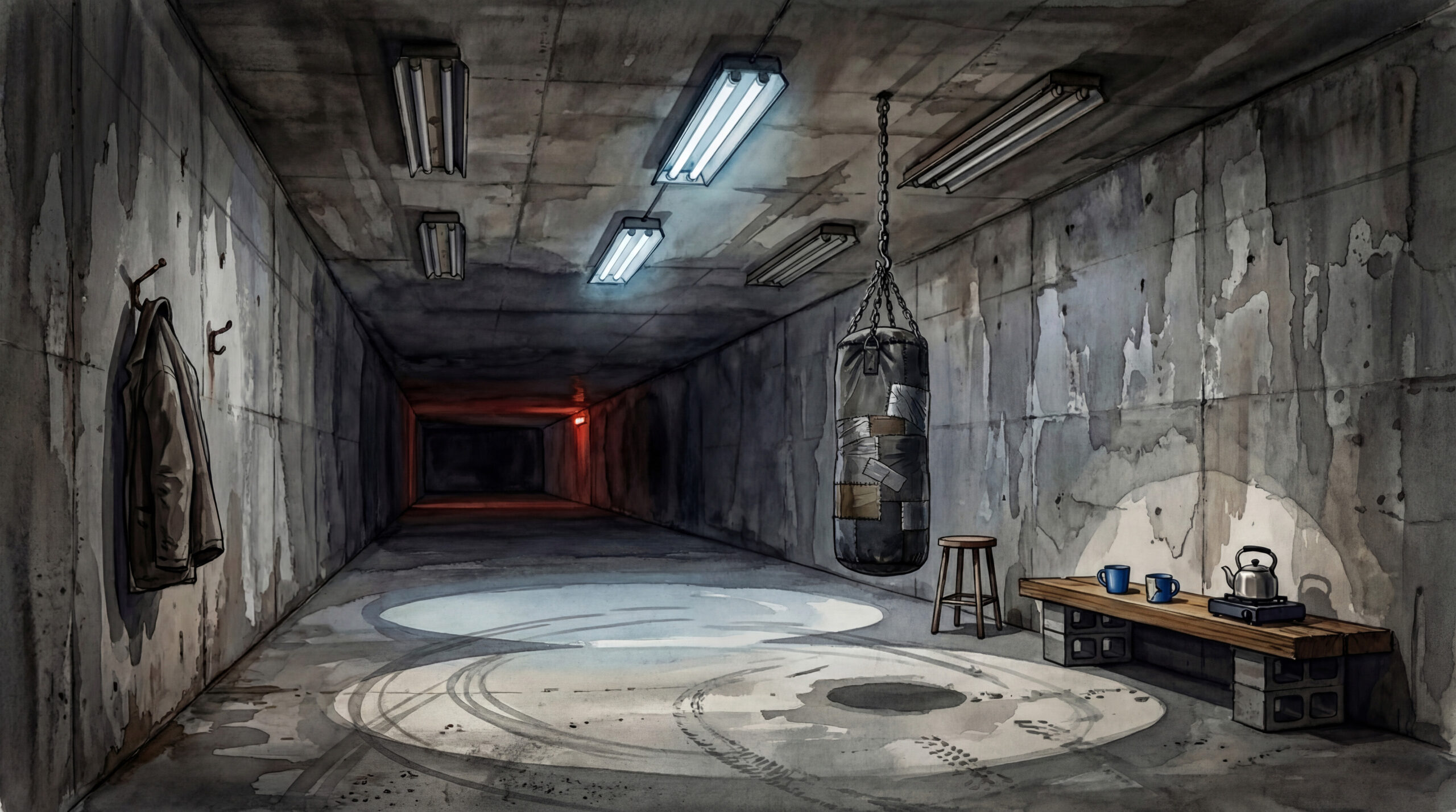
The kettle took longer now.
Not the heating — the heating was gas, and gas didn’t care how old you were. The kettle took longer because his hands took longer. Finding the match. Striking it. Holding the flame steady against the burner while the gas caught. Three separate operations that had been one operation for forty years and were now, on certain nights, three again.
Tonight was a three night.
Spiros set the kettle on the burner and shook the match dead. His fingers smelled of sulfur and the particular cold of the Underbelly — stone that hadn’t seen sun in a century, air that tasted of iron and old pipes. He’d lived in this cold for nine years. Before that, other colds. The Aegean in January. A border in the mountains at night. A concrete cell in a place he never named because naming it would make it somewhere and he preferred it to be nowhere.
He set out two cups. Blue ceramic, cracked, bought in a street market in Thessaloniki in 2031. The crack in the left one ran from rim to base and the cup still held and he didn’t replace things that still held.
From the tunnel: the silence that meant someone was coming. Not sound — the absence of sound, shaped like a man’s passage. Spiros’s body registered it the way a hull registers current, below thought, in the place the Aegean had built into him when he’d learned to feel weather through the deck of a boat before his eyes confirmed it.
Tonight the silence was uneven. Favoring the left side.
The door opened.
“You’re late,” Spiros said, without turning.
“Two-fourteen.”
“I said two. Two means two. Not two-fourteen. Not the vicinity of two. I’ve buried men who had twelve minutes and wasted them.”
A pause. The door closing.
“The eastern junction—”
“I don’t want your itinerary. I want your body on this floor at two o’clock. Coat off. Let me see.”
The wound ran along the lower ribs on the left side. Long, clean — too precise for a blade, the skin parted without argument. Above it, a second line — older, nearly closed, stitched with careful, even sutures. Not his own work. Not professional, either — competent hands, steady, but trained on something other than flesh.
“Who stitched you?” Spiros said.
“A friend.”
“This friend. Do they know the difference between a wound and a sock?”
“The stitches held.”
“The stitches held because the wound was clean. Not because the work was good. Tell your friend: smaller intervals. And tighter knots. A man moves in his sleep and these pull.” He cleaned the fresh wound with iodine. Felt the man’s breath catch and was satisfied. Pain was information. If iodine stung, the nerves were talking. He’d kept men on their feet in the field by listening to what the wound said when you poured fire into it. He taped it tight — not to repair but to hold the shape long enough to function. “You have friends now.”
The man said nothing.
Spiros turned back to the wound.
“Whisper,” he said.
“Yes.”
“Which mark?”
“New configuration. Lateral displacement, no preparatory shift.”
“Omorfo.” The Greek came when he was thinking tactically. “How did it open?”
“Lateral cut. Left side. I read the hips for the direction change—”
“You read the hips.” Spiros tore the tape with his teeth. His teeth had been doing this since Crete and were not interested in retirement. “The hips. On a Whisper. The hips are where men commit. Men rotate from the pelvis because that’s where the weight lives — the pelvis is the axle, the spine is the mast, and the shoulders follow like a sail follows the wind. Whispers are not men. Whatever is in there steering that body is not routing through the pelvis like a Greek fisherman throwing a net.” He finished the tape. Pressed it flat with the heel of his hand. “Whispers route through the thoracic spine. Here.” He placed two fingers between the man’s shoulder blades. “The impulse starts here and radiates. The hips follow, they don’t lead. You were reading the echo. You need to read the source.”
He pulled his hand back. Under his fingers, through the shirt, he’d felt the density of the tissue, the readiness coiled in the muscle. He’d felt it before. Over the years. A little different each time.
He turned to the kettle.
“Tea,” he said. “Then we work.”
They drank the way they always drank. Spiros on the bench, the man on the wooden stool by the heavy bag, cup in both hands. The heavy bag hung between them in the partial light — two fluorescent tubes out of six still alive, the surviving pair casting their cold pools on the swept concrete, the dead four overhead.
“The thoracic reading,” the man said. “Show me what to look for.”
“Finish your tea.”
“I can listen and drink.”
“You can listen and drink when I say you can listen and drink. Right now you’re drinking. When the cup is empty, you’re listening. I don’t mix operations.” He sipped his own tea. “Your generation. Everything at once. Eat while you walk, talk while you fight, think about the next thing while you’re doing the current thing. This is why your footwork is sloppy. You’re already past the step before the step is finished.”
“My footwork is—”
“Your footwork is what I say it is.”
The man drank his tea. Spiros watched him do it. The face that wouldn’t hold in memory — not forgettable, not blurred, but resistant to description. Spiros had stopped trying to describe it years ago. He knew it the way he knew the bay — by feel, by familiarity, by the accumulated weight of hours spent in its presence.
Nine years. Every week. Sometimes twice. The door opening, the footsteps, the coat on the hook, the two cups. Spiros had trained hundreds of men. Special forces, intelligence operatives, private contractors. They came, they learned, they left. The knowledge went with them and he never saw it again.
This one came back.
“Cup’s empty,” the man said.
“Then stand up.”
He started with the guard. Not because the man needed basics but because the basics were where Spiros’s authority was absolute.
“Guard is here.” He placed the man’s hands. Moved the left two centimeters higher. “Not here. Here. The Whisper’s lateral cut comes at this angle” — he traced the line in the air — “and if your guard is where you had it, it catches the soft part of the forearm and you lose the arm. Two centimeters higher, it meets flat bone. Hurts. Doesn’t sever.”
“Two centimeters.”
“Two centimeters is a career. Two centimeters is the difference between a man who fights next week and a man who learns to eat with his left hand. Don’t tell me about centimeters. I have been teaching centimeters for longer than—”
The cough. It came out of him like something with claws, doubling him, and he braced one hand against the heavy bag and let it happen. The sound tore through the bay and echoed off concrete and filled the room with the noise of a body arguing with itself.
When it passed, the man was standing where the man had been. Not closer. Not reaching. The stillness of someone who understood that helping was not always help.
Spiros straightened. Spat in the bin by the bench. Tasted iron.
“The counter,” he said, as if the cough had been a comma and not a paragraph. “When the Whisper commits angular, you don’t meet force with force. That’s arm-wrestling. That’s what gets you killed.” He stepped to center floor. The light fell on him — a compact man, grey, seventy-one years compressed into a body that had been hard and was now just dense, like wood that had lost its flex but held its grain. “The Whisper commits and the force wants to travel here.” He traced the line with his finger. “Your job is to open the door it’s already walking through. You receive the energy, you redirect it, and you strike into the opening the redirection creates. The Whisper ends up here” — he tapped the man’s hip — “with its momentum spent and its thoracic junction exposed. That’s where you end the conversation. Not in the collision. In the emptiness after.”
He placed his hands on the man’s shoulders. Turned them. Fifteen degrees.
“Feel it. Where does the force want to go?”
“Past me.”
“Past you and into nothing. And when it’s past you, when the Whisper’s weight is committed and travelling, that is when your hands do the work. Not before. After. You hit what’s already falling. Again. Full sequence.”
They ran the full sequence. Six movements — attack, angular cut, lateral displacement, counter, redirect, strike. Spiros attacked; the man defended, redirected, and countered into the opening. The counter was clean. The corrected shoulder angle, the open door, the force channeled through and past, the strike landing where the balance had been spent. Good technique. The kind of work Spiros could watch and know that his hands had built it.
Eighty percent.
The man was moving at eighty percent. Maybe eighty-five. Enough speed to make the combinations real, enough resistance to make the counters feel like work. Spiros had been watching bodies move for fifty years. He knew the difference between a man at his limit and a man governing his output — carefully, responsibly, with full awareness of how much engine sat unused beneath the deck.
“Again,” Spiros said. “Faster.”
They ran it faster. Spiros’s body gave him four movements clean — the cross, the angular cut, the footwork, the thoracic rotation. On the fifth, the knee sent its report. Not pain. Absence. The joint declining to confirm its participation, a vacancy where the structure should have been.
He adjusted. Shifted weight. Finished the sixth.
“Better,” the man said.
“I didn’t ask for your assessment. Again.”
Again. This time Spiros threw harder — the cross coming with intent behind it, the body remembering what it had been when it was a weapon, when it had cleared rooms and put men down who needed putting down. His fists found the guard and the guard received them. Absorbed them completely, without comment.
The cough came at the top of the fourth movement. He turned his head, let it out, kept moving. The fifth. The knee again. He overrode it. The sixth — the finish, the strike that should land with authority, with the weight of the whole sequence behind it — arrived at the man’s guard with everything Spiros had.
Everything Spiros had was not enough to move the guard.
“Good,” the man said. “The thoracic read is—”
“I didn’t say stop. Again. Faster.”
“Spiros—”
“Did I say stop?”
He threw the combination. The cross. The angular cut. His body was heating now, the old engine running past redline, the lungs filling with something that wasn’t enough air and sat in his chest like ballast. The knee held. The fourth movement. The fifth. The cough — he forced it down.
“Now you,” he said. “Full speed. Attack me.”
The man stood still.
“Attack me. The Whisper didn’t ask your permission. It came at full speed with full intent. Show me what you showed it.”
The man came at eighty percent. The angular cuts, the lateral displacement. Spiros read the thoracic initiation, opened the door, redirected the force, struck into the opening. Clean. Proper.
And false.
The strike had been decelerating before the counter arrived. Spiros’s hands told him — the vibration through the bones, the frequency of impact. A full-speed strike makes a sound like a door slamming. This made a sound like a door closing. The difference was courtesy.
“Faster,” Spiros said.
The man came again. Eighty-five.
“Faster.”
Eighty-seven. Maybe. The counter still landed. Spiros’s body was running on what the Turks called inat — the stubbornness that outlasted everything, the refusal to yield that had kept his grandfather farming stone fields and his father sailing in weather that killed other men’s fathers. He countered the combination and his ribs ached and his knee filed its report and his lungs sat heavy and he said:
“Is that what you showed the Whisper?”
The man said nothing.
“Is that — eighty percent, eighty-five, whatever — is that what you fought with tonight? Is that how you survived?”
“Spiros.”
“Because if that’s your combat speed, you’d be dead. And you’re here. So either the Whisper was slower than you’re showing me, or you’re not showing me. Which is it?”
“We should—”
“Which is it?”
The man’s jaw tightened. The only movement in a body that was otherwise still.
“Show me,” Spiros said. “Real speed. Full. I want to see what I’m training.”
“No.”
Quiet. Final.
“No? I am your teacher. I have been your teacher for nine years. I need to see the real movement to correct against it. If I’m working with a translation, I’m correcting a copy. Show me the original.”
“I won’t do that.”
“Why?”
Silence.
“Why?”
“Because it would hurt you.”
“Hurt me.” The words came out hard. “I have been shot. I have been cut. I have been beaten in rooms I still smell when the weather changes. And you stand in my training hall and tell me you won’t—”
“Not the strike.”
A silence.
“What the strike would show you.”
Spiros stopped.
The fluorescents hummed. The heavy bag turned its slow rotation on the chain. The man stood in the center of the floor with his hands at his sides.
How fast. How much.
How long the distance between what Spiros could teach and what this man could do.
“Show me,” Spiros said. Quieter now. “I need to see it.”
The man looked at him. A long look. Then he moved.
The combination — the Whisper’s pattern, the angular cuts, the displacement, the redirect, the strike into the opening — at speed. Real speed. The air changed. Not the controlled percussion of a man working within limits but something continuous, a displacement that Spiros’s eyes couldn’t separate into individual movements. The body in the center of the floor was doing what Spiros had taught it to do — the thoracic initiation, the angular cut, the open door, the strike after the redirection — but at a velocity that made the teaching look like a drawing of the thing it described.
Four seconds. The man stopped. The air settled.
Spiros sat down on the bench. Not because he chose to. Because the bench was there and his legs made the decision.
He looked at his hands. The swollen knuckles. The skin going thin at the wrists. The hands that had corrected the guard two centimeters and adjusted the shoulder angle fifteen degrees. His teacher’s hands.
“How long,” he said.
The man didn’t answer.
“How long have you been able to do that?”
“Spiros—”
“A year? Two?” He kept his eyes on his hands. “The whole time? Nine years of corrections and guard positions and the redirect and the open door — nine years, and you’ve been—”
His voice broke. The command structure collapsing, the officer’s bark giving way to something underneath that he hadn’t heard in his own throat since he was young.
“You come in here. Every week. You let me put my hands on you and move you two centimeters. You let me believe—”
He stopped. His hands were shaking. Not the fine tremor. The kind that started in the chest and worked outward.
“You let me believe I was still making you better.”
The heavy bag turned. The fluorescents hummed. The man stood in the center of the floor. His hands were at his sides.
They were shaking too.
Spiros saw it. He’d trained those hands. He knew what they looked like steady — he’d built that steadiness, drill by drill, correction by correction. He knew what it cost to make them unsteady.
“I am not a charity. I am not an old man you visit out of — I have never needed someone to let me win. I would rather you never came back than come back to humour me, to accommodate —”
“Two o’clock,” the man said.
Spiros stopped.
“Every Thursday. Two o’clock. For nine years.” The man’s voice was the same — controlled, measured. But underneath it, something was shaking the way the hands were shaking. “Not because of the teaching.”
Spiros looked at him.
“There are things I can do that weren’t taught. That were in me before I had language. Reflexes. Speed. Things that were built.” He looked at his own hands. “Everything you gave me, I had to earn. Repetition. Correction. Getting it wrong. Your hands moving me and making me do it again until my body learned it.”
He looked up.
“That’s the only thing that’s mine.”
The room held. The fluorescents. The heavy bag. The two cups on the bench, one cracked, both cold.
“I come at two o’clock on Thursday because this is where I learned to live in a body. This room. This floor. Your hands.”
Spiros sat on the bench with his hands shaking in his lap and the cough sitting in his chest like a fist and his eyes burning. He breathed. In. Out. The way he’d taught this man to breathe between combinations — from the belly, not the chest, the breath drawn from below the damage.
“Your footwork,” Spiros said.
The man waited.
“On the fourth transition. At full speed. Your right foot crosses your center line.” He held up his hand. A small gap between the fingers. The hand was still shaking and he held it up anyway. “By this much. A centimeter. At the speed you just showed me, that centimeter puts your weight wrong for a tenth of a second. A Whisper reading your feet — and they will learn to read your feet — will find that tenth of a second. And it will be enough.”
He lowered his hand.
“Thursday. I’ll show you how to fix it.”
The man nodded. The shaking in his hands had slowed. Not stopped. Slowed.
“Thursday,” the man said.
“Two o’clock.”
“Two o’clock.”
“And bring decent tea. Not that dust you brought last week. I’m dying, not dead. I can taste the difference.”
The words came out before he heard them. I’m dying. Said the way you’d say I’m Greek or I’m left-handed. A fact. Released into the room without ceremony because the room had already held worse tonight and could hold this too.
The man crossed to the door. Put on the coat. It settled onto the shoulders Spiros had set, year after year, the guard positions and the angles and the architecture that lived in this body because Spiros’s hands had put it there.
“Boy,” Spiros said.
The man turned.
Spiros looked at him. The face that wouldn’t hold in memory. The hands, quiet now at his sides.
There was something to say. It was in his chest alongside the cough, and it was larger than the cough, and it would not come out in words because words were not the instrument. The instrument was the floor. The repetition. The hands.
“Fix that footwork before Thursday,” he said. “I’m not wasting another session on basics.”
The man almost smiled. A movement at the corners that was there and then wasn’t.
“Yes, teacher.”
He left. The particular silence fading through the tunnel. Present, then less, then the Underbelly’s own deep, mineral quiet.
Spiros sat on the bench.
The bay was still. The two fluorescents hummed. The four dead ones hung overhead, and he looked at them — really looked, for the first time in months — and thought: Thursday. I’ll ask him to bring bulbs.
More light. Not less. More light, for whatever was left.
He stood. The knee spoke. He listened to it without obeying it. He picked up the cups. Washed them in the cold water. The cracked cup held. He set them on the shelf to dry.
He swept the floor. The discipline of the cleared space. But tonight there were scuff marks he paused over — the tracks of a body at full speed, deeper and sharper than anything that had marked this concrete before, alongside the tracks of an old man’s worn shoes, the rubber soles smooth, the weight distributed unevenly because of the knee.
He swept them all. The floor was clean.
He sat on the bench. The heavy bag hung in the partial light, its surface a patchwork of canvas over leather over tape, each patch a night, a lesson. He’d hung the bag himself nine years ago. It had been new then. Now it looked like what it was: a thing that had taken everything thrown at it and was still hanging.
He reached out and set it swinging. The chain creaked. The bag moved through the light and back, the rhythm steady, and Spiros watched it swing and did not turn out the lights.