



The nail was wrong.
Isabel could see it from where she stood. A sliver of white extending maybe a millimeter past the fingertip on the resident’s left index finger. She wouldn’t have noticed it a week ago. Before Margit, she wouldn’t have been looking.
“7-106,” Margit said, not looking up from her tablet. “When was his last nail service?”
Isabel checked the chart. “Eighteen days.”
“Should be?”
“Thirty. On the keratinocyte modulator. Monthly cycle.”
“So.”
“So it grew faster than expected.”
“Which means.”
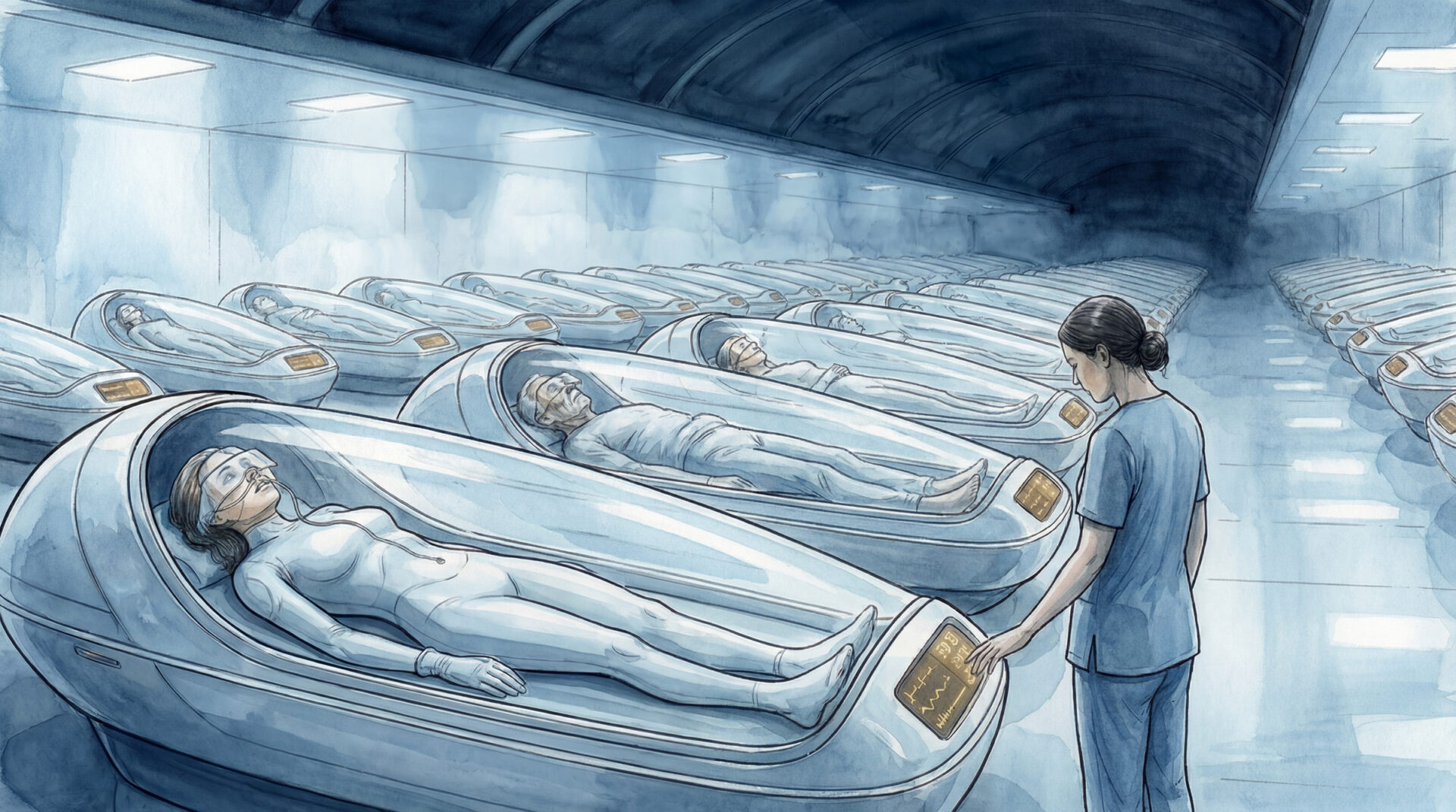
Isabel thought. Around them, the seventh floor of Haven Prime hummed with the sound of a hundred pods keeping a hundred bodies alive. A low thrum of climate systems, pharmaceutical pumps, the quiet machinery of maintenance. She’d stopped hearing it by the third day and heard it again now because Margit was waiting for an answer.
“His dosing is off? The keratinocyte modulator isn’t — the compound isn’t suppressing at the right rate.”
“Possibly. Or.”
“Or his liver isn’t metabolizing it properly. The cascade.”
“Good.” Margit set the tablet on the pod rail. “Check his last blood panel. If the ALT is up, flag it for medical. If the ALT is normal, we note it and check again in a week. Don’t adjust anything. We observe.”
Margit picked up the resident’s hand. The fingers were slack, the skin papery and cool, the nails thin from years of the modulator doing its work. With her other hand she took the clippers from the tray. The curved pair, the ones she kept separate from the straight pair, because curved was for fingernails and straight was for toenails and if Isabel ever used the wrong ones Margit would know, somehow, from across the floor.
Three clips. Quick, precise. She turned the hand over, inspected the nail bed. Pressed the fingertip gently, released, counted. Two seconds for the color to return.
“Capillary refill,” Margit said. “You’re checking for…”
“Circulation.”
“You’re checking for change in circulation. The number doesn’t matter. The trend matters. This one is two seconds today. If it was two seconds last month and two seconds this month, good. If it was one second last month and two seconds this month, that’s a conversation.” She set the hand down, placed it where it should go, in the position it should be in, and moved on.
Isabel wrote it in her notebook. Cap refill — trend not number. Curved for fingers. Check ALT if nail growth accelerates.
Her handwriting was getting worse. Eight days of notes, the pages filling with Margit’s instructions, and Isabel’s hand couldn’t keep up with what Margit knew. She’d started abbreviating. Margit had glanced at the notebook once, on the second day, and said nothing, which could mean the notes were fine or could mean Margit had decided this particular failing wasn’t worth correcting yet.
“Break,” Margit said. “Fifteen minutes.”
The break room was on the far side of the elevator bank. A small windowless space with a table, two chairs, a kettle, and a refrigerator that hummed at a different pitch than the pods. Isabel’s lunch was in the refrigerator. Rice and beans in a tupperware that leaked, because Tomás had said he’d get a new one and hadn’t, and now the bag she carried it in had a permanent stain at the bottom that smelled like cumin.
She set the container on the thermal plate and waited for the indicator to turn green. Margit sat across from her with a thermos of black coffee and a single bread roll, which she ate in small pieces, methodically, the way she did everything.
“You ever bring anything else?” Isabel asked.
“No.”
“That’s… you eat the same thing every day?”
“It works.”
Isabel ate her rice and beans. A grain of rice had escaped through the crack in the lid and was stuck to her scrub top. She picked it off.
“Tomás was supposed to get me a new container. Three weeks now. I remind him, he says sim, sim, and then nothing.” She shook her head. “He does this. He says he will do something, and then nothing.”
Margit drank her coffee. She didn’t say anything for long enough that Isabel thought the conversation was over. Then:
“Don’t tell him what you want. Show him what it costs when he doesn’t do it.”
“What do you mean?”
“Bring the bag. Show him the rice on your scrubs.”
Isabel looked at her. Margit was already breaking off another piece of bread.
“That works? For you?”
“I don’t have a leaking container.”
Isabel laughed. Margit didn’t smile, but something shifted at the corner of her mouth.
The afternoon round was different from the morning round. Mornings were the full walk: every pod, a visual check through the monitoring display, a glance at the visor for eye movement, a scan of the Skin’s readout for motor leakage or actuator alerts. It took two hours for the full floor. Margit walked it in a specific order she’d explained on the first day.
“I start at Zone C. The northeast section. The oldest intakes are concentrated there. Six, seven, eight years in the pods. They’re the most likely to flag overnight. From C, I go to B, then A, then D.”
“Why D last?”
“D is the newest intakes. Under two years. Their systems are stable. They can wait.”
Afternoons were targeted. Eight to ten pods pulled from the rotating maintenance schedule, each getting the full protocol: suit inspection, glove check, catheter seal, waste system, pharmaceutical review. Fifteen to twenty minutes per resident. The intimate work. The work that mattered.
Today they were in Zone C. Margit had pulled the maintenance list and walked Isabel through the first two pods, 7-108 and 7-110, with her usual method: narrate, demonstrate, quiz.
“Open the suit here. The hip access. You’re checking the perineal area. Catheter seal integrity, skin condition, any signs of breakdown.”
The smell when the suit opened was the thing Isabel still couldn’t master. Not the sharp antiseptic of the pod’s atmosphere but the dense, organic smell underneath. Sweat and skin and waste system chemistry and the particular sourness of a body that had been enclosed for years. She breathed through her mouth, the way Margit had taught her.
“Breathe through your mouth for the perineal work,” Margit had said on the first day. “Through your nose for everything else. Your nose tells you things the sensors don’t. If the smell of a pod changes, the membrane is degrading before the system catches it.”
Isabel checked the catheter seal. Firm. No leakage. She checked the skin, slightly reddened at the seal edge, but within normal parameters. She logged it.
“The redness,” Margit said. “Scale?”
“One. Maybe one-point-five.”
“At what point do we escalate?”
“Two, sustained over two checks.”
“Good. Reseal.”
Isabel closed the hip access. Margit watched and said nothing, which meant she’d done it correctly.
They moved to the next pod on the list. The display read 7-112. Margit did this one herself.
“Watch the glove check,” she said. “This resident has non-standard hands. Larger than average. The standard gloves are too small, so we had to order custom sizing. This happens with maybe eight, ten percent of residents. The fit matters. A glove that’s too tight compresses the actuator grid against the skin, which degrades the haptic resolution and can cause pressure injuries at the finger webs.”
She opened the glove access at the wrist. Peeled back the cuff and exposed the hand. It was a man’s hand. Large, the fingers thick, the joints prominent. The nails were trimmed short and clean. The skin was the pale gray of someone who hadn’t seen light in years.
Margit pressed along the finger webs, checking for pressure marks, redness, the early signs of skin breakdown where the glove seams sat. She worked each finger individually. Trimmed the nails. Three clips per finger, the curved clippers, the same economy she used on every resident. Inspected each nail bed. Pressed the fingertips. Counted.
“Two-point-five seconds refill,” she said. “Consistent. We note it and move on.”
She re-sealed the glove, entered the data, and moved to the next pod. Isabel wrote in her notebook: Custom gloves — 7-112. Cap refill 2.5s baseline. Check finger webs for pressure.
On the fourth day, Isabel talked to a resident.
She was running the morning walk on her own while Margit handled a maintenance issue in Zone A. Pod 7-089, an old woman whose face, through the transparent visor, wore an expression that looked exactly like peace. Isabel had named her in her head: avó, grandmother.
“Bom dia, avó,” she said quietly, reading the monitoring display. “Everything looks good today. Your heart is strong. Whoever you are in there, you are doing well.”
She’d been talking to them since the second day. Just small things, the way you’d talk to someone sleeping. A greeting. A comment on their readings. She’d hum sometimes, while checking the displays. Old songs, half-remembered.
Margit had heard her.
“You talk to them,” she said, during the afternoon rounds.
“Is that not allowed?”
“It’s not prohibited. It’s not useful.”
“Maybe not for them. For me, it’s —”
“I know what it is for you. It’s the same thing the names in your notebook are. A way to make the work feel human.”
“What’s wrong with that?” Isabel said.
“Nothing. For six months. Then you’ll know all their names and all their habits and you’ll greet them every morning and then one of them will graduate and you’ll feel like you lost someone. And another. And another. And after twelve or fifteen graduations you’ll stop coming in.”
“Or I’ll keep coming in.”
“You might.” Margit checked a display. Moved to the next pod.
Isabel followed, and did not stop talking to the residents when Margit wasn’t in earshot.
On the fifth day, a woman in Zone D stopped breathing.
The alarm came at 14:22. A sharp tone, different from the routine monitoring beeps, cutting through the floor’s hum. Isabel was closer. She moved to the pod, 7-061, a woman, forty-three, two years in, and the monitoring display was a wall of red.
The nurse arrived from the medical station. A tall man named Pieter who moved with the unhurried urgency of someone who’d done this many times. He opened the pod, began chest compressions, administered the cardiac protocol through the pharmaceutical line.
“Defib,” Pieter said. Isabel handed him the paddles from the emergency kit mounted on the pod rail. He placed them. Shocked. The body jerked.
Nothing. He shocked again. Nothing. A third time. He checked the display. Shook his head.
Then the monitoring system did something Isabel hadn’t seen before. The display shifted. The red alarms dimming, replaced by a soft amber glow, and a small icon appeared in the corner. A setting sun.
“Sunset protocol,” Pieter said quietly. “The system’s initiating.”
Through the transparent visor, Isabel could see the woman’s eyes. They were open. The rapid movements had stopped. The eyes were moving slowly now, drifting, watching something Isabel couldn’t see.
The body’s monitors flattened. The amber glow held steady. Then it went dark.
Pieter logged the time. He began removing the leads, the catheter, the nutrition line. Calm. Professional. The protocol.
Isabel managed to hold it together while Pieter worked. She managed to answer when Margit arrived. “7-061, cardiac arrest, Pieter ran the protocol, no response.” She managed to log it on the tablet, though she had to enter the time twice because her fingers hit the wrong numbers.
Then she walked off the floor. Into the bathroom. She locked the stall and sat on the closed lid and put her face in her hands and cried.
She didn’t know how long she was in there. Long enough that the crying stopped and left her sitting with a wet face and a raw throat.
The door opened. Margit’s shoes. The white nursing clogs, recognizable by their even, unhurried pace.
“Isabel.”
“I’m fine. I just need a minute.”
A pause. Margit didn’t leave.
“That was your first graduation.”
Isabel pressed her palms against her eyes. “Yes.”
“In nine years I’ve processed over two hundred.” Margit’s voice was flat. Not unkind. Flat the way a road is flat. “What we do is the protocol, and the protocol exists so that the next person in that pod gets the same standard of care as the person who just left it.”
Isabel didn’t say anything.
“Take ten more minutes,” Margit said. “Then come back to the floor.”
The door opened and closed.
Isabel washed her face. She went back to the floor.
Margit was at 7-063, running a suit inspection. She didn’t look up when Isabel arrived.
“Hold the access panel,” she said.
Isabel held the access panel.
On the sixth morning, Margit let Isabel lead the walk for the first time. The whole floor.
She started at Zone C, the way Margit did, because Margit’s order made sense, and because habits form fast on the seventh floor, where the routine is the only architecture. She moved through the pods, reading each display, checking the visor for eye movement, scanning for anomalies. 7-108, normal. 7-110, normal. 7-112, normal. Margit walked two steps behind, silent.
At pod 7-024, Margit said: “Wait.”
Isabel stopped.
“The eye movements.”
Isabel looked at the visor. Through the transparent shell, she could see the resident’s eyes. Closed lids, the faint motion beneath them. She’d been told what to look for. Fast saccades, active engagement. Slow drifting, low activity. Fixed gaze, alert condition.
“They look — normal? Active?”
“They’re slower than last week. I logged his saccade pattern at fourteen per minute. Today it’s ten.”
“You can see that?”
“You will. After long enough.” She made a note on the tablet. “When the eyes slow, the body is telling you something the bloodwork won’t show for another week.”
They finished the walk. Isabel missed two things: a motor leakage event at 7-039 that Margit caught from the sound alone, a slight tapping of fingers against the pod’s inner wall, and a nutrition line flow rate at 7-071 that was running three percent slow.
“The flow rate you should have caught,” Margit said. “The motor leakage will come with time. You learn to hear it.”
“How long?”
“Months. The floor has a sound. When something changes in the sound, you notice. You don’t know what changed. You go find it.”
“That’s how you caught it? The sound?”
Margit didn’t answer. She was already pulling up the afternoon maintenance list.
At lunch, Isabel told Margit about the argument she’d had with Tomás the night before.
“He brought something home,” she said. “A Halo. Borrowed from a friend at the shop. He said he wanted to try it. Just to see.”
She waited for Margit to react. Margit was eating her bread roll. Her face hadn’t changed.
“I told him it can’t be in the house. He needs to bring it back. He got upset. He said I was overreacting, that everyone tries it, that it’s just — I don’t know. Entertainment. Like a movie.”
“What did you do?”
“I told him no. I said he can do what he wants but that thing is not staying in our flat. He went to bed angry.”
Margit drank her coffee.
“Was I — do you think I overreacted?”
“Boundaries are not overreactions.”
“But maybe I should ask him why. Why he wants to try it. Maybe he’s bored, or —”
“A more important question,” Margit said. She set her coffee down. “Ask him if he’s happy.”
Isabel looked at her. “Happy?”
“Start there.”
“You think he’s unhappy?”
“I think if you ask about the Halo, you’ll get an answer about the Halo. If you ask if he’s happy, you might get an answer about something else.”
Isabel waited for more, but Margit was already putting the lid on her thermos. Break was over.
The seventh day. Isabel was beginning to feel the rhythm of the floor. The morning walk, the afternoon maintenance, the breaks that Margit called with the regularity of a clock. Fifteen minutes at 10:30, thirty at 13:00, fifteen at 15:30. The same kettle, the same table, the same two chairs. The hum of the pods was becoming the sound of her work, the way the noise of São Paulo traffic had once been the sound of her childhood.
She was getting better. She could check a catheter seal in under two minutes. She could read a monitoring display and pick out the three numbers that mattered without scanning the whole screen. She could trim nails on hands that didn’t hold back.
That part still got to her. Not the way it had on the first day, when she’d held a resident’s hand and felt the weight of it, the heaviness of a hand with no intent behind it, and had to set it down and look away. Now she could do it. But each time, in the second before she picked up the clippers, she felt the absence in the hand. The missing grip.
She said this to Margit during the afternoon maintenance, while they were running suit inspections in Zone B.
“The hands are the worst part.”
“The perineal care is the worst part,” Margit said.
“No, I mean — the hardest. Emotionally.”
Margit looked at her over the open pod. “The hands.”
“When you hold them and they don’t hold back. It’s — they’re so heavy. Like they’re already —” She stopped.
“Already dead.”
“I wasn’t going to say that.”
“You were thinking it.” Margit closed the suit access and entered the data. “The hand is the most human part of the maintenance. That’s why it bothers you. The rest of it, the catheter, the suit, the lines, it’s mechanical. The hand is the part where you’re holding a person. Or what used to be a person. Or what is still a person, somewhere, in a place you can’t reach.”
“Don’t let it stop you from doing the check properly,” Margit said. “The nail beds tell you more about systemic circulation than the monitoring system does. The hands are diagnostic. Treat them that way.”
She moved to the next pod.
That night, in the flat near the Edge, Isabel sat across from Tomás at the small table by the window. The Halo was gone. He’d returned it that morning, without being asked again. He’d left it on the kitchen counter with a note: Devolvido. Voltei cedo. Te amo. Returned. Home early. Love you.
She’d made rice and beans. He’d brought bread from the bakery in the Warrens that stayed open late, the good bread, the one with the hard crust. They ate.
“I want to ask you something,” she said.
He looked at her. He was twenty-nine, dark hair, mechanic’s hands. Broad, scarred at the knuckles, a burn mark on the left thumb from a radiator hose. Hands that were the opposite of the hands she held every day. Hands that moved, that gripped, that were warm.
“Are you happy?” she said.
He put down his bread. “What?”
“Here. In Vesper. With me. Are you happy?”
He didn’t answer right away. He looked at the table, at the bread, at his hands. Then at her.
“Sometimes,” he said. “Not always.”
“Okay.”
“Are you?”
“Sometimes. Not always.”
They sat with that. The window was open. Tomás always left it open, the cold air coming in from the Meridian, and Isabel was always cold, but tonight she didn’t close it.
“The tupperware,” he said.
“What?”
“I’ll get it tomorrow. I know I said that before. But I will.”
“Okay.”
He reached across the table and took her hand. His grip was warm and firm and alive and she held it back and for a moment the seventh floor was very far away.
On the eighth day, a woman named Lehmann came to visit her father.
She was thirty, maybe. She signed in at the floor desk and stood in the corridor with her coat still on, holding a small bag from a bakery in Old Town, and Isabel could see from the doorway that she hadn’t been here in a while because she was looking at the floor the way people look at things they’re not ready to see.
Margit met her at the entrance to the pod row.
“Ms. Lehmann.”
“How is he?”
“Stable. His readings are consistent with his last assessment. There’s a new note on his skin integrity report. The team has adjusted his positioning cycle. Routine.”
“Can I just sit with him?”
“Of course. I’ll set a chair.”
Margit set a chair beside pod 7-049. She positioned it so the daughter could see the resident’s face through the visor shell. She did not open the pod. Family visits were visual unless specifically requested and approved in advance.
The daughter sat. She put the bakery bag on her lap. She didn’t open it. She sat for forty minutes while Isabel worked the adjacent rows and tried not to watch and watched anyway.
When the daughter left, she left the bakery bag on the chair.
Margit picked it up. Looked inside. Bread rolls.
“She brings these every time,” Margit said. “He liked bread rolls. From this particular bakery.”
“She brings food for someone who can’t eat?”
“She brings food because bringing food is what she knows how to do.” Margit placed the bag in the staff room refrigerator. “Tomorrow, put it in the break room on Three. The nurses there will eat it.”
“She doesn’t want it back?”
“She won’t ask. She knows he can’t eat. Bringing it is the ritual. The ritual is what she has.” Margit closed the refrigerator. “Half this job is managing the living. The residents are the easy part. They’re already in paradise.”
The ninth day. Isabel led the morning walk for the second time. She was faster now, more confident. The display readings were becoming familiar, the normal ranges sitting in her memory the way a language settles after you’ve spoken it long enough. She caught a motor leakage event in Zone A before Margit did. A foot, flexing rhythmically inside its pod, tapping against the inner wall.
“7-033,” Isabel said. “Motor leakage. Foot. Rhythmic.”
“Intervention?”
“Not yet. If it continues past thirty minutes, we check Quietude levels.”
“Good.”
In Zone B, Margit stopped at 7-024 and pointed at the visor. “Skin tone. Do you see it?”
Isabel looked closer. Through the visor and the pod’s transparent upper panel, she could see the resident’s face. The pallor that all long-term residents developed, the absence of sun and wind and life. But Margit was pointing at the nail beds. Isabel looked closer.
A grayish tint. Subtle. The kind of thing she would have missed a week ago.
“What does that mean?”
“Circulatory shift. The peripheral vasculature is constricting. The body is redirecting blood flow to the core organs.” She adjusted the pod’s thermal setting, a few degrees warmer. “Three years in. The kidneys are usually the first to signal on the medium-term residents. Different cascade from the long-term liver pattern, but the principle is the same.”
“Is he in danger?”
“Every resident in this facility is in danger,” Margit said. “The question is timeline.” She made a note on the tablet. “The thermal adjustment buys time. Keeps the peripheral circulation open a few degrees longer. It’s not a solution. It’s maintenance.”
“Like everything here.”
“Like everything here.” She closed the display and moved on.
They continued through Zone C. Margit checked two more pods without stopping, then paused at 7-112 and adjusted the thermal setting. A small increase, the same thing she’d done on 7-024. She didn’t explain it. She entered the adjustment on the tablet and moved on.
They ate lunch in silence for the first five minutes. Margit with her roll and coffee. Isabel with her rice and beans, which had not leaked, because Tomás had brought home a new tupperware that morning. A good one. With clips on the sides.
“He got the container,” Isabel said, holding it up. “Finally.”
“The rice is grateful.”
Isabel stared at her. “Was that a joke?”
Margit drank her coffee.
“That was a joke. You made a joke.”
“Eat your lunch.”
Isabel ate her lunch. She was smiling. Margit was not, but the thing at the corner of her mouth was there again. The almost.
“Margit.”
“Yes.”
“Can I ask you something personal?”
“You can ask.”
“Are you married?”
The almost disappeared. Margit’s face went still. Not cold, not hard, just still, the way the surface of water goes still when the wind drops.
“Yes,” she said.
Isabel waited. Nothing else came.
“Okay,” she said. “Sorry. I didn’t —”
“Don’t apologize. You asked. I answered.”
The ring was on her left hand, where it always was. A plain gold band, thin from years of wear. Isabel had noticed it on the first day.
They finished lunch. Margit rinsed her thermos in the break room sink. Isabel put the new tupperware in her bag with a small, irrational satisfaction.
“Margit.”
“Yes.”
“Tomás is — he’s sweet, you know? He is. But he’s not —” She searched for the word. “He’s not romântico. He doesn’t say things. I wish sometimes he would say things. Write me a letter. Something.”
Margit set the thermos down.
“He bought the tupperware,” Margit said.
Isabel laughed. “That’s not romance, Margit. That’s basic function.”
“You said he doesn’t follow through. He followed through.”
“Okay, but — I mean something bigger. Something that shows he —”
“Romance is what you feel. Love is what you do. They’re not always the same thing.”
“You sound like my avó,” Isabel said.
“Your grandmother was correct.”
Isabel shook her head, smiling. She didn’t agree, exactly.
The eleventh day. A half-day. Isabel’s shift ended at 14:00 for the weekend rotation.
At the 13:00 break, Isabel sat down with her rice and beans and said: “I think things are better. With Tomás.”
“Good.”
“We’re talking more. Actually talking. He leaves coffee for me on the counter when he goes to work before me.”
“The things people do matter more than the things people say.”
“Yes. That’s — yes.”
Margit touched her ring. A small motion, her right thumb turning the band on her left ring finger, a rotation that seemed unconscious, the kind of gesture a person makes a thousand times without knowing it.
“Margit.”
“Yes.”
“Your husband,” Isabel said. “Is he —”
“My shift ends in an hour. I’ll finish the Zone C walk before turnover.” Margit stood up, rinsed her thermos, and left the break room.
Isabel sat with the sentence she hadn’t finished.
Monday. The twelfth day. During the morning walk, Margit stopped at a pod in Zone C and pulled up the bloodwork that had come back overnight. Isabel glanced at the display. Pod 7-112. The resident with the custom gloves.
“Liver enzymes are elevated,” Margit told her. “ALT is up eighteen percent from last quarter. After six years on the full stack, the organ burden starts to show.” She flagged the result for medical review and checked the visor. Made a note on the tablet. Then she pulled up the order screen and entered something else.
“What’s that?” Isabel asked.
“Additional panel. Full hepatic workup. And I’m requesting a cardiovascular assessment from the medical team.”
“Is that standard?”
“It’s warranted. When the liver numbers move that fast in a long-term resident, we want the full picture.” She closed the display. “We monitor. We note the trend.”
In the afternoon, Margit ran a saccade assessment in Zone B. Pod 7-024, the resident she’d flagged for circulatory shift and slowing eye movements earlier that week. She studied the visor for a long moment.
“Seven per minute,” she said. “Down from ten.”
“What does that mean?”
“The saccade rate is a proxy for cognitive engagement with the Bright. A declining rate can mean several things. Reduced neural activity. A shift in the Bright’s programming. Or the early stages of systemic decline as the brain reduces its own activity in response to the body’s signals.”
“The body telling the brain.”
“Yes.”
“And you can tell which one it is?”
“Not from the saccade rate alone. We cross-reference with the bloodwork, the cardiovascular trends, the neural monitoring. The Cradle’s EEG will show if there’s a change in brain wave patterns. But the eyes tell you first.” She made a note on the tablet. “The eyes always tell you first.”
The thirteenth day, Ms. Lehmann came back.
She brought bread rolls from the same bakery. She sat in the same chair beside 7-049. But this time she asked to open the pod.
Margit handled it. She pulled up the approval screen on the side panel, entered her authorization code. Before opening the shell, she disconnected the nasal nutrition line and wiped the resident’s face with a warm cloth. Isabel watched. She hadn’t seen this before.
“We do this for open visits,” Margit said. “The family doesn’t need to see the lines.”
She opened the shell. The resident inside, Ms. Lehmann’s father, was thin and still. His eyes were closed. His hands were folded.
The daughter took her father’s hand. She held it with both of hers. She sat there for a long time. The monitoring display showed a small uptick in the man’s neural activity. The system flagged it: EXTERNAL STIMULUS DETECTED.
After twenty minutes, the daughter said: “Does he know I’m here?”
Margit came back from the adjacent row.
“The neural monitor shows a response to tactile stimulus. Whether that translates to awareness at the conscious level is not something we can measure.”
“But he might know.”
“He might.”
“The counselor told me he’s in a beautiful place. That he’s happy. She said the environment is based on his intake profile. Mountains. He always loved mountains.”
“The environment is personalized. That’s correct.”
“So he’s in the mountains. And he might know I’m holding his hand.”
Margit said nothing. The daughter looked at her.
“Is that enough?” the daughter said. “Is that supposed to be enough?”
“I can’t answer that for you.”
“I know you can’t. I’m asking anyway.”
Margit looked at the man in the pod. At the daughter holding his hand. At the bread rolls on the floor.
“You’re here,” she said. “You brought bread. You’re holding his hand.” She paused. “I’d say that’s not nothing.”
The daughter looked at her for a long time. Then she nodded and turned back to her father.
Margit walked away. She passed Isabel at the monitoring station. Her face was the same as always.
The fourteenth day.
It happened at 11:14. Isabel was in Zone B, running a suit inspection on 7-037, when the alarm cut through the floor’s hum. The sharp, rising tone she’d heard once before, nine days ago, when the woman in 7-061 had coded.
She moved. Fast. Across the floor to Zone C, to the row where Margit had been working that morning. She could see which pod before she reached it. The display was a wall of red. 7-112. Cardiac rhythm destabilizing. Blood pressure dropping. O2 sinking.
She reached the pod. She opened it. The full emergency open, the upper panel lifting on its hydraulic arm, exposing the resident to the floor’s cool air. The Bliss Skin was still active, still processing, but the body inside it was failing.
She began the intervention. The protocol Margit had walked her through after 7-061. Check airway. Check lines. Prepare for medical. She was reaching for the emergency kit on the pod rail when her eyes caught the identification panel. The label on the inside of the pod housing, exposed now that the panel was fully open, the label she had never needed to read because the pod number was on the exterior and that was all a shepherd needed.
ERHARDT, KLAUS D. DOB: 2009-03-14 ADMITTED: 2060-08-22 FLOOR: 7 — POD 112 EMERGENCY CONTACT: ERHARDT, MARGIT S. (SPOUSE)
She stared at it. The letters were small, institutional. ERHARDT, MARGIT S. The name on the badge that Margit clipped to her scrub top every morning.
The custom gloves. Nine years without a sick day. The ring on her left hand. Yes, she’d said when Isabel asked if she was married. One word. No follow-up.
Nine years.
Isabel turned. Margit was there. Walking toward the pod with her even, unhurried pace. But her face was already different. Not broken. Not yet. Controlled, still controlled, but she’d heard the alarm. She knew which pod.
“Margit —”
“What’s his status.”
“Cardiac rhythm is —”
“I can read the display. What did you do.”
“I opened the pod. I was starting the —”
“Good.” Margit took position at the pod rail. She picked up the tablet. Her movements were precise. Her voice was even. “Get Pieter.”
Pieter arrived within a minute. He assessed the display, the body, the pharmaceutical lines. He began the cardiac protocol. The defibrillator paddles, the same paddles Isabel had handed him nine days ago for 7-061.
The shock. The body jerked. The display didn’t change.
“Again,” Margit said.
Pieter shocked again. Nothing.
“Again.” Her voice was tighter now. Still controlled. But the pitch had changed.
Pieter looked at the display. He looked at Margit. He placed the paddles again.
“Again,” Margit said. “Try again.”
The shock. The jerk. The flat display.
Pieter lowered the paddles. He looked at Margit. He shook his head.
The ambient music played. The pods hummed. The sunset icon appeared on the display. The small amber sun, descending.
Nobody moved.
Through the visor, the eyes had stopped. Not closed. Open, still, the lids no longer flickering. And there was nothing in the eyes now, nothing at all, and Isabel watched the sunset icon dim and go dark.
Pieter stepped back. He looked at Isabel. She looked at him. Neither of them looked at Margit.
Then they did.
Margit was standing at the pod rail. Her hands were on the rail. Her face was the face Isabel had seen every day for fourteen days. Contained, precise. The face of a woman who had processed over two hundred graduations and knew every step and never shook.
Isabel took Pieter’s arm. Gently. She guided him back. Two steps. Three. Pieter understood, or he was beginning to understand, and he went.
Margit picked up the tablet. She entered the time of death. 11:21. She entered the cessation confirmation. She tapped through the first fields of the graduation protocol. The form she had filled out over two hundred times. Just data. Just the work.
Her hands were shaking.
She got through the first three fields. Time. Confirmation. Resident ID. Then the protocol required physical documentation. Open the visor housing. Remove the Cradle headrest. Document the face.
She reached for the visor release. Her fingers found the latch. She pressed it and the visor shell lifted and for the first time in six years the face underneath was in the open air. A man’s face, gaunt, the cheekbones sharp under skin that had forgotten what light was, the lips slightly parted, the eyes open and still.
Margit’s hands stopped on the edge of the visor housing. Her whole body went rigid, every muscle held.
“Margit.” Isabel’s voice. Quiet. “I can do it.”
Margit didn’t answer. Tears were running down her cheeks, silent, and her hands were still on the visor housing and she was trying to continue.
“Klaus,” she said. Barely a whisper. “I’m here.”
She reached for the Cradle headrest, the next step, the protocol, and her fingers found the release clips and she unclipped the first one and the second one and then she had to lift it and she couldn’t. Her hands were shaking so badly that the headrest rattled against the pod housing. A sound came out of her that wasn’t a word and wasn’t a cry.
Isabel stepped forward.
“Let me,” she said.
Her hands were steady.
She took Margit’s hands. She moved them, gently, off the headrest. She guided Margit back. One step, just one, enough. Margit let herself be moved.
Isabel turned to the pod. She lifted the Cradle headrest. Gently. She set it aside.
She documented the face. She removed the nutrition line. She checked the catheter system for the final log. She worked through the protocol the way Margit had taught her. With care, with precision, with the attention that each step required and deserved.
She reached the hands. The large hands with the custom gloves. She unclipped the glove access and slid the first glove off and there was the hand. Klaus’s hand, the hand Margit had held every month for six years, the hand she had trimmed and inspected and pressed for capillary refill. The ring finger with its groove, where a wedding band had sat for decades, the ghost of the ring that matched the one on Margit’s left hand.
She held the hand. Not for the protocol. For a moment.
Then she set it down, the way Margit would have. Where it should go. In the position it should be in.
She finished. The protocol was complete. She entered the final data on the tablet and set it on the rail.
Margit was sitting on the floor. Her back against the adjacent pod, her knees up, her hands in her lap. Not crying anymore. Not doing anything.
Isabel sat down next to her. On the floor. She didn’t say anything. The ambient music played. The pods hummed. 7-112’s display was dark.
They sat there for a long time.
Margit went home at 13:00. She didn’t say goodbye. She changed out of her scrubs in the locker room and put on her coat and walked to the elevator and left.
Isabel covered the shift. She walked the floor. She moved through the zones in order. At 7-112, the pod was clean. The systems reset. Cleaned and reassigned within four hours. The waiting list was long.
She moved on.
At 18:00, the night shift arrived. She briefed the replacement, told him about the flow rate issue in 7-071, the motor leakage pattern in 7-033. She didn’t mention 7-112. He’d see the empty pod. The protocol handled the rest.
She changed in the locker room. She put on her coat. She picked up her bag with the tupperware inside, the one that didn’t leak, the one Tomás had finally bought.
Outside, the Meridian was cold. February air, the kind that cut through a coat. Isabel pulled up her collar and walked toward the Edge, toward the Warrens, toward the flat where Tomás would be home by now, where the window was probably open and there would be coffee left for her on the counter.
And on Tuesday morning, she would go back. She would hang her coat in the locker. She would walk the floor. She would start at Zone C, the way Margit had taught her, because the oldest intakes were there and they needed checking first.
The walk home took twenty minutes. Tomás had left the light on.