


The bullet takes him in the shoulder before he hears the shot.
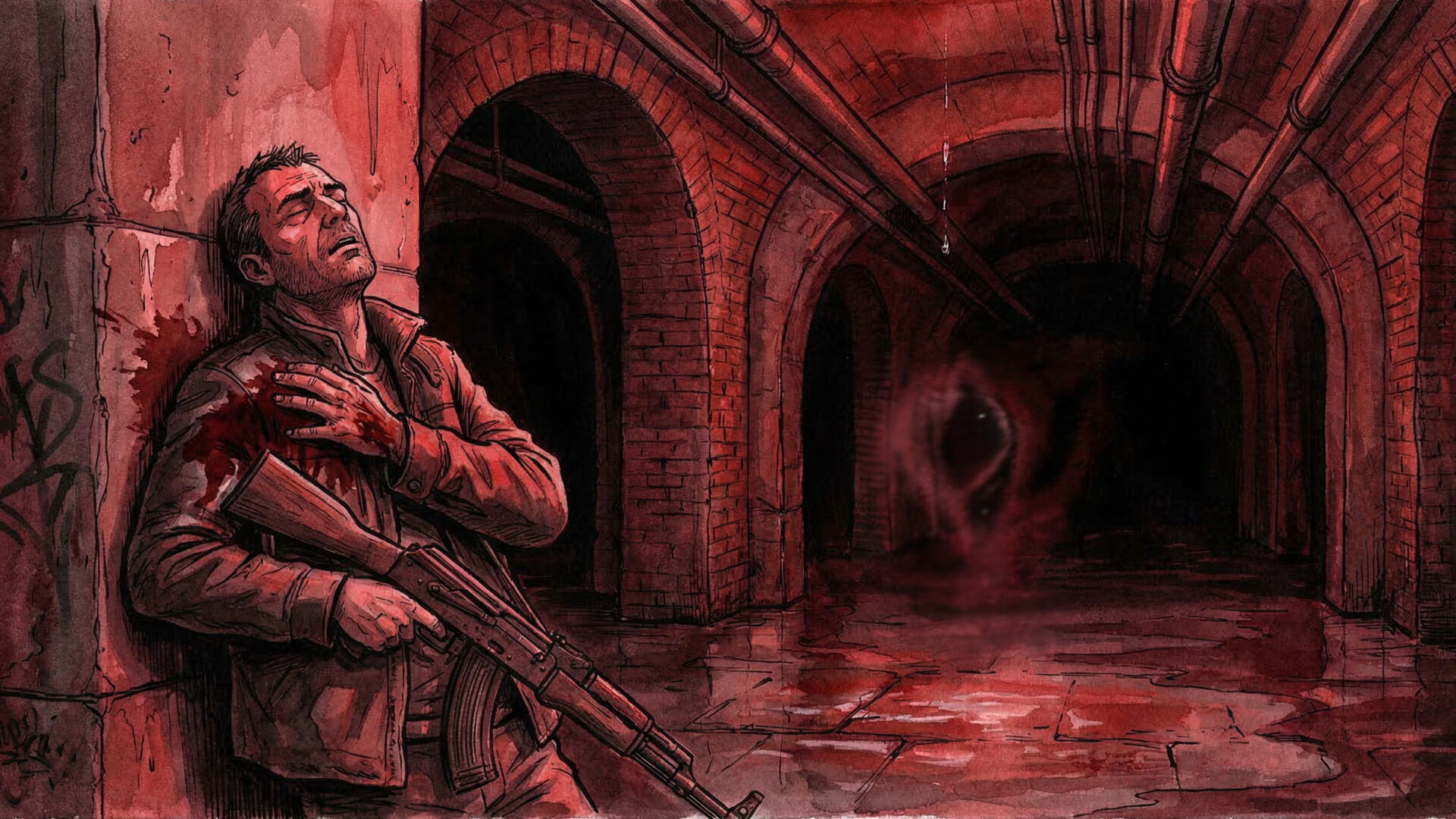
Nikos throws himself behind a concrete pillar, gasping, his old Kalashnikov clutched against his chest. The pain hasn’t hit yet but it will. For now there’s just the wet heat spreading down his arm and the knowledge that he’s outmatched in every way that matters.
He reaches into his vest. The autoject is where it always is — small black cylinder, retractable needle, the opioid cocktail that every runner in the Underbelly carries because you don’t survive down here if you can’t keep moving through damage. He jams it against his upper arm and triggers it. The hiss. The cold bloom spreading up toward the shoulder. Not painlessness — reduction. The world backing off half a step.
The Whisper moves in the darkness. He can’t see it, can only hear the soft displacement of air, the faint whine of tech that shouldn’t exist. They said these things used to be people. He doesn’t believe it. People hesitate. People breathe loud when they’re hunting. This thing moves like water finding its level.
He checks his magazine. Half empty. The rounds are old — black market surplus, manufactured before he was born. The kind that jams at the worst possible moment.
The pillar explodes.
Not bullets — some kind of focused pulse that turns concrete to dust. Nikos is already running, firing blind behind him, the Kalashnikov kicking against his wounded shoulder. The opioid has taken the edge off but the shoulder still knows something is wrong, keeps sending its signal through the chemical fog. He keeps moving. You learn that, in his line of work.
The Whisper doesn’t bother to dodge his shots. He hears them spark off something — a field, a barrier, tech from corporate black sites that officially doesn’t exist. It’s still walking. He can hear its footsteps, steady, unhurried. Why would it hurry? He’s bleeding. He’s outgunned. He’s running through tunnels it probably has mapped to the centimeter.
He ducks into a maintenance shaft, drops down a ladder one-handed, nearly loses his grip when the shoulder flares through the drug. The tunnel below is darker, older, Victorian brick instead of concrete. He knows these passages — spent years running contraband through them, back when that was his business. Before he moved up. Before he became the kind of man who has other people do his running.
The shaft narrows, then opens into a junction — four tunnels branching off, emergency lighting casting everything in dim red.
The opioid is settling into him now. The red light has a softness to it, a warmth it shouldn’t have. His thoughts are loosening at the edges. The panic is still there but it’s further away, behind glass, and something else is seeping in through the cracks.
The red light on the brick. The same red as the kitchen tiles in Piraeus. Maria’s kitchen. Her hands on the counter, flour on her wrists, and the radio playing something he can’t — Dimitri on the floor with the wooden boat, pushing it across the tiles making engine sounds with his mouth, three years old, four, the boat hitting the table leg and Dimitri looking up with that face, that round face—
Nikos blinks. Brick. Tunnel. Blood on his hand. He picks the eastern passage, the one that leads toward the harbor. If he can make it to Driftwood, he knows people. People who owe him.
He keeps moving. His boots on the brick sound wrong — too loud, too wet. He’s leaving a trail. The shoulder has settled into a heavy numbness, the arm hanging, but the opioid is doing something to the rest of him too, softening the borders between here and not-here, and the red light keeps pulling at him.
The boat. Dimitri’s boat. He’d carved it from a scrap of pine on the balcony while Maria slept, the knife slipping twice, his hands too big for the work, and when he’d given it to the boy on his name day, Dimitri had held it with both hands like something holy. He’d slept with it for a year.
Focus. Move.
The Whisper drops from above.
It lands in front of him, silent, and Nikos sees it — not clearly, not fully, the opioid and the blood loss smearing everything, but enough. The shape of a man. The shape of a man with something wrong where the face should be. Eyes that don’t — that aren’t — he can’t hold it. The details slide off. He knows what he’s looking at and the knowing won’t stay.
It raises its weapon. Something sleek and black, worth more than everything he’s ever owned.
He fires first. Empties the magazine, thirty years of shooting experience putting every round center mass.
The rounds spark and die against that invisible field. The Whisper doesn’t flinch.
It shoots him in the thigh.
The leg goes out from under him. He hits the ground hard, the Kalashnikov skittering away, and the brick comes up against his knees, his palms, his head hanging between his arms, the pain deep in the muscle of his thigh, a new architecture joining the shoulder, and the opioid gives ground, the warm fog thinning—
His knees on the stone. The cold of it. The same cold as the flagstones in Agios Nikolaos, the incense still in the air, his palms flat against the church floor because his legs wouldn’t hold, and Dimitri beside him. Eleven years old. Standing while his father knelt. Not crying. His face closed like a door. Not looking down. Looking straight ahead at the altar, his jaw set the way a child’s jaw sets when the child has decided something.
Nikos hadn’t known what the boy was deciding. He knows now.
He tries to crawl. His hands scrabble against the old brick, pulling himself backward. His vision is pulsing, contracting, the red light throbbing in time with his heartbeat, and the tunnel is getting smaller or he’s getting larger or the drug is collapsing the distance between the walls.
His hand closes on something. A length of rebar, left behind by whatever work crew abandoned this tunnel decades ago. He swings it with everything he has, a wild desperate arc.
The Whisper takes it out of the air like a man catching a ball. Tosses it. The rebar rings off the brick wall ten meters away and the sound fills the tunnel and keeps going.
Nikos falls back against the floor. His arms won’t hold him. The brick is cold against his back, the blood warm under him, and the opioid swallows him.
He’s in the office. The warehouse office behind the port, the desk with the green lamp, and the man on the floor — Petros, who owed eight thousand and had come with six and a story about his daughter’s hospital bills — and Nikos’s hand closing on Petros’s collar and pulling him up and the sound of it, the particular sound of a fist on a face that has stopped trying to defend itself—
And the silence behind him. The held breath. He’d turned and Dimitri was in the doorway.
Twelve years old. School bag still on his shoulder. He’d come to walk home with his father.
The look. Nikos has never been able to describe it and he can’t now, lying on the brick with his blood pooling under him. It wasn’t fear. It wasn’t surprise. It was the look of something finishing. Something in his son’s face closing, quietly, the way a book closes, and staying closed.
He’d been closing since the kitchen. Since he was five. Since the flour and the sound and the small body going still.
Nikos hadn’t hit Maria again. Once was enough. One backhand across her face, flour in the air, and Dimitri in the doorway making a sound like air leaving something small. And Nikos on his knees holding her, saying he was sorry, he would never — and she’d taken him back because she always took him back.
But Dimitri. Dimitri had gone to his room. And when Nikos went to the door an hour later the boy was sitting on his bed holding the wooden boat with both hands, not playing with it, just holding it, and he hadn’t looked up.
The Whisper stands over him. Raises its weapon.
The rebar is on the ground, ten meters away. Out of reach. No last swing. No dying like the man he’s always pretended to be.
He reaches into his jacket. The Whisper’s weapon tracks him, but Nikos isn’t reaching for a gun.
The photograph is old. Creased and worn, the colors faded, carried in his inside pocket for twenty years. He’s never let himself look at it. Every time he reaches for his wallet, he feels it there, and he doesn’t look.
Dimitri at six, sitting on Nikos’s shoulders. Both of them laughing at something Maria said from behind the camera. The boy’s hands in Nikos’s hair for balance. The wooden boat tucked under one arm.
He looks at it now.
He presses the photograph against his chest. Closes his eyes.
Somewhere under the hum of the emergency lights — beneath it, or inside it, or somewhere the drug has opened that wasn’t open before — a sound. A woman’s voice, low, repeating. The cadence of something said ten thousand times.
Κύριε Ἰησοῦ Χριστέ, ἐλέησόν με.
His mother’s voice. The prayer she’d said every morning in the kitchen in Piraeus with her eyes closed and her hand on the counter, the words so worn they were almost not words anymore, just rhythm, just breath shaped into the oldest thing she knew.
Κύριε Ἰησοῦ Χριστέ, ἐλέησόν με.
He hadn’t thought of it in thirty years. He’d left that kitchen, left Piraeus, left everything that voice belonged to. But the drug has opened the doors and the voice is here in the tunnel, under the hum, and he holds the photograph and listens to it the way he listened as a boy, not understanding the words, just the sound of someone meaning them.
Let him be okay. That’s all. Let him have found something better than this.
He waits for the shot.
The tunnel is silent.
He opens his eyes.
The Whisper is moving. Not toward him — away. Stepping back, the weapon lowering to its side, the empty face turning from Nikos to the tunnel the way a man checks his watch. A recalculation. The target down, the wounds sufficient, the scene consistent with a confrontation between tunnel runners. No execution. No ballistic evidence that didn’t match the Kalashnikov and the rebar and the story the brick would tell. It moved toward the eastern passage, and the wrongness that was the Whisper — the weight of it, the pressure of being watched by something assembled rather than born — thinned, and faded, and was gone.
Not mercy. Something colder. The efficiency of a thing that had determined its work was done.
Nikos lies in his own blood on Victorian brick, holding a photograph of a boy he failed.
He doesn’t understand. Doesn’t try to.
Time passes. He doesn’t know how much. The opioid recedes in stages — the warm distance pulling back, the borders re-hardening, the pain returning like sound returning after an explosion. First the shoulder. Then the thigh, deep and structural, the kind of pain that has opinions about whether you’ll ever walk right again.
The memories go back behind their doors. The kitchen. The office. The boat. They return to where he keeps them, but the doors don’t close all the way. Not anymore.
He lies still and lets the pain come. The red lights hum. The tunnel smells of brick dust and blood and the particular cold of underground places that haven’t seen the surface in a hundred years.
The photograph is still on his chest. He can feel the corner of it against his collarbone.
He reaches into his pocket with his working hand. His phone is cracked but functional. The battery is at four percent.
He hasn’t dialed this number in eight years. Dimitri probably changed it. Probably blocked him. Probably wouldn’t answer even if he hadn’t.
He dials anyway.
It rings. Once. Twice. Three times.
“Hello?”
His son’s voice. Deeper than Nikos remembers. A man’s voice now.
Nikos opens his mouth. The words catch in his throat, pile up, too many of them and none of them right.
“Hello? Who is this?”
“Dimitri.” It comes out broken, barely a whisper. “It’s…”
He can hear his son breathing on the other end. The silence stretches.
“I’m sorry.”
Two words. Everything he has.
More silence. Nikos watches the battery tick down to three percent.
Then, quietly: “Papa?”
Nikos closes his eyes. The tears come again, but different now. Cleaner.
“I’m here,” he says. “Still here.”
The line is silent, but his son hasn’t hung up. They stay like that — breathing together, saying nothing, the wire between them holding something that words would only damage.
The connection cuts out at two percent.
Nikos lies in the tunnel, holding the phone. Above him, the city goes on — drifting, dying, forgetting itself one person at a time.
He should move. Call someone. Stop the bleeding.
Instead he looks at the picture again. Dimitri’s face. Maria’s hand at the edge of the frame. The wooden boat under the boy’s arm.
For the first time in twenty years, he’s not running from anything.
The tunnel is quiet. The red emergency lights hum.
Nikos holds the photograph and closes his eyes.