


The apartment smelled like his father.
Tobacco and stone dust and the sourness of a window left cracked through winter. Dimitri stood in the doorway with his suitcase in one hand and his coat still buttoned, taking inventory. Kitchen to the left. Sitting room ahead. The window facing the harbor, gray light through glass that hadn’t been cleaned in months. A half-finished crossword on the table, pen beside it, cap off.
He set the suitcase by the door. Hung his coat on the hook behind it, the only empty hook, the others holding a canvas jacket and a wool scarf that still held the shape of being knotted.
The briki was on the counter. Handle facing left. His mother had kept it facing right, and when they’d moved to Vesper his father had turned it the other way and Maria had never corrected him. Twenty years and she’d never corrected him. Dimitri filled it with water, measured the grounds the way she’d taught him. Three spoonfuls, packed level. Sugar before the water. He lit the burner and stood watching the surface for the first sign of foam.
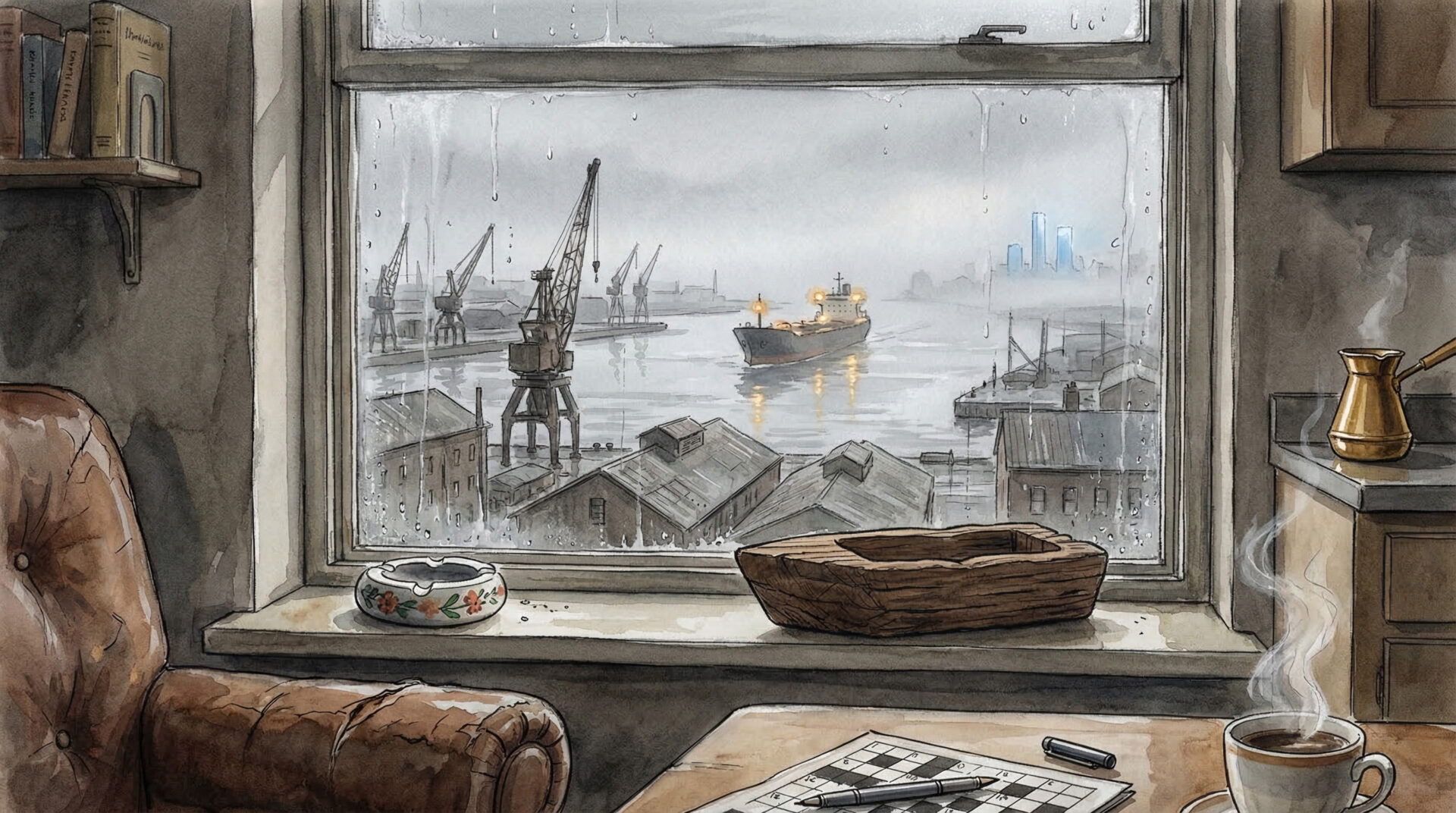
The apartment was a third-floor walk-up in a building that had been industrial housing when the harbor still worked. Two rooms and a kitchen. The walls were plaster over brick, cracked along the window frames where the building had settled unevenly over decades. The furniture was heavy, dark, built to last and not to please. A reading chair by the window, leather cracked and shaped to a body that wasn’t coming back. A shelf of paperbacks in Greek, some of them with cracked spines, most of them untouched. An ashtray on the sill, ceramic, hand-painted, the kind sold at church bazaars.
Dimitri’s eyes found the shelf above the window. The boat was there. Pine, darkened with age, small enough to hold in one hand. The knife marks visible where the blade had slipped, where hands too big for the work had tried to be careful.
He didn’t pick it up. He watched the coffee.
The foam rose. He pulled the briki from the heat, let it settle, poured it into the one clean cup on the counter. The rest were in the sink, unwashed, and he didn’t wash them.
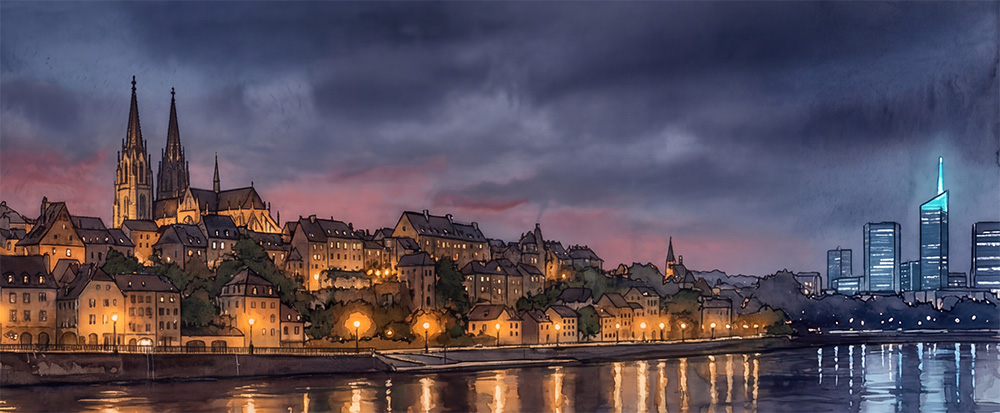
He took the cup to the window. Below, the street was wet. A freighter moved through the harbor channel, running lights blurred by the rain that had been falling since he’d arrived. The cranes along the waterfront stood like sleeping animals. Driftwood looked the way he remembered it: gray buildings, gray water, the fog sitting on everything like a hand.
In his coat pocket, folded into the passport sleeve, the return ticket. Hamburg, five days out. He’d confirmed it at the airport.
He drank the coffee standing up.
The funeral home was on Grieve Street, which was its actual name, not a coincidence anyone in Driftwood found remarkable. Dimitri arrived at nine. He’d told them nine and it was nine.
The director was a small man in a suit that fit him the way suits fit people who wear them every day. He spoke in the voice funeral directors cultivate, the one that never rises above a murmur, and he guided Dimitri through the decisions with the efficiency of long practice. The casket. The service time. The flowers, or no flowers. The question of a wake.
“No wake,” Dimitri said.
“Your father had friends. People will want to pay respects.”
“The service is enough.”
The director made a note. He didn’t press. He’d been doing this long enough to recognize the sons who came from far away and wanted it handled.
Dimitri confirmed the time. “Two o’clock.”
“Two o’clock. At the church?”
“Yes.”
“Father Makris will officiate. He knew your father. Not well, but enough.”
Dimitri signed the paperwork. He read every line before signing, which took longer than the director expected, and he asked one question about the plot, confirming the cemetery section and row number, and wrote both down in a small notebook he took from his jacket pocket.
Outside, the rain had stopped but the sky hadn’t lifted. He stood on the pavement and looked at the street in both directions. The funeral home was between a hardware shop with a metal cage over its window and a place that sold marine supplies. Across the street, a building with its windows dark, the brick streaked with water stains. Three doors down, a café with two tables outside, both empty.
He walked to the hardware shop. Looked at the window display without seeing it. His reflection looked back at him: compact, dark, heavy-browed. His father’s jaw. He’d been told this enough times to stop hearing it as information.
He walked back to the apartment. Took the stairs to the third floor. The stairwell smelled like cooking from one of the lower floors, garlic and oil, and something sweeter underneath it, the closeness of a building where too many people lived together.
At the second-floor landing, a door was open. He caught a glimpse of a hallway, a child’s shoe on a mat, a strip of light from a kitchen window. The door closed as he passed.
He went upstairs. Made more coffee. Began on the crossword his father had left unfinished, and when he found himself unable to sit still with it, he got up and started washing the cups in the sink.
The church was cold and mostly empty.
Agios Nikolaos, the Greek Orthodox parish in the Warrens, the old Greek Quarter where the community still held on. The nave could hold two hundred; twenty-three people came. Dimitri counted them the way he counted things, automatically, the number registering alongside the dimensions of the room, the placement of the exits, the distance from the front pew to the door.
Father Makris spoke about Nikos Andreou with the careful generality of a priest who’d known a man well enough to nod to on the street but not well enough to describe. He spoke about community. He spoke about the faithfulness of returning to the church even when the pews were empty. He spoke about God’s mercy, and the mercy was real, and the God was real, and none of it touched the man in the casket.
Dimitri sat in the front pew. He wore the dark suit he’d brought from Hamburg, the one he wore to client meetings, and he sat with his hands on his knees and his eyes on the iconostasis and did not cry.
Panos was in the third row. Dimitri had recognized him immediately, though it had been thirteen years. The same face, weathered further, the hands clasped in front of him like he was holding a rope. Two other men sat with him, both in clothes that didn’t quite fit the occasion, the stiffness of men who owned one jacket.
A woman stood at the back of the church, near the door. Dark hair, dark coat. A boy beside her, five or six, fidgeting the way children fidget in churches. She was watching the service with the particular stillness of someone who was not performing grief but holding it.
Dimitri saw her. She saw him seeing her.
Something crossed her face. He couldn’t read it at this distance. Recognition, maybe. Something harder than recognition.
She didn’t come forward. When the service ended and the small congregation filed past, touching his shoulder or murmuring the things people murmur, she was gone. The boy with her.
At the cemetery, in the rain that had returned, Dimitri stood with seven people at the graveside and watched the casket go into the ground. Panos was there, and the two men, and three women Dimitri didn’t know, and Father Makris, who said the words and made the signs and meant them.
When it was done, Panos came to him. Up close, the years showed more. Bad knees that made him move carefully on the wet grass. Thick hands, the knuckles swollen, a face that had been outdoors in bad weather for forty years.
“Kid,” Panos said. He was looking at Dimitri the way a man looks at a photograph he’s seeing for the first time. “You’ve got your mother’s eyes.”
“So I’m told.”
“You need anything.”
“I’m all right.”
“You need anything, you come to the chandlery. Pier Six. I’m there most days.” Panos gripped his shoulder once, hard, and let go. He walked away across the grass with the careful steps of a man whose body had started telling him things he didn’t want to hear.
Dimitri stood by the grave until everyone was gone. The cemetery was on a hill above the harbor, and from here he could see the water, the cranes, the rooftops of Driftwood sloping down toward the docks. The rain fell on the fresh earth and on the stone markers around it and on his shoulders and he let it fall.
He looked at the grave for a long time. Then he walked back to the apartment and confirmed his return ticket on his phone, sitting at the kitchen table, the briki handle facing left in front of him.
The chandlery was exactly where Panos had said. Pier Six, set back from the water, a low building with a corrugated roof and a hand-lettered sign that read GIANNIDIS MARINE in letters that had been repainted more than once. Rope coils hung from hooks along the front wall. The smell of tar and salt.
Dimitri came at noon the next day because noon seemed like a time a man would be at work.
Panos was at a workbench near the back, splicing rope. He looked up and set the rope down and didn’t seem surprised.
“Sit,” he said.
There was one chair, wooden, near a kerosene heater that was throwing more heat than the space required. Dimitri sat. Panos went to a corner where a kettle lived on a hot plate and came back with two cups of coffee that was not Greek coffee, that was instant and too strong, and set one in front of Dimitri without asking.
“You’re here to settle things,” Panos said.
“The apartment. His affairs. Yes.”
Panos nodded. He held his cup with both hands, warming them. “The apartment’s his. Owned, not rented. He bought it fifteen years ago. Cash.”
“Cash.”
“Don’t look at me like that. He worked.”
“I know what he did.”
Panos studied him. The studying was not subtle. “You know what you knew when you were fourteen. You don’t know what he did.”
Dimitri drank the coffee. It was terrible. He drank it anyway.
“The funeral was good,” Panos said. “Small, but he’d have wanted small. He wasn’t a man for crowds.” He turned the cup in his hands. “Elena Markos was there. You see her?”
“At the back. With the boy.”
“She lives on the second floor. His building. She’d bring him food. Only person he’d open the door for, some weeks.” Panos was looking at his cup now, not at Dimitri. “The old man liked the boy. Taught him knots. You know, sailor knots, the kind nobody needs anymore. The boy would sit on the floor and the old man would put a rope in his hands and say like this, like this and the boy would get it wrong and Nikos would untie it and start again.” Panos almost smiled. “Patient with the boy. Patient with her. Not patient with much else.”
“He was patient with you?”
“With me he was a bastard.” The almost-smile arrived and left. “But fair. Fair counts for something.”
Dimitri set the cup down. “I need to know about his affairs. Whatever he left. Property, accounts, obligations.”
Panos leaned back. The chair creaked. “You want the business version.”
“I want whatever version there is.”
Panos was quiet. Outside, a gull was screaming over something on the pier, and the water slapped at the pilings with the rhythm of a body turning in sleep.
“He ran things,” Panos said. “Underground. You know this. Moving goods through the tunnels, the routes nobody maps. Twenty years. Built it from nothing.” He spread his hands. “He had people. A base in the Shallows. Routes he’d mapped himself, walked with his own feet before he’d send anyone else through.” Panos paused. “He’d ask about you.”
Dimitri said nothing.
“Middle of a job, sometimes. Loading something, moving something. He’d stop and say, ‘You think the boy is eating?’ Like you were still twelve.”
“I was eating.”
“He didn’t know that. You stopped calling.”
“He stopped calling first.”
Panos looked at him. The look was not gentle. It was the look of a man who had watched two people wound each other from opposite ends of a continent and had no patience for the accounting of who started it.
“He had Viktor,” Panos said. “Security. Enforcement. Hard man, good at what he does. He’s still at the base. He’s not going to be friendly.”
“I’m not looking for friendly.”
“I know what you’re looking for. You’re looking for a list of what to sell and a number to put on it so you can go back to Hamburg with a clean ledger.” Panos finished his coffee. “There’s a list. There’s a number. But it’s not that simple.”
“Why not?”
“Because your father didn’t leave a business. He left a hole in the ground that people depend on. You pull the operation out, those routes close. Medicine doesn’t move. The Wakers lose supply lines they’ve been using for years.” He set his cup on the bench. “You can sell. You should probably sell. Viktor says sell. But you should see what you’re selling first.”
Dimitri looked at the rope coils on the wall. At the tar bucket by the door. At Panos’s hands, swollen at the knuckles, a lifetime of grip work written into the joints.
“When can I see it?” he said.
“Tomorrow. I’ll take you down.”
“What time?”
“Seven.”
“Seven,” Dimitri confirmed.
He stood. At the door he stopped.
“The woman. Elena. Did he talk about her?”
Panos picked up his splicing work. “He didn’t talk about her. He didn’t have to. She was there every day. That’s how the old man operated. He didn’t tell you things. He showed up, or he didn’t.” He worked the rope through his fingers. “She’s angry with you, by the way.”
“I got that sense.”
“Good. Means she’s paying attention.”
She was on the stairs when he came back.
Second-floor landing, her door open behind her, standing with a plastic bag of groceries in one hand and her keys in the other. She looked up as his footsteps came around the turn of the stairwell and her face did the thing it had done in the church: recognition first, then something that closed over it like weather moving in.
The boy was behind her, half-visible through the open door. He was sitting on the hallway floor with a piece of rope, working it between his fingers with the concentration of a child who has been shown how to do something and is trying to remember.
“Elena Markos,” Dimitri said. “I’m Dimitri. Nikos’s son.”
“I know who you are, Dimi.” She said it the way you say a name you’ve been saying since you were a child. “You don’t remember me.”
It wasn’t a question. He looked at her again. The dark hair, the direct eyes. Something at the edge of recognition, a girl at the church, at the periphery of Sunday mornings he’d stopped attending at twelve. He couldn’t place it.
“I’m sorry,” he said.
“Don’t be. You left. People who leave stop seeing the people who stay.”
She shifted the groceries. The bag was heavy. He could see the plastic stretching at her hand. He didn’t offer to help because the distance between them was a distance she was maintaining and he could feel the edges of it.
“Panos told me you looked after him,” Dimitri said. “Brought food. Checked in.”
“Somebody had to.”
She shifted the bag to her other hand. Looked at him, measuring something.
“You’re here to sell the apartment.”
“I’m here to settle his affairs.”
“You have a suitcase and a coat from Hamburg. You’ve decided.”
Behind her, the boy had stopped working the rope. He was looking at Dimitri through the gap in the door with the frank curiosity of a child for whom strangers are still interesting. Dark eyes. Narrow face. The rope hung from his hands in a shape that was almost a knot.
“Who showed him that?” Dimitri said.
Elena glanced back. The boy looked down, went back to the rope.
“Your father,” she said.
The three of them were quiet. In Elena’s apartment, a timer went off, the mechanical kind, and she turned her head toward the sound and then back.
“I have to go,” she said.
“Elena.”
She stopped.
“Thank you,” he said. “For looking after him.”
Her face changed.
“He didn’t need looking after,” she said. “He needed his son.”
She went inside. The door closed. Not slammed. Closed, firmly, and stayed closed.
Dimitri stood on the stair for a moment, between floors, and then went up to the third floor and sat in his father’s chair and didn’t know what to do with his hands.
He called Hamburg at five o’clock.
His supervisor at Kessler Logistics, a man named Brandt who had been reasonable about the bereavement leave and would be reasonable for exactly as long as the bereavement remained professionally manageable.
“Everything sorted?”
“The funeral was today.”
“I’m sorry. How are you holding up?”
“Fine. The apartment needs clearing. Some legal matters.”
“Take the week. You have it. Just keep me posted on the timeline.”
“I’ll be back by Saturday.”
“Good. We’ve got the Maersk review on Monday. Schiller can cover but he doesn’t have your eye for the routing.”
“I’ll be there.”
He ended the call. Set the phone on the table. The table was wooden, heavy, scarred with ring marks from cups and glasses. His father’s knife marks, too, a constellation of small cuts from a man who opened things at the table.
Dimitri opened his notebook. The dark cover, the grid paper inside. He wrote the date, the time, the details from the funeral home. Plot section, row, the name of the cemetery. Apartment: third floor, owned outright. Below it he wrote: Chandlery, Pier Six. Panos. Tomorrow 7am. Base visit.
He closed the notebook. Slipped it back into his jacket.
The boat was on the shelf. The light from the window was fading, and in the gray dusk the pine looked almost black, the knife marks shadowed. He went to the shelf and picked it up. It was lighter than he remembered. His hands covered it completely now. When he was five it had been enormous. He’d held it with both hands on his name day, sitting on his father’s shoulders, the weight of it like holding a real ship.
He set it down after a few seconds and went back to the kitchen.
The bottom drawer of the dresser in the bedroom had been mentioned by the funeral director, who’d been through the apartment once with a representative of the building. Personal effects, undisturbed. No one has touched the bedroom.
He pulled the drawer open.
Her things. Maria’s things. A cloth bag with something inside it. A comb, tortoiseshell, teeth missing. Two folded letters in envelopes, unsealed, that he didn’t read. A laminated card, small, the Theotokos on the front, her gold robe bright against the dark background. He turned it over. His mother’s handwriting on the back, faded blue ink: Κύριε Ἰησοῦ Χριστέ, ἐλέησόν με τόν αμαρτωλόν.
Lord Jesus Christ, have mercy on me, a sinner.
He put the card in his coat pocket, with the ticket.
The cloth bag. He knew what it was before he opened it. Lemon soap. She’d brought it from Piraeus, bought it in bulk from a shop near the port, and the smell of it had been the smell of their kitchen, their bathroom, her hands. She’d been dead sixteen years and his father had kept her soap in a drawer in a cloth bag for sixteen years and the smell was still there.
Dimitri opened the bag and the smell hit him and his hand went to the edge of the dresser and held on.
He stood there. Not long. A few seconds. Then he closed the bag and put it back in the drawer and pushed the drawer shut and went to the kitchen and washed his hands with the dish soap that was there and made more coffee.
He was at the chandlery at seven. Panos was there, as promised. A second man stood outside, smoking, back against the corrugated wall.
“Viktor,” Panos said.
Viktor was mid-forties, lean, with the posture of a man who had learned to carry weight without showing it. He looked at Dimitri the way a foreman looks at someone who has wandered onto a construction site without clearance.
“This is him,” Viktor said. Not a question.
“This is him.”
Viktor dropped the cigarette. Ground it under his boot. “You’ve been in Hamburg thirteen years pushing containers on a screen.”
“I’m in logistics.”
“I know what you’re in.” Viktor looked at Panos. The look contained an entire conversation. Panos didn’t answer it.
“I’m here to see the operation,” Dimitri said. “Understand what my father built. After that, I’ll make decisions.”
“Sell,” Viktor said. It came out the way a doctor says a word that closes a conversation.
“I’d like to see it first.”
Viktor studied him for another moment. Then he pushed off the wall and started walking. Not toward the pier but inland, toward the edge of Driftwood where the industrial buildings gave way to older construction, brick warehouses with steel doors, buildings that had been repurposed so many times their original function was archaeological.
They walked for ten minutes without speaking. The morning was cold and the fog was low, the kind that doesn’t burn off, that just sits on the district like a lid. Viktor moved fast and Panos moved with the careful pace of his knees, and Dimitri walked between them and noticed things. Three ways into the block they were crossing. A camera on the corner of the second warehouse, mounted high, lens facing the approach. The steel door Viktor was leading them toward had been replaced recently; the frame was old but the hinges were new.
He noticed these things the way he noticed the approach routes on a logistics map: automatically, without decision. The information filed itself.
Viktor produced a key. The door opened. Behind it, a corridor, then a second door, heavier, with a combination lock. Viktor blocked the keypad with his body when he entered the code.
Behind the second door: a room. Low ceiling, work lamps hanging from exposed conduit, a scarred table in the center covered with papers and hand-drawn maps. Shelves on two walls with crates, some labeled, some not. A radio on a shelf, switched off. And the chair.
His father’s chair. Cracked leather, the seat molded to the shape of a man who’d sat in it for years. It was behind a desk in the corner, and Viktor walked to it and sat down in it.
The gesture was not accidental.
“This is the base,” Panos said. “Shallow level, forty meters down. Access from three points, the one we used, plus two emergency routes. The tunnels go deeper from here, Victorian-level brick, then older than that. Your father mapped most of it himself.”
Dimitri looked at the maps on the table. Hand-drawn, in ink, on paper that had been handled so often the edges were soft. He recognized his father’s handwriting. The blunt capitals, the slashes for notation, the way he drew arrows like he was pressing through the page.
“What moves through here?” Dimitri said.
“Medical supplies. Food. Equipment the people down below can’t get any other way. Some of it purchased, some of it redirected.” Panos leaned against the table. “The Wakers use our routes for extraction runs. We’re not Wakers, but we’re how they move when they need to move quietly.”
“Revenue?”
“Don’t insult the man’s grave,” Panos said, and his voice changed, went rough at the bottom. “Your father didn’t keep a spreadsheet. People paid what they could. He took what covered costs and put the rest back in. Sometimes it wasn’t enough and he carried the gap himself.”
“I wasn’t insulting anything. I need to understand the economics.”
Viktor made a sound from the chair. Not a word. A sound that contained his assessment of the conversation.
Dimitri walked the room. He looked at the shelves, the crates, the maps. His feet carried him along the perimeter, pacing the dimensions. Twelve meters by eight. He stopped at a map on the wall, the largest one, which showed the tunnel network in his father’s hand. Three main arteries, branching. Depth markings. Access points circled.
“Who else operates down here?” he said.
“Three, four other outfits,” Panos said. “Dušan Lazarević runs the biggest one. Serbian. Bigger routes, more people, more resources. He and your father had an understanding. Territories, shared corridors, the usual.”
“And the Whisper.”
The room went quiet.
“The Whisper that killed my father,” Dimitri said. “Panos told me it was a Whisper. Those are corporate. Deployed through contractor networks.”
Viktor was looking at him from the chair with an expression that had shifted. “What about it.”
“A Whisper in the tunnels means someone flagged my father’s location. His route, his schedule. Whispers don’t hunt. They’re sent.”
“We know this,” Viktor said.
“Then you know someone sold his position.”
“We know the schedule was compromised.” Viktor’s voice was flat. “We don’t know by who. Could be a leak. Could be a data breach. Could be a dozen things.”
“But you suspect.”
“We suspect everyone. That’s the job.”
Dimitri looked at the map. He looked at the chair, at Viktor sitting in it. He looked at the door, the distance to the exit.
“I’d like to see the tunnels,” he said.
Panos and Viktor exchanged a glance.
“Not where he died,” Dimitri said. “Not yet. Just the routes. What he built.”
Panos pushed off the table. “I’ll take you.”
The descent was physical in a way he hadn’t expected.
Not the ladder or the stairs cut into old stone. Not the change in temperature, the air going cool and mineral, the smell of brick dust and standing water. It was the silence. A silence that had texture, that pressed against the ears like a hand, that replaced the harbor noise and the gull cries and the mechanical hum of the surface with something older and more patient.
The tunnel was Victorian-era brick, curved at the ceiling, wide enough for two men to walk side by side. Work lamps had been strung at intervals, their light the color of weak tea, casting the bricks in amber and leaving the spaces between the lamps in a darkness that felt inhabited.
Panos walked ahead, flashlight in hand. Dimitri followed.
“He’d come down here at night,” Panos said. “After you and your mother were asleep. He’d walk the routes, check the caches, talk to the people who lived down here. Some nights he’d be gone three, four hours. Come back with mud on his boots.”
“I remember the mud.”
“Your mother hated it. She’d put newspaper by the door.”
Dimitri said nothing.
They passed a junction. Three tunnels branching. Panos took the left without hesitating, the route in his body. The brick changed here, older, the mortar crumbling in places, and the air was colder and carried something sweet underneath the mineral smell, something organic, like the inside of a greenhouse.
“That smell,” Panos said. “You get used to it. Something grows down here. Nobody knows what.”
They walked. Dimitri’s feet measured the distances. He counted junctions, noted the cable routing on the walls, the placement of the work lamps, the spots where the brick showed water damage. He did this the way he walked a warehouse floor at Kessler, assessing capacity and flow, and he did not think about what he was doing.
Panos glanced at him. “You walk like him. Measuring the room before you’ve been in it ten seconds.”
Dimitri said nothing.
At a widening in the tunnel, Panos stopped. A cache point: a metal cabinet bolted to the wall, padlocked, with a laminated list taped to the front.
“Medical supplies,” Panos said. “For the people who live down here. The ones who can’t come up.” He opened the cabinet. Gauze, antibiotics, syringes sealed in plastic. A box of nutrition bars. “Your father checked these himself. Every week. Restocked from his own money when the supply chain broke.”
Dimitri looked at the contents. Organized by type, then by size. The same system his father used in the kitchen cabinets.
“He was organized,” Dimitri said.
Panos laughed. A short, rough sound, a cough with humor in it. “Organized. Like calling a storm a breeze.” He closed the cabinet. “He was a machine. Not with numbers, not with computers. With his hands, his feet, his memory. He could tell you every turn in this tunnel from here to the harbor, every cache, every safe point. He carried the whole thing in his head.”
“There’s no backup? No records?”
“The maps at the base. What’s in his head. What’s in mine.” Panos tapped his temple. “That’s the operation. That’s what you’re selling, if you sell. A dead man’s memory and a bad-kneed old Greek with a rope shop.”
They stood in the tunnel, the work lamp above them buzzing slightly, the darkness on both sides heavy and patient.
“I can take you to where it happened,” Panos said. “If you want.”
“Not yet.”
Panos nodded. He didn’t ask when. He turned and walked back the way they’d come, and Dimitri followed, and the tunnel closed behind them as they went.
That night he couldn’t sleep.
The bed was his father’s. The sheets had been changed by someone, the funeral home perhaps, or a neighbor, but the mattress held the shape of a heavier man, and Dimitri lay in the depression of his father’s body and stared at the ceiling.
The apartment was quiet in a way Hamburg was never quiet. No trams. No neighbors’ televisions through the wall. Just the building settling, the occasional creak of the pipes, and the sound of the harbor, distant and rhythmic. And from below him, through the floor, the faint sound of a child’s voice, and a woman’s voice answering, and then quiet again.
He got up. Went to the kitchen. Made coffee because making coffee was something to do with his hands.
The boat was on the shelf. He stood with his cup and looked at it.
His father had carved it on the balcony in Piraeus. He knew this because he had a memory of it, or a memory of being told about it, the two indistinguishable now. His father’s hands around the knife, the pine curling in ribbons onto the tile floor, the knife slipping once and Nikos swearing and Maria coming to the door and the three of them on the balcony in the evening light.
He was five. Or four. The memory had that underwater quality, the edges dissolved, the center sharp. His father’s hands. The knife. The wood.
He picked up the boat. Put it in his coat pocket with the ticket and the icon card, and left it there, and went back to the bed that didn’t fit him and lay in the dark and listened to the building breathe.
In the morning, he made coffee. Grounds first. Sugar before the water. The slow heat.
He took the cup to the window. The harbor was there. The cranes were there. The fog was there.
He opened his notebook. Wrote the date. Wrote:
Base: Shallows, 40m. Three access points. Main corridor 12×8. Viktor: hostile. Panos: loyal. Tunnel network: hand-mapped, no digital backup. Supply caches at intervals — medical, food. Revenue model unclear, probably informal. Dušan Lazarević: neighboring operation, larger. Understanding with N re: territory.
Whisper deployment implies compromised schedule. Someone with route knowledge. Follow.
He closed the notebook.
From below him, through the floor, the sound of a door opening. Footsteps on the stairs. The boy’s voice, high and musical, saying something he couldn’t make out. Elena’s voice, lower, answering.
The front door of the building opened and closed. He went to the window. She was crossing the street with the boy, his hand in hers, his red coat too big for him, and they turned the corner toward wherever they were going and were gone.
Dimitri stood at the window with his coffee. The boat was in his coat pocket. The notebook was in his jacket. The ticket was confirmed.
He drank the coffee and washed the cup and went back to the table and opened the notebook again and looked at what he’d written and did not cross anything out.
The dish was on the landing when he came home that evening.
Ceramic, covered with a plate, still warm. He picked it up. Moussaka, layered thick, the béchamel browned at the edges. A fork wrapped in a cloth napkin beside it. No note.
He ate it at the table. It was good. The kind of good that comes from a recipe made enough times that the hands know the measurements without thinking. He washed the dish and the fork and dried them and went downstairs and knocked.
She opened the door partway. Behind her, the apartment was lit by the kitchen overhead and a lamp in the sitting room. The boy was on the floor with a length of rope, his fingers working at something that wasn’t coming together.
“The dish,” Dimitri said, and held it out.
She took it. Looked at it. Looked at him.
“Are you eating?” she said. “Upstairs. There’s nothing in his kitchen.”
“I bought bread.”
“Bread.” She said it the way his mother would have said it, the single word carrying an entire opinion about the nutritional habits of men who live alone. “There’s soup on the stove. I made too much.”
He should say no.
“Come in,” she said. “He’s trying to tie a bowline and it’s driving me insane.”
She turned and walked back into the apartment, leaving the door open. The boy looked up from the rope.
“Niko showed me this,” Ilias said. “But I can’t remember.”
Dimitri stepped inside. The apartment was warmer than his father’s. Smaller, tighter, the walls painted a pale yellow that caught the lamp and held it. A kitchen table with three chairs, one of them pushed against the wall with a stack of folded laundry on the seat. The smell of the soup from the stove. A child’s drawing on the refrigerator, crayon, what might have been a boat on water.
He sat on the floor beside the boy. Took the rope.
“Like this,” he said. He made the loop, crossed the working end, pulled it through. His fingers knew it. His father’s hands over his hands on a pier in Piraeus, the same rope, the same patience. “The rabbit comes out of the hole. Around the tree. Back in the hole.”
“That’s what Niko said.”
“He taught me. Same way.”
Ilias took the rope. Tried it. Got the loop wrong. Tried again. His fingers were small and the rope was thick and the concentration on his face was total, the way children concentrate, with their whole bodies.
Elena put a bowl of soup on the table. Then another. She didn’t say sit down or eat. She put the bowls there and went to the sink and began washing something that didn’t need washing.
Dimitri stood. Sat at the table. The soup was avgolemono, egg and lemon, the surface bright, a piece of chicken at the bottom. He picked up the spoon.
“Thank you,” he said.
“The food doesn’t keep.” She was facing the sink. Her back was straight, her shoulders set, and she was scrubbing a pot with the focus of someone who needed the pot to require her attention.
He ate the soup. It tasted like his mother’s kitchen. Not the same recipe — nobody makes avgolemono the same way — but the same principle. The lemon. The warmth.
Ilias put the rope down. He went to the shelf where Elena kept books and came back with a picture book, Greek text, and set it on the table. The page was open to an illustration of a harbor, boats in the water, a lighthouse on a cliff. He pointed to one of the boats.
“Niko made one,” the boy said. “A boat. From wood. It’s upstairs.”
Dimitri was still.
“My father carved it,” he said.
“Can I see it?”
“Ilias.” Elena’s voice had an edge. “Leave him alone.”
“It’s upstairs,” Dimitri said. “On the shelf.”
The boy looked at him. The look had no agenda in it, no calculation. Just the clear interest of a child who has heard about a thing and wants to see it.
“Not tonight,” Elena said. She turned from the sink. “More soup.” She was already ladling it.
“I’m fine.”
“You’re not fine. You’re thin.” She put the bowl in front of him. “Your father ate like a horse. I don’t know where it went. His arms were like pipes.”
“He was bigger than me.”
“Everyone was bigger than you.” She stopped. The words had come out before she’d checked them, and she pressed her lips together. “Ilias, bed.”
“I’m not tired.”
“Bed.”
The boy went. The protest was ritual, not real. He took the rope with him.
Elena sat down across from Dimitri. The soup was between them. She held her cup of tea with both hands and looked at the table.
“He waited for you,” she said. “Nikos. He didn’t say it, but I knew. He’d check the post. He’d look at his phone and put it down. Every time someone knocked on the door, his face would do this thing.” She gestured at her own face, a flinch quickly corrected. “Then he’d see it was me or Mrs. Papadakis and the thing would go away and he’d let us in and he’d be fine.”
Dimitri held his spoon.
“I’m not telling you this to make you feel bad,” she said. “I’m telling you because someone should have told you a long time ago and he was too proud to say it himself.”
“He could have called.”
“He did call. You didn’t answer.”
Dimitri set the spoon down. The soup was cooling. The apartment was quiet except for the boy in the other room, the sound of a child settling into a bed, the creak of springs.
“I answered,” he said. “Once. Three years ago. He was drunk. He told me I was a coward for leaving and a coward for staying away and that my mother would be ashamed.”
Elena’s hands tightened on the cup.
“I hung up,” Dimitri said. “He didn’t call again.”
She was quiet for a while. The kitchen clock ticked. The steam from the soup drifted between them.
“He was a difficult man,” she said. “I’m not going to pretend he wasn’t.”
“You don’t have to pretend anything.”
She looked at him. The look was sharp, searching, and then something behind it softened and she pulled it back before it could show.
“Eat your soup,” she said. “It’s getting cold.”
He ate it. She drank her tea. The clock ticked. From the other room, the boy was quiet.
At the door, leaving, he stopped. “The moussaka was good.”
“It was average,” she said. “I was out of nutmeg.”
He went upstairs. Sat at the table. The boat was in his coat pocket. The notebook was in his jacket. The empty apartment held the shape of a man who had waited and waited, and the shape was in the chair and the walls and the smell of the air and the briki on the counter, handle facing left.
Below him, through the floor, the sound of a cup being set down. A chair pushed back. A door checked, locked. The small sounds of a woman closing down a kitchen for the night.
Panos called him at six the next morning. A number Dimitri hadn’t saved, the voice unmistakable.
“I need to talk to you. Not at the base. At the shop.”
“When?”
“Now.”
The chandlery was cold. The heater hadn’t been lit. Panos was sitting at the workbench with his hands flat on the surface, the posture of a man who has been thinking and the thinking has not gone well.
“Viktor wants to sell,” Panos said. “He wants to sell the routes, the caches, the contracts, everything. Package it, price it, hand it to Dušan or whoever bids.”
“What do you want?”
“I want the old man to walk through the door and tell us both what to do.” Panos looked at his hands. “That’s not coming.”
Dimitri sat in the wooden chair near the heater. The cold was in the floor, in the walls, in the rope coils that hung from their hooks like sleeping things.
“How much would Dušan pay?”
“For the routes? Enough. The routes are the value. Your father mapped tunnels nobody else knows about. Side passages, old Victorian, some of it going back to the original brick. Dušan would kill for those maps.” He stopped. The word sat in the air between them. “He’d pay well for them.”
“And the people who depend on the supply runs?”
“Dušan would run supplies. His operation already handles distribution. He’d absorb the routes, absorb the clients. It’s a logistics problem.” Panos gave the word a flatness it didn’t deserve. “That’s what Viktor says. Logistics problem.”
“And what happens to the routes your father kept off the books? The ones that don’t have clients, that just have people?”
Panos was quiet for a long time.
“Those close,” he said. “Dušan doesn’t do charity.”
Dimitri looked at the window. The pier was visible through the glass, the water gray, a fishing boat heading out with its lights on. The morning was barely happening.
“Tell me about Dušan,” he said.
“What about him.”
“Everything. How he operates. Where he works. Who works for him. How his routes connect to my father’s. Everything.”
Panos studied him. The studying took longer than it had the first time, at the chandlery, when he’d looked at Dimitri and seen a boy with his mother’s eyes. This time he was looking at something else.
“Dušan Lazarević,” Panos said. “Serbian. Mid-fifties. Running tunnel work since before your father — longer, broader. Got a warehouse in Driftwood, ground floor, office in the back. Eight, ten people. Serious people. The kind that don’t talk at funerals.”
“His relationship with my father.”
“Territory. Your father took the east — the deep Victorian, the harbor access. Dušan took the west, newer construction, Meridian side. They shared the middle. Worked because your father kept his word and Dušan kept the math. Math worked, nobody had problems.”
“And the Whisper.”
Panos’s hands went flat on the bench again. “What about it.”
“The Whisper that killed my father needed schedule information. Route, timing, position. That’s not a data breach. That’s not a leak. That’s specific operational intelligence. Someone with access to my father’s movements sold that information to the contractor network that deploys Whispers.”
“I know what it means.”
“Walk me through it. His schedule. Who knew.”
Panos went to the hot plate, filled the kettle, set it to boil. “Tuesday night runs. Every Tuesday. Eastern circuit. Six caches, the deep Victorian, the harbor junction. Out at nine, back by one. Same every week.” He poured the water. “Me. Viktor. The two runners, Alexei and Tomasz. That’s the inner circle. But your father wasn’t careful about the schedule the way he should have been. He’d mention it to people. Tell someone he’d be at a certain junction at a certain time. He used the schedule as a kind of currency — I’m telling you when I’ll be somewhere, that means I trust you.”
“On the night he died.”
“The Tuesday before, he’d been at Dušan’s. Meeting about the junction corridors, shared routes. Maintenance issue. They talked for two hours. Dušan’s people were there. Four, five of them.” Panos set the coffee down. “Your father discussed his schedule at every meeting. It was how he operated. He gave out his position the way some men give out cigarettes.”
“So Dušan’s people knew the route.”
“Dušan’s people knew the route.”
“And Dušan’s operation would benefit the most from my father’s routes being available.”
Panos put his cup down. “Don’t say the thing you’re about to say.”
“I’m not saying anything.”
“You’re sitting in my shop adding numbers that point in one direction and I’m watching you do it and I’m telling you: don’t say it to me. Not yet. Not until you’re sure.”
“When would I be sure?”
“When the number only comes out one way.”
They sat with the coffee. Outside, the pier. The water. The gray.
“Your father liked Dušan,” Panos said quietly. “That’s what makes this ugly. They’d drink together. Two old men doing what old men do. Your father trusted him — not with his life, he didn’t trust anyone with his life — but with his word.”
Dimitri finished the coffee. Set the cup down.
“I want to meet him,” he said.
“Dušan?”
“You said he’d be interested in buying. Set up a meeting. Tell him the son from Hamburg wants to discuss the operation.”
Panos was still. The fishing boat had cleared the harbor mouth, its lights swallowed by the gray.
“What are you doing, kid?”
“I’m exploring options. That’s what you do when someone offers to buy.”
Panos didn’t believe him. Dimitri could see it, the disbelief sitting in the old man’s face the way weather sits on the harbor, visible from a distance. But Panos had spent thirty years taking orders from an Andreou, and the habit was in his bones.
“Your mother had that look,” Panos said. “When she was working something out. The same thing in the eyes.” He picked up his splicing rope. “She was always right. That was the worst part.”
He was quiet for a moment. Then: “I’ll make the call.”
The meeting was the next afternoon. Dimitri confirmed the time twice.
Dušan’s office was behind a warehouse on the south end of Driftwood’s working waterfront. The entrance was unremarkable: a metal door, a camera mounted above it, a short corridor leading to a second door. Panos had offered to come. Dimitri said no.
The office was larger than he’d expected. A desk, heavy, dark wood, positioned so the man behind it could see both the door and the window. Two chairs facing the desk, leather, cracked. The window looked onto an alley where a delivery truck was idling. On the desk, a shipping box, medium-sized, brown cardboard, a printed label facing away.
Dušan stood when Dimitri entered. He was a big man, thick through the chest and shoulders, with a face that had been handsome and was now expansive, the features broadened by decades of good eating and easy smiling. He came around the desk with his arms open.
“Dimitri.” The embrace was warm, total, the kind that presses your chest against another man’s chest and holds you there. Dušan’s hands on his shoulders, holding him at arm’s length, looking at his face. “My God. You look like him. The jaw, the brow. My God.”
“Thank you for seeing me.”
“Thank you? Thank you.” Dušan released him, gestured to a chair. “I should have come to the funeral. I wanted to. Your father and I, we had our disagreements, you know, all men do, but he was a man I respected. He was real. In this city, where everything is smoke and mirrors and people disappearing into machines, your father was real. His word was his word.”
He sat behind the desk. Moved the shipping box to the floor, casually, making room. The box was heavy. Dimitri heard the contents shift.
“How are you? How is Hamburg? I hear you’re in logistics.” Dušan smiled. “Runs in the blood.”
“Container routing. Port management.”
“Ah, the clean version.” The smile widened. “Your father used to say, ‘My boy pushes boxes on a screen and they pay him more than I make in a year.’ He was proud. In his way.”
Dimitri sat in the chair. The leather gave under him. He could see the alley through the window: the truck, a man unloading crates, the rhythm of a delivery operation. Regular schedule. The truck had a company logo on the side. A camera on the exterior wall, different from the entrance camera, covering the alley approach.
“I’m told you might be interested in the operation,” Dimitri said.
Dušan leaned back. His chair was larger than the guest chairs, heavier, a chair that established the occupant as the center of the room. “Interested is a word. Your father built something valuable. The eastern routes, the deep tunnels, the harbor access. There’s nothing else like it in the system. I’d be a fool not to be interested.”
“Panos tells me you had a territorial arrangement.”
“Arrangement.” Dušan waved a hand. “Your father and I had an understanding. I take the west, he takes the east, we share the middle. Simple. Clean. It worked because he was a man you could shake hands with.”
“And now?”
“Now.” Dušan folded his hands on the desk. The hands were large, the fingers thick, a gold ring on the right hand. “Now the east has no one. Panos is a good man but he’s not a leader. Viktor is a soldier, not a general. The operation needs someone at the center, and there isn’t anyone.”
“What would you offer?”
Dušan named a figure. It was higher than Dimitri expected, and Dimitri’s face showed nothing, because his face didn’t show things unless he let it.
“That would cover the routes,” Dušan said. “The maps, the cache locations, the contracts. I would absorb the supply runs, the client relationships. Panos could stay on. Viktor too, if he wants. Continuity.”
“And the deep tunnels. The passages my father found.”
“Those too. Those especially.” Dušan was watching him. The warmth was still there, the avuncular ease, but underneath it something was working. Measuring. “Those tunnels are irreplaceable. Your father found things down there that nobody else could find. He had an instinct for it. An animal sense.”
Dimitri nodded. He was looking at the desk, at the surface of it, the scratches and ring marks. A pen holder with three pens. A desk lamp, brass, the kind you angle by hand. Papers in a stack, weighted by a stone.
“What happened to him,” Dimitri said. “In the tunnels. The Whisper.”
The office went quiet. The truck outside shifted gears. Dušan’s face shifted too, the warmth deepening into something that was either grief or the performance of grief, and Dimitri couldn’t tell the difference and the inability to tell was itself information.
“A tragedy,” Dušan said. “A man of his experience, in his own tunnels. It shouldn’t have happened.”
“It required specific intelligence. His route, his schedule. The Whispers don’t hunt randomly. They’re deployed.”
“They are.” Dušan’s voice was steady. “And deployed through contractor networks that sell to anyone with money. Bliss, corporate interests, people who want things cleared. It’s a system, Dimitri. Things happen inside systems. There’s no single person to blame.”
“Someone provided the schedule.”
“Someone always provides the schedule. That’s the nature of the business. Information moves. People talk. Someone sees something, someone says something, and the system takes it from there.” Dušan opened his hands. “Your father knew the risks. He operated in those tunnels for twenty years knowing that any night could be the last. He accepted that. It’s what made him who he was.”
Dimitri was quiet. The delivery man outside finished his work. The truck pulled away. The alley was empty.
“I’ll think about the offer,” Dimitri said.
“Take your time. I’m not going anywhere.” Dušan stood. The embrace again, the hands on the shoulders. “You know where to find me. This office, most days. I’m here.”
The warmth in it. The steadiness. The particular generosity of a man who has all the time in the world because the outcome is already decided.
Dimitri walked home. The fog was low, the harbor invisible, the streets of Driftwood reduced to shapes in the gray. He walked the route from Dušan’s warehouse to the building without thinking about it. Nine minutes on foot. Three turns. The alley behind the warehouse connected to the waterfront road through a passage between two buildings, wide enough for a delivery truck but not for two.
He walked into the building. Climbed the stairs. Passed Elena’s door.
She was on the landing. Going out. The transformation was exact: dark top, silver earrings that caught the stairwell light, her hair down, a jacket she hadn’t been wearing that afternoon. She smelled different. Something sharp and deliberate, not the cooking oil and soap of her kitchen.
They stopped on the stairs, the same way they’d stopped the first time. The landing between them.
She looked at him and didn’t explain. He looked at her and didn’t ask.
“Ilias is with Mrs. Papadakis,” she said. “Third floor, apartment B. If he bothers you.”
“All right.”
She adjusted an earring. “I’ll be back late.”
“All right.”
She went past him. Her shoulder didn’t brush his coat this time. She was careful about it. At the bottom of the stairs, she stopped.
“Dimi.”
He waited.
“There’s bread on your landing. And honey. From Mrs. Papadakis, not from me.”
She left. The front door opened and closed. He heard her heels on the pavement, a rhythm that faded.
He climbed to the third floor. The bread was there, on a plate, with a small jar of honey beside it. He took it inside.
He opened the notebook. Wrote:
Dušan’s office: ground floor, rear of warehouse, south end waterfront. Desk facing door and window. Window faces alley. Alley connects to waterfront road via passage between two buildings. Deliveries via truck, regular schedule, driver uses alley entrance. Camera on exterior, covering approach. Interior camera uncertain — check. Shipping box on desk — routine deliveries accepted at the desk. Box was moved to the floor. Heavy. He opens them himself.
Below it, separate, in smaller writing:
“Things happen inside systems. No single person to blame.”
He looked at what he’d written. Closed the notebook. Made more coffee.
The boy came to his door in the morning.
Dimitri was at the table with his coffee and his notebook closed and the tap of small knuckles on wood brought him to the door expecting Elena, and finding Ilias. Alone, in pajamas, barefoot on the cold landing.
“The boat,” Ilias said.
“Does your mother know you’re here?”
“She’s sleeping.” The boy’s eyes went past Dimitri into the apartment. Looking for the shelf. Looking for the boat.
Dimitri should send him back. The boy was five, barefoot, and his mother was asleep one floor down. The correct response was to walk him to his door and knock.
“Come in,” he said. “Don’t touch the stove.”
Ilias came in. He walked straight to the shelf and stood on his toes and couldn’t reach.
Dimitri took the boat down. Held it.
The boy looked at it the way children look at objects that have been described to them. The difference between a thing imagined and a thing seen. The pine was dark with age, the knife marks visible along the hull, the rough places where his father’s blade had caught.
“Niko made this,” Ilias said.
“My father. Yes.”
“For you?”
“For me. When I was small. Smaller than you.”
The boy reached for it. Dimitri put it in his hands. Ilias held it with both hands and turned it, examining the hull, the prow, the flat bottom where it could stand on a shelf or a table.
“It’s not smooth,” he said.
“His hands were too big for the work.”
Ilias looked up. “Can I keep it?”
“No.”
The word came out before he had time to shape it. Flat, final, a door closing. The boy’s face didn’t crumple. He held the boat another moment, then held it out.
Dimitri took it back. Put it in his coat pocket.
“I’ll show you again sometime,” he said.
He walked the boy downstairs. Knocked on Elena’s door. She opened it in a robe, her hair disarranged, her face carrying the blur of interrupted sleep.
“He came upstairs,” Dimitri said. “I brought him back.”
She looked at her son. At Dimitri. At her son again.
“Ilias. What did I say about going upstairs?”
“I wanted to see the boat.”
“What did I say.”
The boy went inside without answering. Elena looked at Dimitri. Embarrassment, gratitude, and something else she put away before it reached the surface.
“Sorry,” she said.
“Don’t be. He’s curious.”
“He’s five. Five-year-olds don’t understand boundaries.”
“He held the boat well. Good hands.”
She looked at him. The morning light from the stairwell window caught her face, and for the first time he saw her without the architecture of anger or armor. Just a woman standing in her doorway in a robe, her hair still holding the shape of the pillow, her eyes still soft with sleep.
“Thank you,” she said. It was the first time she’d said it to him without irony.
He took the stairs back up. The coat was heavier with the boat in it. He put it on and went out into the morning, and the harbor was there, and the fog was there, and the notebook was in his pocket.
That evening he heard music from below.
Faint through the floor. Not recorded. Someone singing, low, half under the breath, the melody Greek and old. He sat at the table and listened. The voice was Elena’s, and she was singing to the boy, and the song was one he knew. His mother had sung it. A folk song, a lullaby, the words blurred by the floor between them but the melody clear and carrying.
He sat and listened until the singing stopped and the apartment below went quiet and the building settled into its nighttime sounds: the pipes, the harbor, the silence of rooms where people have stopped moving and started sleeping.
He opened the notebook. Drew a line down the center of a fresh page. On the left side he wrote the names of everyone who had known his father’s schedule on the night of the killing. On the right side he wrote what each of them would gain from Nikos’s death.
Most of the names had nothing on the right side. The runners. Panos. Viktor. Nothing gained. Only lost.
Dušan’s name had the eastern routes, the deep tunnels, the harbor access. Everything.
Below the line he wrote: Method: contractor network deployment. Bliss-affiliated. Payment route unknown. Operational knowledge required: route, timing, position. Source: Dušan’s meeting, one week prior.
He closed the notebook. Put it in his jacket.
He went to the bedroom. Lay in the dark in the bed that didn’t fit him. Listened to the building breathe.
From below, nothing. Just the clock ticking in Elena’s apartment, faint through the floor, measuring the hours with the indifference of a mechanism that doesn’t know who’s listening.
She knocked on his door in the morning. Early, before the boy was awake.
She was dressed for the day, her hair pulled back, and she was holding a plate with two pieces of bread and a jar of honey and a look on her face that was not angry and not warm but something between them.
“You’re not eating,” she said.
“I eat.”
“Coffee is not eating.”
She came in without being invited. Set the plate on the table. Looked at the apartment the way women look at apartments that are not being lived in properly. The unwashed cups. The bed visible through the bedroom door, sheets tangled.
“He never cleaned either,” she said.
She sat at the table. He sat across from her. The bread was fresh. The honey was from somewhere that sold honey in jars without labels, dark and local.
“I used to come up here three, four times a week,” she said. “Not because he asked. He never asked. I’d bring food and he’d eat it or he wouldn’t and I’d wash the cups and he’d tell me to stop and I’d wash them anyway and he’d sit in that chair and watch me like I was weather he couldn’t do anything about.”
Dimitri ate the bread. The honey was thick and sweet.
“He told me about Piraeus once,” she said. “About the apartment there. Your mother’s kitchen. He said she had red tiles on the floor and every morning she’d sweep them before she made coffee. He said the sound of the broom on the tiles was the sound of the world being put in order.”
She wasn’t looking at him. She was looking at the briki on the counter.
“After she died, he had the floors here redone. Tile. Red tile.”
Dimitri looked at the kitchen floor. Red tile. He’d been walking on it for days and hadn’t seen it.
“I noticed,” he said.
She knew he was lying. She didn’t call him on it.
She picked up her cup.
“Ilias liked him because he was simple,” she said. “Not stupid. Simple. He’d sit with the boy and teach him knots and not try to make it anything more than what it was. A man and a boy and a piece of rope.” She paused. “I don’t get that very often. People who don’t need it to be more than what it is.”
The apartment was quiet. The gray light of Driftwood through the window.
She looked into her cup.
“I work in Neon Row,” she said.
Then she looked up and her face was braced, the jaw set, the muscles along her neck taut. Waiting for the thing she’d been waiting for since she walked in the door.
Dimitri’s face did nothing.
“Your father knew,” she said. “Six years. Not a word about it.”
“He wouldn’t.”
“No.” She turned the cup in her hands. “He wouldn’t.”
The clock ticked.
“I take Ilias to church on Sundays,” she said. It came out like a change of subject except it wasn’t. “Agios Nikolaos, in the Warrens. We sit in the same pew every week. I light candles. I can’t take communion.”
She stopped.
“I don’t know why I’m telling you this.”
“Because you’d rather I hear it from you.”
The accuracy of it landed. She looked away.
“Ilias doesn’t know,” she said. “He thinks I work at a restaurant.”
“Then that’s what you do.”
She looked at him. Something shifted behind her face, fast, then gone.
She stood. Took her cup to the sink. Washed it with her back to him.
“Anyway,” she said. “You should eat the bread before it goes stale.”
“Elena.”
“Three days,” she said, still facing the sink. “Then Hamburg. That’s the plan.”
“That’s the plan.”
She dried the cup. Set it in the rack. Turned. Her face was composed again, the armor back in place, fitted so precisely he could see the seams.
“Good,” she said. “Good.”
She went downstairs. He heard her door close. He sat at the table with the bread and the honey and the empty cups.
He opened the notebook. Closed it. Opened it.
On a fresh page, below the operational notes, below the names and the schedules, he wrote:
Red tiles.
Then he put the notebook away and washed the cups and stood at the window looking at the harbor and did not move for a long time.
He went to the base that afternoon.
Viktor was alone. Sitting in the chair, Nikos’s chair, with a cigarette and a silence that had the quality of a room that has been sat in for hours.
“Panos tells me you met Dušan,” Viktor said.
“Yesterday.”
“And?”
“He made an offer.”
“A good one?”
“Generous.”
Viktor looked at him. The contempt was still there but it had shifted. Less dismissal, more assessment. The kind of look a man gives when he’s recalculating.
“Take it,” Viktor said.
“I’m considering it.”
“Don’t consider it. Take it. Go back to Hamburg. Push your containers on your screen. Let us handle the rest.”
“What rest?”
Viktor didn’t answer. He smoked. The base was quiet, the work lamps humming, the maps on the table where they’d been since the first visit. The chair creaked when Viktor shifted.
“Your father would have wanted you to sell,” Viktor said.
“You didn’t know what my father wanted.”
The contempt flickered. Something behind it, brief, quickly covered. “I knew what he built. I know what it costs to keep it running. And I know that the son from Hamburg with the good coat and the notebook doesn’t know what he’s looking at.”
“Then show me.”
Viktor crushed the cigarette. He stood. Walked to the maps on the table and began to talk. Not the tour Panos had given, not the guided walk through a dead man’s legacy. Viktor talked the way an engineer talks about a machine: systems, loads, failure points. The supply chain was breaking down. Two of the regular routes had been compromised since Nikos’s death. A cache in the deep Victorian had been raided. The Wakers were rerouting their extractions because the eastern tunnels weren’t secure.
“Without someone at the center,” Viktor said, “this falls apart in three months. Two months if the raiding continues. The routes your father mapped, the passages nobody else knows, those are the only thing keeping the eastern network functional. Sell them to Dušan and at least someone’s running them.”
“Or?”
“Or what? You’re going to run them? From Hamburg?”
Dimitri looked at the maps. His father’s handwriting. The blunt capitals, the slashes, the arrows pressing through the page. He could read the notation system now. He’d been studying it for days, the logic of it, the way routes connected and caches served as nodes and the whole thing formed a network that functioned the same way a port logistics system functioned, the same principles, the same architecture. Supply, demand, routing, timing.
He said nothing. Viktor watched him say nothing.
“You’re not selling,” Viktor said.
“I haven’t decided.”
“You decided three days ago. You just don’t know it.”
Dimitri looked at Viktor. Viktor looked at him. The chair between them, the dead man’s chair, sat empty and shaped to a body and neither of them sat in it.
“Show me the compromised routes,” Dimitri said.
Viktor showed him. They worked for three hours. Viktor talked and Dimitri listened and wrote nothing down, not in front of Viktor, but his eyes moved over the maps the way his feet had moved through the tunnels, measuring, counting, absorbing. When they finished, Viktor stood by the door and waited for Dimitri to leave first. A test. See if he walks out like a visitor or like someone who plans to come back.
Dimitri stopped at the door. “Tomorrow. Same time.”
Viktor said nothing. But he locked the door behind them both, and he walked beside Dimitri to the surface exit, not ahead, and the change in position was the smallest thing and it meant everything.
She knocked at eight o’clock. Her face was wrong.
Not angry — something else, the set of a person who is about to ask for something that costs them. She was dressed for work, the earrings, the jacket, her hair down. But she wasn’t going.
“Mrs. Papadakis fell,” she said. “On the stairs. She’s all right, but she can’t take Ilias tonight.”
Dimitri waited.
“I know this is —” She stopped. Started again. “I wouldn’t ask if I had anyone else.”
“You want me to watch him.”
“He goes to bed at eight-thirty. He’ll be asleep by nine. You just have to be there.”
“All right.”
She’d been building to this — he could see it, the way she’d prepared justifications, reasons, fallback positions. His acceptance before she’d deployed any of them left her standing in his doorway with nowhere to put the effort.
“He likes stories,” she said. “Before bed. I usually — there’s a book, on his nightstand, the one about the fisherman.”
“I’ll find it.”
“And he has to brush his teeth. He’ll say he already did. He’s lying.”
“Understood.”
She looked at him. The earrings caught the light. She was adjusting her sleeve, a small pull at the cuff.
“I’ll be back by midnight,” she said. “Maybe one.”
“Take your time.”
“I don’t want to take my time.” The words came out hard and she heard them come out hard and she turned away from the hardness. “His door doesn’t lock from the outside. Just pull it shut.”
She went downstairs. He followed her.
The apartment smelled like her. Not the sharp deliberate scent of the earrings and the dark top — the other one, the real one. Soap and cooking and something warm that he couldn’t name. The lamp by the couch was on. The boy was on the floor with the rope, still working the bowline.
“Dimi is going to stay with you,” Elena said.
Ilias looked up. “Why?”
“Because Mrs. Papadakis is resting and I have to go to work.”
“Can he do the boat?”
“Ask him.”
Elena picked up her bag. At the door she turned. Dimitri was standing in her sitting room with his hands at his sides and the boy was looking at him and she was looking at both of them and something crossed her face that she killed immediately.
“Don’t let him have sugar after seven,” she said. “His teeth.”
She left.
Dimitri sat on the floor.
“Show me where you’re stuck,” he said.
The boy showed him. The loop was right now. The crossing was still backward. Dimitri took the rope and did it slowly, each step visible.
“You’re fast,” Ilias said.
“I’ve had a long time to practice.”
“How long?”
“Twenty years.”
“That’s a lot.”
“It is.”
Ilias took the rope. Tried. The crossing was right this time but the pull-through failed. He tried again. Again.
“Niko said I’d get it,” Ilias said. “He said it took him a whole summer.”
“It took me three days.”
“Three days is nothing.”
“I know. My father was angry about it.”
Ilias looked at him. The five-year-old’s directness, the gaze that hadn’t learned to be anything other than what it was.
“Was Niko your papa?”
“Yes.”
“He talked about you.”
Dimitri held the rope. “What did he say?”
“He said you were far away.” The boy took the rope back. “He said you were clever and far away and that the far away was his fault.”
The apartment was quiet. The clock ticked. The lamp cast a pool of light on the floor where the boy sat with the rope in his hands, small and certain, repeating what had been said to him with the perfect recall of a child who doesn’t understand which words are heavy.
“Teeth,” Dimitri said. “Then the book.”
“I already brushed.”
“Your mother told me you’d say that.”
The boy went. Dimitri heard the water run. The toothbrush. The spit. The boy came back in pajamas and Dimitri found the book on the nightstand — a picture book, Greek text, a fisherman and a magic fish — and sat on the edge of the boy’s bed and read it.
His Greek was rusty. He mispronounced a word and Ilias corrected him and the correction was gentle, the way children correct adults when the error is obvious, and Dimitri said it again correctly and turned the page.
The boy was asleep before the fisherman caught anything.
Dimitri pulled the blanket up. Turned off the lamp. Went to the sitting room.
He sat on the couch. The rope was on the floor where Ilias had left it. The apartment was warm, the kitchen clean, the counter wiped. A child’s drawing on the fridge. A pair of small shoes by the door, one on its side.
He picked up the rope. Tied the bowline. Untied it. Tied it again. The motion was automatic, the hands knowing what the hands knew, and the rope passed through his fingers in the pattern his father had put there thirty years ago.
He sat with the rope in his hands and the apartment around him and the boy sleeping in the other room and the clock ticking and the building quiet.
He closed his eyes.
She found them like this.
The key in the lock, the door opening quietly because she always opened the door quietly, the habit of a woman who comes home late to a sleeping child.
Dimitri was asleep on the couch. His head was tilted back, his mouth slightly open, one hand on the armrest. The rope was on his lap.
And Ilias. Ilias had come out of his room — she could see the blanket trailing from the hallway — and was curled against Dimitri’s side, his head on Dimitri’s arm, the rope looped around his small fist. Asleep. Deeply asleep, the complete unconsciousness of a child who feels safe.
The dishes were done. She could see them in the rack, washed and stacked. The book was on the counter, closed, a receipt marking the page.
Elena stood in the doorway of her own apartment.
Her hand came up to her mouth.
She didn’t make a sound. Her shoulders shook once, and then again, and her eyes filled with tears and she stood there in her earrings and her jacket with her bag in one hand and the other hand pressed over her mouth and just looked at it. Dimi asleep on the couch. Her son against his side. The dishes done. The book put away. The quiet.
She stood there for thirty seconds. Then she wiped her face with the back of her hand. Put her bag down. Took off her jacket. Hung it on the hook.
She touched Dimitri’s shoulder.
He woke the way some people wake — immediately, completely, his eyes open and aware before his body moved. He saw her. Saw Ilias against him. Saw the clock: one-fifteen.
“He came out at ten,” Dimitri said quietly. “I didn’t send him back.”
“It’s all right.”
She picked Ilias up. The boy murmured, his arms going around her neck automatically, the rope dropping to the floor. She carried him to his room. Dimitri heard the bed, the blanket, her voice saying something low and soft.
She came back.
They stood in the sitting room. Her eyes were dry now but the redness around them was visible and he saw it and she saw him see it and neither of them said anything about it.
“Thank you,” she said.
“He tied the bowline.”
“What?”
“Before he fell asleep. He got it. The crossing, the pull-through, all of it. First time.”
She pressed her hands flat against her thighs. “Nikos would have been pleased.”
“I think so.”
She went to the kitchen. Came back with a glass of water that she didn’t drink. Held it.
“You should go upstairs,” she said. “It’s late.”
“It’s late.”
“So go.”
He stood. She walked him to the door. In the hallway, the stairwell light was off, and the landing was dark except for the light from her apartment falling through the open door.
“Dimi,” she said.
He turned.
She was standing in the light from her apartment with the glass of water in her hand and something in her face she wasn’t ready to let him see.
“He likes you,” she said. “Ilias. He doesn’t like many people.”
“He’s a good kid.”
“He is.”
She closed the door. The lock turned.
He went upstairs. Made coffee. Drank it at the window. The harbor at night, the cranes lit against the dark, the water invisible except for the running lights of ships moving through the channel.
Then he opened the notebook.
He turned past the operational pages, past the names and routes and schedules. On a clean page he began to draw. Not words. Lines. The architecture of a tunnel network, schematic, the way he’d draw a port logistics system on a whiteboard in Hamburg. Nodes, corridors, connections. The eastern routes, from memory. The compromised sections Viktor had shown him. The deep Victorian passages his father had mapped and no one else could find.
He drew for an hour. The coffee went cold. The harbor lights moved in the dark.
When he finished, he looked at what he’d drawn. A network. An operation. A system waiting for someone to run it.
He turned the page. Drew the same system with the compromised routes rerouted, the raided caches relocated, the weak points reinforced. Clean lines, efficient connections, the logic of a man who had spent thirteen years optimizing the movement of things from one place to another.
He closed the notebook. Put it in his jacket. Went to the bedroom.
From below, through the floor, nothing. She was asleep. The boy was asleep. The apartment was quiet.
He lay in the dark in the bed that didn’t fit him. The notebook was in his jacket on the bedpost. The boat was in his coat on the chair.
In the morning he would make coffee. The morning after that he would make coffee. The morning after that he was supposed to be in Hamburg.
He closed his eyes. From below, through the floor, nothing.
He went at first light.
Not through the base. He’d memorized the secondary access from his father’s maps — a service hatch behind the derelict pump station on the harbor road, the cover rusted but functional, a ladder descending into brick. Panos had pointed it out during the first tour without stopping. A detail in passing. Dimitri had counted the rungs from the surface.
Fourteen. Then the tunnel floor, and the silence.
He’d brought the flashlight from the apartment, the one his father kept in the drawer beside the sink. The beam was weak, yellowed. It showed him brick walls, cable runs, the work lamps overhead unlit at this hour. The air was cold and mineral and carried that sweet underlayer Panos had mentioned, something growing in the dark.
He walked east. The route was in his notebook, committed now to something deeper than the page. Three junctions. Left, right, left. The brick changed as he went deeper — older, the mortar softer, the Victorian sections where the ceiling curved and the walls narrowed and the work lamps gave out entirely.
He’d asked Panos for the location once, on the second visit to the chandlery. Not the full story. Just the junction. Panos had given it to him without comment. A four-way branch, deep Victorian, eastern circuit. Past the third cache. He’d know it by the emergency lighting.
The red light found him before he found it. A dim glow at the end of the passage, the color of something cooling. He walked toward it. The emergency fixtures were old, bolted to the ceiling at intervals, their light the color of rust, and the junction opened around him — four tunnels branching, the brick stained with decades of damp and the air heavy and still.
He stopped.
The blood was on the eastern wall. Not much. A dark stain on the brick, the edges feathered where it had run before it dried. Shoulder height, roughly. A second stain lower, near the floor, wider, where a body had come to rest.
He stood and looked at it.
The flashlight beam moved without his directing it, the hand doing what hands do. He found the marks on the floor — scuff marks, the drag of boots, a long scrape where something heavy had been pulled. A section of brick near the base of the wall was chipped, the damage fresh relative to the age of the tunnel. Impact. Rebar, maybe. A last swing at something that didn’t care.
He turned off the flashlight. Stood in the red light.
The junction was quiet. The emergency fixtures hummed, a low electrical sound, and beyond that nothing. No dripping. No air movement. Just the silence of a place underground where something had ended and the place had not changed because of it.
He put his hand on the wall. The brick was cold. His fingers found the edge of the bloodstain. Dry, rough, the texture of something that had soaked into porous stone and would not come out.
He stood like that for a long time. His hand on the wall. The red light on the brick.
His father had bled here. Against this wall, on this floor, in this light. The Whisper had come and his father had fought it with whatever he had. His father had bled on the brick and the brick had kept it because brick keeps what’s given to it.
He took his hand off the wall.
He didn’t wipe it. He looked at his fingers. Clean. The blood was too old to transfer. But he could feel where it had been, the rough patch on the brick, the map of a wound written on stone.
He turned the flashlight back on. Walked back the way he’d come. Three junctions. Right, left, right. The brick getting newer around him, the mortar harder, the work lamps reappearing. The ladder. Fourteen rungs. The service hatch. The gray morning, the harbor, the sound of gulls and water.
He walked to the apartment. Climbed the stairs. Passed Elena’s door. It was early enough that no sound came through. He went to the kitchen. Did not make coffee. Sat at the table.
The notebook was in his jacket. He didn’t open it.
He sat at the table for a long time. Then he went to bed. Slept four hours, flat on his back, dreamless.
When he woke, he made coffee. Drank it at the window. The harbor was there. The cranes were there.
He put on his coat and went out.
Three hardware stores. Cash.
The first was on the far side of Driftwood, a place that sold industrial supplies to the waterfront. He bought wire, a soldering kit, electrical tape. Paid cash. The man at the register didn’t look at his face.
The second was near the Warrens, smaller, the kind of place that had been there for decades and sold everything from nails to fishing line. He bought a timing mechanism. The kind used for sprinkler systems, garden automation. Analog. No digital signature. Cash.
The third was across the district, a twenty-minute walk. He bought a battery pack and a length of copper tubing and a box of ammunition for a caliber of gun he didn’t own. The woman at the register looked at the ammunition and then at him and he held her gaze and she rang it up without comment.
He carried everything to the apartment in a plastic bag. Laid the components on newspaper on the kitchen table. Wire. Solder. Timer. Battery. Tubing. Ammunition.
He worked at the table for three hours, his phone propped against the briki, a diagram on the screen. The work was precise, systematic, each step following the last with the logic of assembly. His hands didn’t shake. The soldering iron moved where it needed to move. The connections were clean.
When he finished, the device sat on the newspaper. Small. Compact. The size of a hardback book. He packed it into a shipping box he’d taken from a recycling bin behind the second hardware store. Brown cardboard, unremarkable. He sealed it with packing tape.
The label. He wrote it in block letters on a blank shipping label. The kind of letters that leave no personality on the page. The return address: Bliss Technologies, Distribution Center, The Meridian.
He pressed the label onto the box. Set it by the door.
Made coffee. Drank it at the table with the newspaper still spread out and the smell of solder in the air and his hands steady.
He made the call to Hamburg at five o’clock. Brandt picked up on the second ring.
“Dimitri. Good news?”
“I need more time.”
A pause. The kind of pause that recalculates. “How much more time?”
“I don’t know yet. There are complications with the estate. Legal matters.”
“The Maersk review is Monday.”
“Schiller can handle it. I’ll send him my notes.”
“This isn’t like you.”
“I know. I’m sorry.”
Another pause. “A week. I can give you a week. After that, we need to have a different conversation.”
“Thank you.”
He ended the call. Set the phone on the table. The box was by the door. The briki was on the counter. The light was failing.
The base. Seven in the morning.
Panos was there. Viktor was there, in the chair. Dimitri came through the door and set his notebook on the table, open to the redesign.
Panos looked at it. Viktor didn’t get up.
“This isn’t an inventory,” Panos said.
“No.”
“You’ve rerouted the eastern corridors. The compromised sections, the raided caches. You’ve moved everything.”
“The weak points are structural. The routes my father built assumed a single operator with personal knowledge of every passage. That’s not sustainable. The redesign distributes the knowledge. Cache locations rotated on a schedule. Three operators with overlapping routes instead of one with total coverage.”
Panos turned the notebook. Read the notations. Something moved across his face — grief, maybe, or pride, or the place where those two things meet.
“You’re not selling,” Panos said.
“No.”
Viktor stood. Walked to the table. Looked at the redesign from the other side. His eyes moved over the lines the way Dimitri’s had moved over his father’s maps: reading the logic, following the connections.
“The harbor junction,” Viktor said. “You’ve added a secondary access.”
“There’s a passage my father mapped but never used. The notation’s in his original charts, northeast corner, behind the flood gate. I checked it yesterday. It’s clear.”
“You went down there alone.”
“Yes.”
Viktor looked at him. The contempt was gone. What replaced it was harder to name. Not respect. Something adjacent to it. Recognition.
“Dušan controls the eastern routes,” Viktor said. “He supplies half the Stacks. Whatever you’ve drawn here doesn’t work if he’s still in the picture.”
“I know.”
“So what’s the plan?”
“He’s expecting my answer about the sale.”
“And?”
“He’ll get his answer.”
Viktor looked at Dimitri. Dimitri looked back. The silence between them had weight.
“What do you need from us?” Viktor said.
“Nothing. It’s handled.”
“Handled.”
“Go home. Both of you. Tomorrow we start.”
Panos looked at Dimitri for a long time. He saw the jaw. The set of the shoulders. The quiet that wasn’t calm but something else. He’d watched it in the father for twenty years.
Viktor picked up his jacket. At the door he stopped. Looked at the chair — Nikos’s chair, the cracked leather, the shape of a man still pressed into the seat — and then looked at Dimitri.
“You want it?” he said.
“Tomorrow,” Dimitri said.
Viktor left. Panos followed. The door rang shut.
Dimitri sat alone in the base. The map on the wall. The notebook on the table. The chair against the wall, empty.
He closed the notebook. Put it in his coat. Left.
She was waiting for him in the stairwell.
Standing on the second-floor landing with her arms crossed and her back against the wall. Ilias was not with her. The apartment door behind her was closed.
“You haven’t packed a single box,” she said.
He stopped on the stairs.
“Eight days. You said five. You’ve been to the base every day this week. You called Hamburg and asked for more time — the walls are thin, Dimi, I heard you. And you haven’t packed one box.”
“The estate is complicated.”
“The estate is an apartment and a dead man’s name on a utility bill.” She pushed off the wall. “You’re not settling anything. You’re not selling anything. So what are you doing?”
He climbed the first flight. She didn’t move from the landing. The stairwell was narrow and she was in the middle of it.
“I’m handling his affairs.”
“You’re handling his affairs.” She repeated it flat. “Your father’s affairs are underground. In tunnels. With Viktor and Panos. Those are the affairs you’re handling.”
He said nothing.
“You said you were going back.”
“I am going back.”
“When.”
“When it’s done.”
“When what’s done?” Her voice cracked on the word and she pulled it back. “What is it that’s not done? What are you waiting for?”
“Elena.”
“You said Saturday. You said Hamburg. You said five days.” Her hands were pressed flat against her thighs, the fingers straight. “So go. Go back. That’s what you said you’d do.”
“I will.”
“Your father was a better liar,” she said. “He’d at least look me in the eye.”
“I’m not my father.”
“No.” She was breathing harder now. “He fell into it. He built it by accident, one handshake at a time, because that was who he was. You don’t fall into anything. I’ve seen you with your notebook. You’re building something on purpose.”
The stairwell was quiet.
“So go. You said you’d go. Go.”
She was two steps above him. He could see the gold cross at her throat.
“Is that what you want?” he said.
She stopped. The question sat in the stairwell between them.
“What I want doesn’t matter,” she said.
“Elena.”
“What I want —” She stopped again. Her hands moved from her thighs to her arms, crossing, holding herself. From behind her door, the faint sound of the boy, the television, the murmur of a cartoon.
“Come upstairs,” he said.
“Why?”
“Because this is a stairwell.”
She stood with her back to him for a long moment. Then she turned. Her eyes were bright with tears.
“Stop — stop being —” She pressed her lips together. Whatever the end of the sentence was, she put it away.
“I’ll make coffee,” he said. “That’s all.”
She came up the stairs.
He made coffee. She sat in the chair by the window — Nikos’s chair — and neither of them said anything about her sitting in it. The leather was cracked and the shape of the old man was in the seat and she fit differently but she fit.
He brought the coffee. Set it on the sill beside her. Sat at the table.
She drank. He drank.
“He used to sit here and look at the harbor,” she said. “He’d say the cranes looked like animals. I never saw it. But he’d say it every time.”
“Sleeping animals.”
She looked at him. “He said that to you?”
“No. I thought the same thing when I arrived.”
The apartment was quiet. The briki on the counter. The box by the door.
Elena set her cup down. “Pastitsio,” she said. “Thirty minutes.”
He heard her go down the stairs. He stood in his father’s kitchen with the two cups on the table, hers half-finished, his empty. The harbor light was fading. The cranes were going dark.
He washed both cups. Dried them. Put them in the cabinet.
He went downstairs at thirty minutes exactly.
The apartment was warm. The oven was on. Ilias was at the table with the rope, and when Dimitri came in the boy held it up — the bowline, tied correctly, the loop clean, the knot tight.
“I remembered,” Ilias said.
“Show me.”
The boy untied it and tied it again, his small fingers moving with the particular care of a child performing for an adult he wants to impress. The knot held.
“Niko would be proud,” Dimitri said.
Elena put the pastitsio on the table. The dish was heavy, ceramic, the pasta layered with meat and béchamel, the top golden brown. She’d set three places. Three forks, three glasses of water, three napkins.
She served him first. Then Ilias. Then herself.
They ate. The boy talked about a cat he’d seen on the waterfront and the way it had looked at him and the fact that it only had one ear. Elena told him not to touch strange cats. Ilias asked why. She said because they bite. He said this one wouldn’t bite because it had kind eyes. She said cats with kind eyes bite too. He considered this and ate his pastitsio.
Dimitri ate. The food was good.
Elena looked at him once across the table — a quick glance — and then she looked away and told Ilias to eat his vegetables and the dinner went on.
At the door, leaving, Dimitri stopped.
“Thank you,” he said. “For the food. For the anger.”
“The anger is free.”
“I know. That’s why I’m thanking you for it.”
She looked at him. Something softened and then caught, and she said “Good night, Dimi” and closed the door.
He went upstairs. The apartment was cold after hers. He stood at the window. The harbor was dark. The cranes were dark.
He didn’t open the notebook.
He stood at the window for a long time. Then he went to bed.
In the morning he took the box and walked to the Warrens.
He chose a public drop point on a side street near the old market, the kind of spot where packages sat on shelves behind a counter and nobody looked at faces. He filled out the slip. The same courier company he’d seen deliver to Dušan’s warehouse. The delivery window: two to four, the same window he’d watched the truck arrive. Return address: Bliss Technologies, Distribution Center, The Meridian.
The man behind the counter took the box, weighed it, set it on the shelf with the others. Dimitri paid cash.
He walked home. Made coffee. Drank it at the table. The apartment was quiet. Elena and the boy had left an hour ago, the front door opening and closing, their voices in the stairwell, the sound of the boy’s shoes on the steps.
He sat at the table with his coffee and the notebook open to a blank page and waited.
At two forty-three, he heard it. Faint. Nine minutes on foot, but sound carries in Driftwood, through the old brick, along the waterfront. A thud that traveled through the ground more than the air.
He drank his coffee. The cup was steady in his hand.
He set the cup in the sink. Washed it. Dried it. Put it away.
He sat at the table. Opened his phone. Navigated to the airline’s website. Found his booking. The return ticket. Hamburg, confirmed.
He cancelled it.
The confirmation came through in seconds. Your booking has been cancelled. A refund will be processed within 5-7 business days.
He closed the phone. Put it on the table. Looked at the kitchen. The briki on the counter. The red tile floor. The window facing the harbor.
He sat there for a long time. The apartment was quiet. From below, through the floor, the sound of the boy waking up. A child’s voice, thick with sleep, asking for something. Elena’s voice answering. The sounds of a morning beginning.
Dimitri went to his coat. Put his hand in the pocket. The icon card was there. His mother’s handwriting.
Lord Jesus Christ, have mercy on me, a sinner.
And the boat. The pine dark with age. His father’s hands in every mark on the hull.
He held it. Held it with both hands the way he’d held it when he was five, when it was the size of a real ship, when his father had put it in his hands and the weight of it was the weight of something given by a man who didn’t know how to give anything else.
He put the icon card on the table. Left it there, face up, his mother’s prayer visible in the gray light.
He put the boat in his pocket. Went to the door.
Went downstairs.
The second-floor landing. Her door. The paint peeling at the edges, a mat with a child’s shoe print on it, the smell of coffee from inside.
He knocked.
Footsteps. The lock turning. The door opening.
Elena looked at him. Her hair was wet from the shower. She was holding a dish towel. Behind her, Ilias was at the kitchen table, eating bread, the rope beside his plate.
“Dimi,” she said.
He reached into his pocket. Took out the boat.
Behind her, the boy slid from his chair. The chair scraped and then he was running, bare feet on the kitchen floor, and he was at the door looking up at the boat in Dimitri’s hands.
“It’s yours,” Dimitri said.
Ilias reached for it. He held it carefully, the way a five-year-old boy holds something heavy, something precious. He turned it over. Found the knife marks. Ran his thumb along the hull.
Elena looked at Dimitri. Her eyes were bright and she was not going to cry and the not-crying was an act of will he could see in the muscles of her face and the set of her jaw.
“Come in,” she said.
He stepped through the door. She closed it behind him.
Upstairs, the empty apartment. The icon card on the table. The briki on the counter, handle facing left. The chair by the window, shaped to a body, facing the harbor and the cranes that looked like sleeping animals and the gray water that went on and on.
Sirens could be heard in the distance.
Below, in the kitchen, Elena poured him coffee without asking. The apartment was warm. The boy was holding the boat with both hands.