He came back on the third evening.
She was at lamp twenty-three, one of her father’s scratch marks on the doorframe here, the hooked one, the one that meant the Blooms could surface, and she felt him before she saw him: no sound, no movement, only a change in the air behind her, as if the street had been holding its breath and suddenly remembered to exhale.
“You’ve been gone,” she said, without turning.
“Yes.”
“Is it handled?”
“For now.”
She lit the lamp. The mechanism caught on the first try. Twenty-three had always been reliable. She moved to twenty-four.
He fell into step beside her. Not close: a body’s width between them, the lamplighter’s pole between them like a fence. She could see the edge of new dressing on his left arm where the sleeve rode up. Someone else’s work. Neater than hers.
“Who stitched you?” she said.
“A doctor.”
“The same different doctor.”
The hint of a smile on him. “The same different doctor.”
“Is the arm better?”
“Better enough.”
She lit twenty-four. Twenty-five. He held the pole for her at the cracked step near thirty-one, steadying it while she adjusted the gas line. The step had always been treacherous, the cobblestones pitched at an angle that wanted to send her sideways, and her father had braced himself against the lamp post and held the pole for her when she was learning, and she hadn’t needed anyone to hold it for a year.
His hand on the metal was warm. She could feel the heat of it through the pole, conducted like a current, and she adjusted the gas line and didn’t look at his hands and didn’t think about his hands.
“My father’s log,” she said. “He drew you.”
He went still.
“In the back of the book. No label. Just a sketch: the coat, the hands, the way you stand. I recognized you.”
The route carried them through the narrowing streets toward the courtyard. The lamps here were older, the mechanisms stiffer, the light they threw more yellow and less certain.
She lit thirty. Thirty-one. Thirty-two. Thirty-three. Thirty-four. The courtyard was ahead. She could see the Bloom-girl’s eyes already, catching the lamplight from the shadow.
“He was a good man,” the Fixer said. His voice was the quietest she’d heard it. “He was a good man and he did good work and he should have had more time.”
She looked at him. His face was turned toward the courtyard, toward the Blooms emerging from their shadows, toward the ritual of food and care that her father had built and she had inherited.
“You were there,” she said. “When he needed you. All those years.”
He didn’t answer.
“You could have told me.”
“He didn’t want —”
“I know what he didn’t want. I’m asking what you wanted.”
He looked at her. The lamplight caught his face and she saw, for just a moment, what was behind the discipline: a crack in the architecture, a window she wasn’t supposed to see.
“It doesn’t matter what I wanted,” he said.
He moved into the courtyard. She watched him kneel by the Bloom-girl and check the suture on her arm, Zara’s work, holding well, and the girl reached up and touched his face the way she touched Zara’s. One finger. Tracing. He held very still and let her.
Zara lit the last six lamps and tried not to think about what it meant that he let the Bloom-girl touch him but kept a body’s width between himself and everyone else.
The rain came three nights later, and it came as if the sky had been saving it.
Not the usual Vesper drizzle, the thin gray presence that was more atmosphere than weather. This was rain with intention. It hit the cobblestones hard enough to bounce, and by lamp fourteen the route was a river and her jacket was soaked through and the lamps hissed when the water found the seams in their glass.
She was alone. He’d been back for three nights, walking the route at that careful distance, but tonight she’d started early and the courtyard was still an hour away and the rain was a wall between her and everything else.
At lamp thirty-one, the cracked step, her boot slipped on the wet stone. A lurch, her ribs protesting, a bright flare of the old bruise, and the pole swung wide. She caught it before it fell but her balance was gone, and then his hand was at her elbow.
She hadn’t heard him come. Hadn’t seen him. Just the hand, warm, steadying, the lightest pressure redirecting her weight, and then he was there beside her, rainwater running down his face as if he’d been walking in it for hours.
“The step wants repointing,” he said.
“My father said that ten years ago.”
“He was right ten years ago.”
She laughed. It surprised her, the sound escaping before she could catch it, loose and ungoverned, and in the rain and the dark it sounded like something that belonged to a version of herself she’d misplaced.
He looked at her. She couldn’t read his expression in the rain-dark, but his head turned and held, and she felt the weight of his attention the way she felt the rain: everywhere, at once.
She kept walking. Thirty-two. Thirty-three.
At the courtyard, the Bloom-girl was waiting.
Crouched in the rain, arms wrapped around herself, the dark shapes under her skin pulsing faster in the cold. Her hair was plastered to her skull and she was shivering, not the minor tremor of someone chilly but the deep, structural shaking of a body that didn’t have enough fat to insulate it and enough care to know it should come in out of the wet.
Zara set the food down under the overhang of the garden wall, the one dry patch in the courtyard. The girl didn’t move toward it.
She was looking at the Fixer. Her too-wide eyes fixed on him. She made a sound, deeper than the almost-words, a vibration Zara felt more than heard.
He answered.
The same low sound he’d made for the kitten, but different. Modulated, shaped, as if the vibration had grammar. The girl’s shaking eased. She moved toward the food. Started eating.
Zara didn’t ask. She’d stopped asking about the things she noticed. The questions accumulated like the blue-veined stones in her pocket, held and turned and never resolved.
She lit the last lamps. Thirty-seven. Thirty-eight.
At thirty-eight, the rain intensified. A curtain of water between her and the lamp, the mechanism refusing to catch, the gas hissing and the flame dying before it could take hold. She tried again. Her hands were numb. The cold had gotten into her fingers and the fine motor control was going, the pole slipping against the wet glass.
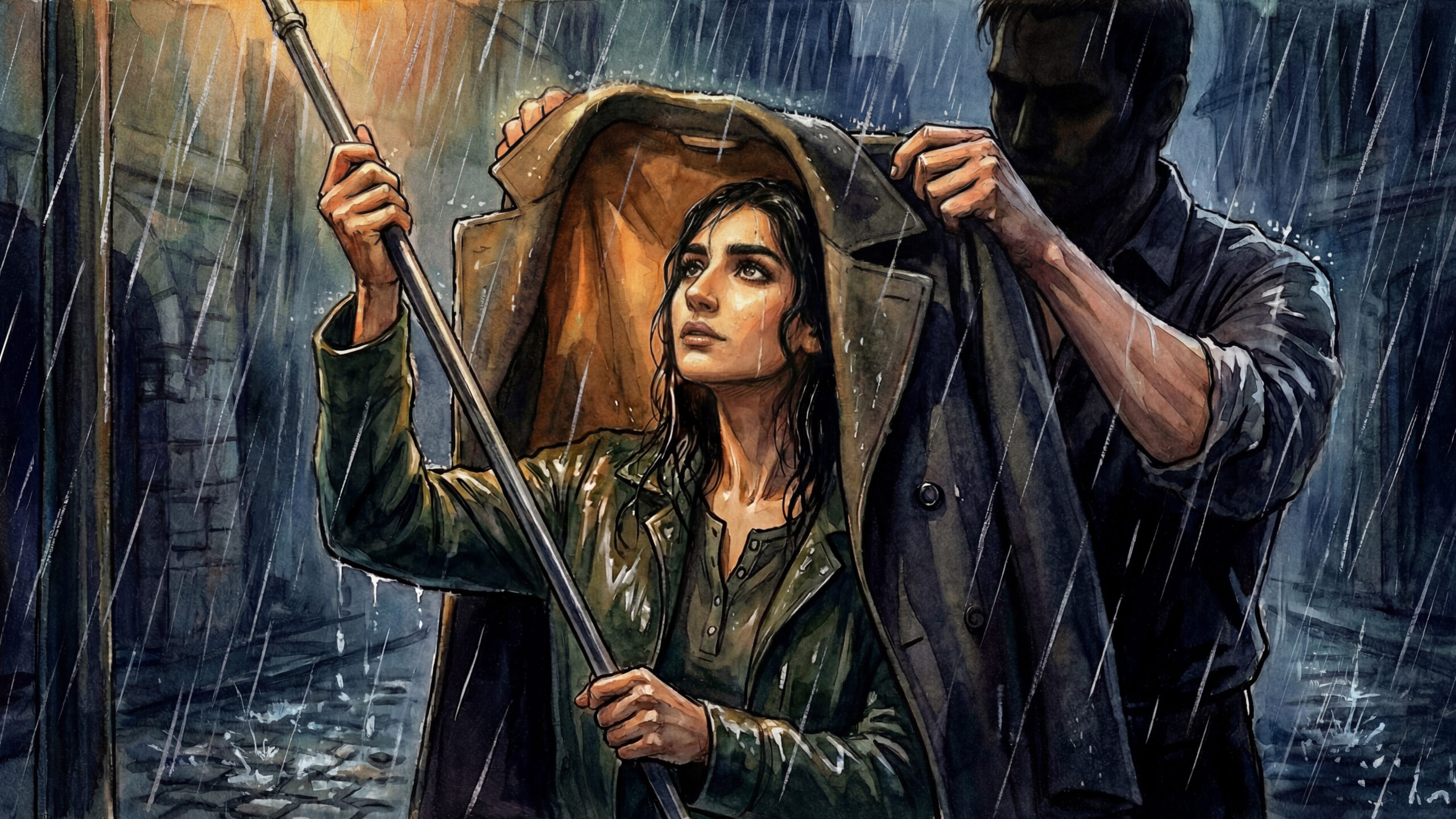
His coat settled over her shoulders.
She went still. The weight of it, heavier than she expected, warm from his body, smelling of rain and something underneath the rain that she couldn’t name, that she’d been breathing all these nights without knowing it. The coat fell past her hips. It was enormous on her. Inside it, the world contracted to warmth and the smell of him.
“The lamp,” he said.
She tried the mechanism. Her hands were still shaking.
He stepped behind her. His hands came over hers on the pole, his fingers finding the spaces between her fingers the way water finds the spaces between stones. His chest against her back. His arms along her arms. The warmth of him enormous and specific, and underneath it his heartbeat, slow, slower than it should be, a rhythm that didn’t match any she knew.
“Turn it left,” he said, near her ear. “The housing’s warped. Your father used to —”
“I know how the lamp works.”
“Then light it.”
She turned the mechanism left. The housing shifted. The gas caught. The flame took hold, steady, golden, indifferent to the rain hammering the glass above it.
His hands stayed on hers. One second. Two. The rain came down and the lamp burned and his heartbeat was the slowest thing in the world.
He stepped back. The cold rushed in where his warmth had been.
She lit thirty-nine. Forty. “Done,” she said, and her voice cracked on it, and she didn’t know if the crack was the cold or the thing she wasn’t saying.
They walked home through the rain, his coat on her shoulders, his shirt soaked through, neither of them speaking. The rain said everything that needed to be said, and the silence between them was the loudest thing in Old Town.
At the cottage door she took off his coat and held it out.
He didn’t take it.
“It’s your coat,” she said.
“Keep it tonight. You’re cold.”
“You’re colder.”
“I don’t feel it the way you do.”
She held the coat. He stood on the step. The rain ran down his face and he didn’t blink, and she thought: What are you? And then: It doesn’t matter.
She hung his coat on the hook by the door. The hook where her father’s coat used to hang. It fit like it had been measured.
“Come inside,” she said.
“I’ll be on the step.”
“Come inside. Sit by the fire. Drink tea. Stop being on the step.”
He looked at her. She looked at him. The rain between them.
He came inside.
He sat in her father’s chair. She made tea. The fire crackled and spat and the cottage filled with the smell of wet wool and wood smoke and the castile soap from the kit she used to re-dress his arm while the kettle heated.
He held the tea with both hands. She held hers. The kitten curled on the hearth between them and the rain hit the windows in waves and neither of them spoke.
She was looking at the shelf above the mantel. The photograph she’d turned face-down months ago and never righted.
“My mother used to make this tea,” she said. “This exact kind. She kept it in a tin on the top shelf because she said the heat from the chimney kept it dry.”
He was watching her. She could feel it without looking.
“She’d make it after the route. My father would come in and she’d have the pot ready and they’d sit, him in that chair, her on the couch, and they wouldn’t talk for the first cup. Just sat. She said the first cup was for the cold, and the second cup was for the conversation.”
The fire popped. A log shifted.
“She went into the Bright when I was fifteen. Didn’t say goodbye. Didn’t leave a note.” Zara looked at her cup. “I came home from school and the tin was on the counter and her coat was gone and my father was sitting in that chair and he didn’t say anything for a very long time.”
The rain hit the windows. The kitten purred.
“He made tea that night. Same kind. Same tin. Put a cup in front of me and sat back down and we drank it and didn’t talk and that was — that was how we learned to do it. Just the two of us.”
She set her cup down. Didn’t look at him.
The fire settled.
“He kept a tin of it,” the Fixer said. “In the supply room. Top shelf, behind the suture kits. Same tea. I asked him once why he kept tea with the medical supplies.” A pause. “He said it was Nadia’s. That’s all he said.”
She looked at him. He was watching the fire.
“I didn’t know what that meant,” he said. “Until now.”
She pressed her thumbnail into her palm and held.
The rain eased. They sat without speaking for a long time, the fire burning down to coals and the kitten shifting between them and the cottage settling around them the way old houses do at night, with small sounds in the walls and the wood contracting in the cold. The clock in the hall struck eleven. The sound was thin, old, slightly behind the hour the way it had been for years because her father had never fixed it and neither had she.
He finished his tea. Set the cup down carefully, the way he did everything. Then he stood and reached for the coat on the hook.
She was looking down at her hands in her lap.
“Stay,” she said. Quietly.
His hand on the coat. Her word in the air between them. A single syllable with the weight of a house that had emptied twice.
“Zara —”
“The fire’s still going. The rain hasn’t stopped. There’s a blanket on the couch.”
He stood with his hand on the coat for a long time. She watched the decision move through him like weather, distant at first, then gathering, then arriving.
He sat down.
Not in her father’s chair. On the couch, where she’d pointed. He didn’t take his boots off. Didn’t take the blanket. Sat on the edge as if he might leave at any moment, as if sitting down were a thing that could be done provisionally, on loan.
She got the blanket. Put it on the couch beside him. Then she went to her room and closed the door.
She lay in the dark listening to the fire settle and the rain fade and the silence of a man who was, for the first time, inside her house and sitting still.
She pressed her hand to her mouth and breathed.
In the morning he was gone. But the blanket was folded. The fire had been fed. Fresh wood, the coals arranged the way her father used to arrange them, banked to last.
His coat was still on the hook.
She touched it. The fabric was dry now, rough under her fingers. Inside the left pocket, something small and hard. She reached in and found a blue-veined stone, white striations, the size of her thumbnail.
She held it in her palm for a long time.
Then she put it in her pocket with the key and the other stones, and got dressed, and fed the kitten, and went to check the first lamp on the route, because the day didn’t stop and neither did she.
He came for the coat that evening.
She heard the knock from the kitchen. Two taps, a pause, a third. Her father’s knock. The one he’d used on the supply room door, on her bedroom door when she was small, on the garden gate when he came home from the route. Two taps, a pause, a third.
She opened the door.
He stood on the step. Clean shirt. The arm in a proper sling now. He looked past her into the cottage, at the fire, the coat on the hook, the kitten watching from the kitchen doorway.
“I came for the coat,” he said.
“I know.”
She took it off the hook. Held it out. He reached for it and their hands were close on the fabric, his fingers and hers, and neither of them moved for a beat, two beats, and the evening light was the color of old gold and the street behind him was empty and the bells of St. Anna’s were counting six.
He took the coat and put it on. The layers restored.
“The route starts in an hour,” she said.
“I know.”
“Are you walking it with me?”
“If you want.”
“I want.”
He nodded. Turned. Walked down the garden path. At the gate he stopped and looked back — not at her, at the doorframe, where the sensor blinked green. Checking. Always checking.
She closed the door and leaned against it. Her hand found the stone in her pocket.
Twenty-seven days since she’d found the footprints in the supply room, and the Old Town evening was clear. No rain, no fog, just the cold and the stars hidden behind Vesper’s permanent overcast, and the lamps catching one by one as she worked the mechanisms and he walked beside her, and something had changed, though not between them; between her and the work. The anger had shifted. Still there, but threaded now with something else.
“The crossed scratches,” she said, at lamp twenty-three. “I figured them out.”
He waited.
“Danger. The places where the Blooms shouldn’t surface because they’ve been spotted. He was tracking the threats.”
“Yes.”
“There are three new ones. Since he died. Someone’s been adding to his marks.”
“Yes.”
“You.”
He didn’t answer. He didn’t need to.
She lit the lamp. “Your scratches are deeper. He used a penknife. You use something harder.”
“You notice too much.”
“He said the same thing.”
“He was right.”
The courtyard opened before them. The Bloom-girl was in her shadow, the fountain boy at his basin, the pair emerging from the gap in the garden wall with the careful slowness of things that had learned to check before committing to the light. Two of the younger ones tonight, holding each other. No sign of the small one. The watcher. The last to trust.
Zara set the food out. He moved through the courtyard checking the wall, the tunnel entrance, the sightlines. She watched him kneel by the pair and check their bandages, his hands as careful with them as hers, the same gestures, the same patience. He re-dressed the smaller one’s shoulder wound and the Bloom held still for him the way it held still for her. Trust, or something shaped like trust. The currency of the dark.
“You’re good at this,” she said. “The care. Not just the fighting.”
He finished the dressing. Stood. “Your father was better.”
“My father had years of practice.”
“Yes.”
“The work doesn’t get easier, does it.”
He looked at her. The courtyard lamp threw his shadow long across the cobblestones. The Bloom-girl, behind him, had moved to the food and was eating with her more-human hands, her more-human face, her more-human eyes that still caught the light wrong.
“Lamp thirty-nine,” he said.
She turned. The flame was out. The seventeenth was guttering too, the gas line that ran between them had the intermittent fault her father had never been able to fix, the one that plagued the original lamps, the ones with character.
She went to thirty-nine. He followed. She opened the glass and worked the mechanism and the flame caught, and in its light she saw the latest stone, blue-veined, white, placed on the ledge where the Bloom-girl always left them.
“She leaves these for me,” Zara said, and picked it up. “Every few nights. I have seven now.”
“Your father had a jar of them.”
“I found it. In the supply room, top shelf. Forty-three stones.” She turned the new one in her fingers. “He never told me what they meant. But I’ve watched her choose the ledge — the same ledge, every time — and I think they’re how she says this place is safe.”
“That’s what your father thought.”
“What else did he tell you?”
The question was quiet. The courtyard was quiet. The Blooms were eating and the lamps were burning and the night was still, and she was asking what she hadn’t meant to ask, the question that came from below the anger and the grief, where the only thing left was the need to understand a man she’d buried without knowing.
“He told me you’d be angry,” the Fixer said. “When you found out. He said you’d be furious. And then he said you’d do it anyway, because you’re his daughter, and his daughter doesn’t walk away from things that need doing.”
Her eyes burned. She turned back to the lamp. Closed the glass. Moved to forty.
“He was right,” she said.
“He usually was.”
She lit the last lamp. “Done,” she said. The word was steady. Her hands were steady.
They walked back through the route in silence. At her gate, he stopped.
“Good night, Zara.”
“Good night.”
She went inside. Stood at the kitchen window. Watched him walk away down the lamplit street until the dark took him.
The sensor on the kitchen window blinked green.
She touched it. Still warm.
She kissed him at lamp thirty-eight.
Not at the cottage, not by the fire, not in any of the places where a kiss might be expected, where the lighting was right and the moment was prepared and the gesture could be folded neatly into a story about two people falling for each other. At lamp thirty-eight, on the route, in the cold, with the Bloom-girl watching from the shadow and the courtyard stones wet with the evening’s earlier rain. The mechanism was open and the gas line was hissing. His hands were over hers on the pole because the housing was warped and she hadn’t turned it far enough. He’d reached over to help and his fingers had found the spaces between her fingers and she’d felt his heartbeat through his wrist, that same slow rhythm, and she’d turned her head and his face was right there and she kissed him.
It wasn’t graceful. Her mouth found the corner of his first, then corrected, and for a moment the kiss was nothing: just pressure, just contact, a thing that had happened before the decision to do it had finished forming.
Then she felt him — he didn’t pull away, didn’t lean in, went completely still. The stillness of the Blooms when the Whisper came, the stillness of held breath, of something that had been moving for so long it didn’t know how to stop. His mouth was warm and he wasn’t breathing and his hands were still on the pole, and under her palm she could feel him shaking, and the shaking had nothing to do with cold or weakness; it was structural, as if the architecture that held him together, the discipline, the distance, the careful careful careful management of every point of contact, had been struck at the foundation and the whole edifice was trembling.
She pulled back, and he looked at her, and she looked at him, the lamplight between them, the gas hissing, the Bloom-girl in the shadow watching with those clearing eyes.
Zara put the lamplighter’s pole in his hands.
“Finish the route,” she said.
And she walked home. She didn’t run. She wanted to; every step was a negotiation with the part of her that was screaming to go back or to go faster or to stop in the middle of the street and cry. But she didn’t run.
She walked. Through Old Town. Past the lamps she’d lit, one through thirty-seven, each one burning the way it was supposed to burn. The routine was still a rope. She held on.
At the cottage, she closed the door. Leaned against it. The kitten wound between her ankles and she sank to the floor and sat with her back against the wood and her hands shaking in her lap.
She’d kissed him. On the route. At the lamps. In front of the Bloom-girl.
The tears were already coming, hot and stupid, the kind that didn’t ask permission. She let herself sob — once, hard, the sound ugly in the dark kitchen — and then again, and the kitten climbed into her lap and she held it against her chest and cried the way she hadn’t cried since her father’s funeral, which was the last time she’d been this sure she’d lost something she couldn’t get back.
She sat on the floor for a long time. The kitten purred against her sternum. The sensors blinked green on the doorframes. The fire was dead and she didn’t light it.
Eventually, she got up. Went to bed. Didn’t sleep.
In the morning, she opened the front door.
He wasn’t on the step.
The morning was thin and gray, Vesper’s default, the sky that couldn’t commit to clearing or to storming, the light that made everything look like a photograph taken through gauze. The street was empty. The gate was closed. The garden was still.
She looked down.
On the step, placed with the care of someone who understood that placement was meaning: a stone. Blue-veined with white. Larger than the ones the Bloom-girl left, polished, or held for a long time, the surfaces smooth, the veins vivid against the white like rivers seen from very far above.
He’d answered in the only language they shared.
She picked it up. It was cold from the night. She held it until it warmed.
The route that evening was forty lamps, and all of them caught on the first try.
She walked it the way she always walked it. Dusk, pole, the mechanism that was muscle memory now, her body moving through Old Town’s narrowing streets with the mindlessness of long practice. The bakery at four, where Madame Fournier’s bread was in the window. The alley at nine, where Severan had stood and wouldn’t stand again. The print shop at fifteen. The scratch marks at twenty-three, her father’s and his, layered now, a shared language written on the bones of the city. St. Anna’s bells somewhere behind her, counting the hours.
The cracked step at thirty-one. She braced herself, the way she always did. No hand at her elbow tonight. No warmth on the pole. She managed it alone, the way she’d managed it before he came, the way she’d manage it if he left.
But the stone was in her pocket. And his coat had hung on her hook. And the sensors were on her doorframes.
She reached the courtyard.
The Bloom-girl was waiting in her shadow. The fountain boy at his basin. The pair at the wall, freshly bandaged. The younger ones near the statue, holding each other, making their quiet rhythmic sounds. And behind them, further back, in the deepest part of the shadow: the small one. The watcher. Come at last. Trust at the very edge of its reach.
Zara set the food down. Lit thirty-five. Thirty-six.
At thirty-seven, she paused. The lamp her father had loved. Two hundred years old, the mechanism worn smooth, the glass etched by centuries of weather. She opened it and the gas caught.
Thirty-eight, where his hands had been over hers, where the rain had come down like a wall and his coat had settled on her shoulders and his heartbeat had been the slowest thing in the world.
Thirty-nine, where the kitten had been found, where the stones appeared, where the Bloom-girl had pressed a key into Zara’s palm and changed the shape of her life.
Forty. The last lamp. Her father’s lamp.
She closed the glass. The flame burned steady. The courtyard was full of creatures that had been children once and were becoming children again, and the night was cold and the dark was wide and there were things in it that wanted to do harm, and she would be here tomorrow and the next night and the next.
“Done,” she said.
She walked home through the lamps she’d lit, one through forty. Her father’s route. Her route.
At the cottage, the kitten was in the window.
The sensors blinked green.
She put the key and the stones on the kitchen table, all of them, nine now, including his. A small cairn.
She touched the sensor on the kitchen window. Warm.
She left the garden gate unlocked.