


The girl had three dolls and one of them was sad.
The Bloom could tell by the voice the girl gave it. Higher, thinner, pulled tight like something stretched too far. The other two dolls had lower voices, fuller, and the girl moved them closer to the sad one and said things in those voices that were round and warm and meant something the Bloom could not understand but could feel.
The girl sat on the step above the grating. Dark coat, white at the neck, shoes with hard pieces that clicked when she moved her feet. Her thumb rubbed the front of the sad doll’s dress, a faded spot where the color had gone thin. She rubbed it the way the Bloom rubbed her own arm sometimes, tracing the line where the skin was smooth and the skin was ridged, back and forth, not thinking about it, just the thumb knowing where to go.
The light was good. Late, gold, coming through the bars of the grating and making stripes on the stone floor beneath. The Bloom pressed flat against the dry wall of the space under the grating and watched through the iron bars. The bars were wide enough for her hand. She kept her hands down.
The girl’s hair was behind one ear. A scratch on the back of her other hand, almost gone, the skin pink and new where it had been open. The weed in the crack of the step had grown since last time. A pale leaf, almost white, unfurling from the stem.
The sad doll said something. The girl held it close and the other two dolls leaned in and one of them said, in the girl’s rounder voice, the same two sounds, soft and low, again and again.
The door behind the step opened. Light fell out onto the stones, warm and yellow. A woman’s shape in the light, bending down.
The girl gathered her dolls. She went up the step and through the door and the Bloom saw a piece of the room inside. The edge of a table. A chair. Something red on the wall. The woman took the girl’s coat and the girl lifted her arms and the door closed.
The light went. The bars of the grating were dark iron against grey sky.
From inside, behind the closed door, a voice went on. Muffled. Steady. Saying things to someone small.
The Bloom lay on her side in the dry space beneath the grating. The stone was cold but the air held a warmth that came up from somewhere beneath the street, an old pipe maybe, deep down. She curled her knees up.
She made her sound. Low, from the chest. The sound she made when the dark was hers and nothing was coming.
After a long time she got up and went back the way she had come.
The way back was long.
Through the low passage where the ceiling pressed close and her shoulders touched both walls and the stone above her was stained dark in a shape like a hand, always the same hand, five fingers spread. Through the wide space where the floor dropped away on both sides and the air smelled wrong, salt and sharp and something underneath that was older. The wet sliding thing came through here on some nights. She held her breath and crossed the ridge, her feet knowing where the edges were, and on the other side the air was dry again and hers.
Down the sloped passage where water ran along the left wall in a thin line and the stones underfoot were slick and green with something that grew in the wet. Past the place where the tunnels met and three ways opened. She took the middle one, always the middle one, her feet knowing the turn even in the full dark. The ceiling rose and she stood taller. Her hand found the wall and followed it, the brick rough and then smooth and then rough again where the old mortar had fallen away and someone, long ago, had patched it with something harder.
The warm pipe was first. She felt it through the floor before she reached the sleeping place, a hum travelling through the stone into her feet. She followed it.
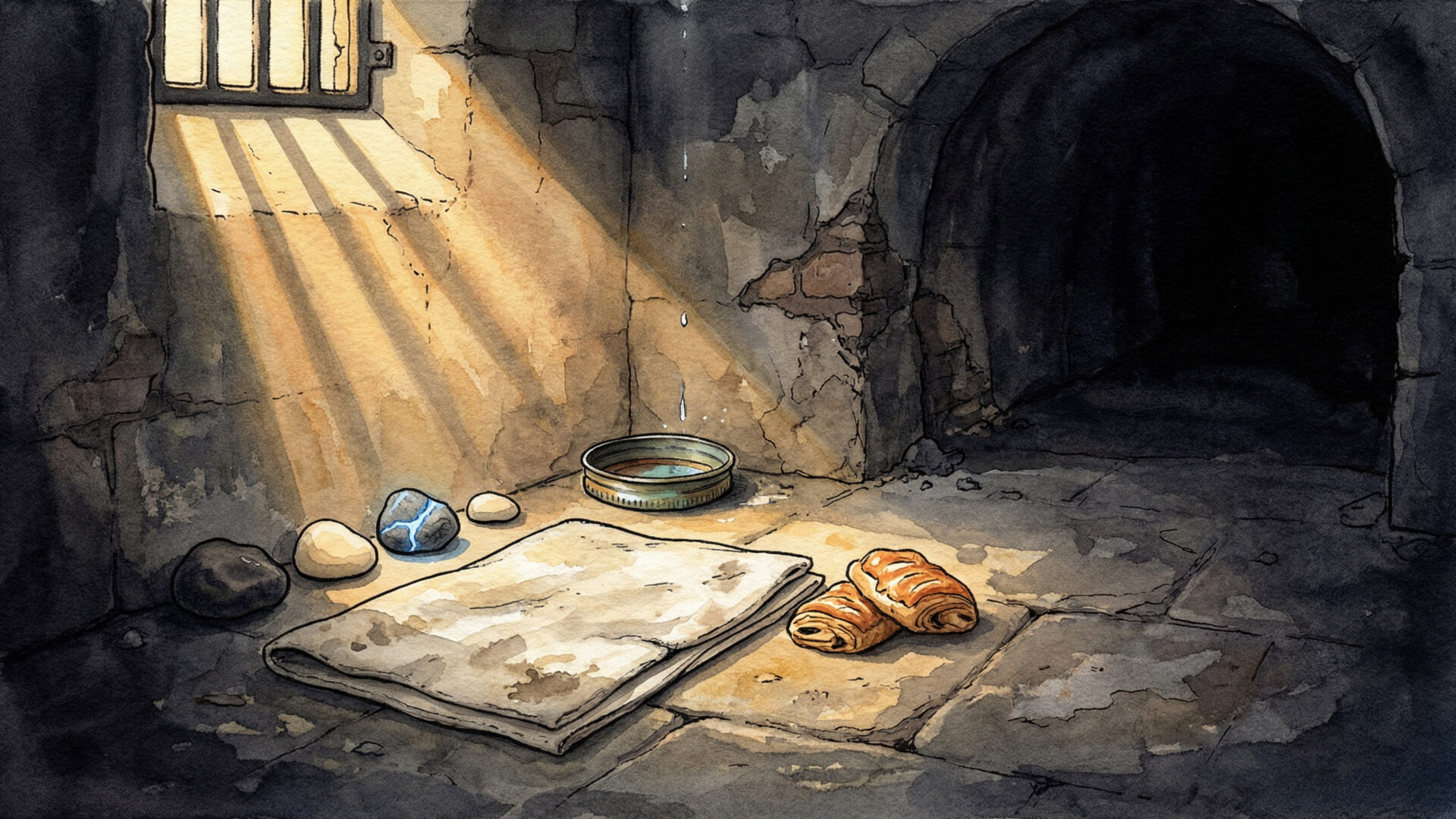
The sleeping place was dry. It had been dry for two cold-times, which was why she had stayed. The warm pipe ran under the floor here, and the heat came up through the stone and made the air different from the tunnel air. She had a cloth, folded once, in the corner where the wall met the floor and the stone was smoothest. A jar lid for water, metal, old, placed where the drip from the ceiling fell every night and filled it by morning. Three stones against the wall in a line, because she liked them. One dark, one pale, one with a vein of blue that caught any light there was.
She lay on the cloth on her side, her body curled around an empty space, her arm out along the edge of it.
The dark forms under her skin moved with their slow rhythm, the tidal pull that was hers, that she had always had. She watched them for a time. Then she closed her eyes.
She slept. The dreams did not come tonight.
The rat was at the food place.
She went there in the early dark, before the sounds above changed from the quiet sounds to the busy ones. The food place was a gap in a wall, a flat stone inside, and on the stone: bread. Someone left it. She had never seen who. The bread was old but not hard, and she took it and held it and that was when she saw the rat.
It was pressed against the wall behind the flat stone. Small, brown and grey, the fur dark with wet where it had been licking itself. One back leg was wrong — bent in the middle where legs did not bend, the foot turned sideways, the claws pointing at the wall instead of the floor. Above the bend, the leg was fat and tight, the fur standing up stiff around the swelling.
The rat pressed itself flatter. Its eyes were dark and the light from her eyes — the oily sheen, catching the faint light from the passage — reflected in them, two small points.
She made her low sound and held still.
The rat’s ears moved forward, then back, then forward again. Its nose worked, the whiskers touching the air in front of it.
She broke a piece of the bread, set it on the stone between them, and pulled her hand back.
The rat did not move. She waited. The bread sat on the stone and the tunnel was quiet except for the drip, somewhere far off, that was always there.
She sat against the wall and waited. Her body knew waiting. She could be still longer than the dark, longer than the cold, longer than anything that hunted or hurt.
The rat moved. One front foot, then the other, the body dragging the bad leg behind it in a way that made the Bloom’s chest tight. It reached the bread and ate, fast, the small mouth working, crumbs falling from the whiskers. It ate everything she had set down and then it looked at her, its nose still working, and it did not run.
She reached toward it slowly, her hand open, flat, low to the ground. The rat watched her hand come. It pressed down but did not run. Her fingers stopped a finger’s length away.
The rat’s nose touched her palm. Cold and wet. The whiskers moved across her skin, back and forth across her fingers and her palm and the soft place at the base of her thumb.
She picked it up with both hands, one underneath, one over the top. The rat was warm, warmer than she expected, the heart fast under her fingers.
The bad leg hung wrong. She held it carefully.
She carried it back through the tunnels to the sleeping place.
She set it on the cloth. It sat in the middle and looked at everything — the walls, the ceiling, the stones, her — turning its head in small jerks, the nose working. The bad leg was underneath it, tucked, the swelling pressed against the cloth.
She sat beside it and watched.
It tried to walk. The three good legs moved and the bad one dragged, and the rat went in a circle on the cloth, the circle tightening, the bad leg pulling it around. It stopped and sat. The fast breathing made its sides move in and out.
She gave it bread. It ate some and left some. She gave it seeds from her pocket — she carried them, found in the bins above, small and dry, a handful for the walk. The rat picked through them. Some it ate. Most it pushed aside with its nose.
The drip from the ceiling fell into the jar lid. She set the lid beside the rat and it drank, the tongue moving fast, the sound small and exact.
That night the rat slept on the cloth beside her. She lay on her side, curled around the space the way she always did, and the rat was inside it. Smaller than the space, but warm, and the warmth spread, and her arm lay along the edge and the rat was there.
The heartbeat against her ribs. She made her low sound and the rat’s ears turned toward her, and then the ears settled, and the rat slept, and she slept.
The leg did not get better for days. The rat sat on the cloth and she sat beside it and brought water in her cupped hands when the lid was empty and the drip had not come yet. She held her hands to its mouth and it drank from her palms, the tongue rough and quick.
On one of those days the rat fell from the cloth. It had tried to move and the bad leg folded and it went sideways onto the stone floor and made a sound she had not heard before, high and sharp and very short. She picked it up and held it against her chest with both hands. Its heart was fast against her ribs. She made her sound, and after a long time the trembling slowed.
Then it began to walk. Three legs and a drag, a circle on the cloth that got wider each day. The swelling went down. The foot was still sideways, the claws still wrong, but the rat was putting weight on it, testing, pressing and lifting, pressing and holding.
She made the rising sound, the one she made for careful things, the sound that went up from her chest into her throat and held there, almost a note. The rat’s ears turned toward her. They were large for its head and thin, and in the faint light from the passage she could see through them — the skin translucent, pink, the blood inside mapped in tiny lines like the veins in a leaf.
She sat beside the rat. She had not been to the grating in many days now. The way there was long and the trip cost her the whole day and the rat was here.
At night the space was full. She felt the heartbeat and the warmth of it. She closed her eyes and the dreams did not come and the dark was hers.
The light room was through the low passages and up.
She went the way that was tight, where the crack in the wall opened into a space she had to turn sideways to pass through, her chest and her back touching stone. Then the stone fell away and the room opened.
The ceiling disappeared. The room was vast, old smooth stone, a floor covered in fine dust that her feet left marks in. Marks that were still there from the last time because nothing came here to erase them. Her old footprints and her new ones, side by side.
A crack in the far wall, high up near where the ceiling would be if the ceiling were visible. Through it: light. Real light, from the sky. It came in at an angle and hit the floor in a circle, and inside the circle the dust turned. Motes rising and falling, moving in patterns that changed and did not repeat. When she breathed, they scattered. When she was still, they found their way back.
She sat in the circle. The light was on her hands and her arms and the dark forms under her skin looked different here. Not wrong. The shapes moved with their tidal rhythm and the light passed through the top layer of her skin and the forms underneath were just there, just part of her, the way the blood was inside the rat’s ears.
She traced one with her fingertip. It shifted away from her touch and came back. She did it again. Away. Back.
A water drop fell from somewhere high above. The sound was round and clear and it echoed once, twice, and went up into the space where the ceiling was not and came back smaller.
She sat for a long time. Her body was different in this room. The crouch loosened. Her shoulders dropped. Her mouth opened a little. She breathed and the dust scattered and came back.
After a long time she thought of the rat and went back.
The woman who made light came at the same time every night.
The Bloom watched from the deepest shadow of the open place where the old lamps stood. The woman moved from lamp to lamp with her long pole, opening the glass at the top, and inside each one a flame caught and the light grew on the stones in a warm circle. Lamp after lamp. The woman’s boots on the cobblestones were steady, the rhythm of someone who had walked this path so many times the path was in her body.
She left food near the wall. Bread, fruit, things wrapped in cloth. She put it down and moved on and did not wait and did not watch, and the food was just there, the way the drip filled the jar lid. Not given, just present, arriving because it arrived.
The Bloom watched from far back. The other Blooms were closer. The older one, bigger, with clearing eyes and hands that were almost the right shape, moved toward the food first. She knew the woman. She was not afraid of her.
One night the woman was at the lamp nearest the wall and the older Bloom came close. Very close. She reached up and touched the woman’s face. One finger, tracing the cheekbone, the way the Bloom traced the dark forms under her own skin.
The woman’s face changed. Something in it opened, and she did not pull away.
The Bloom watched this from the deep shadow and carried it with her back into the tunnels. Not an image. A pressure inside her ribs that she had no name for.
The dream came.
A room with no shadows because the light was everywhere, flat and white, coming from the ceiling and the walls and the floor. Hands in gloves gripping her arms and turning them. A face above her, the mouth moving but the sound not matching. Metal against her skin. The bars of something close above her, cutting the white light into strips.
And the feeling. A terror so large it had no edges, that filled every part of her and pressed against the inside of her skin the way the dark forms pressed against it now.
She woke with her arms drawn in tight and her breathing fast. The forms under her skin were moving wrong, quicker, pressing outward. The rat pressed closer against her. She made her low sound, for herself this time, and the rat was warm and the cloth was real and the darkness of the sleeping place was her darkness. Her breathing slowed. The forms quieted.
The air changed before anything else.
Cold. Not the cold of the tunnels, which was steady and familiar. A different cold, sudden, pressing in from outside like something leaning against a door. The Bloom was at the edge of the open place, watching the woman light the lamps. The other Blooms were at the wall, at the food.
Then every Bloom went still.
All of them, at the same instant. The dark forms under every skin freezing, the tidal rhythm stopping the way water stops when it turns to ice. The Bloom pressed flat against the wall and closed her eyes. She went to the place she went when the dreams were worst — stone against stone, the body becoming the wall, not there, not breathing, not anywhere the cold could find her.
The cold came past her. Not a sound, not a shape. A pressure, an absence that wore a body. She felt it move through the open place the way she felt the wet sliding thing in the wide tunnel — by what the air did when something that should not be there passed through it.
She kept her eyes closed. Sounds came from far away, muffled, the way bad things sounded when she pressed herself flat. Then a long stillness.
The cold pulled back. The air eased. The tidal rhythm under her skin started again, unsteady, finding its way back.
She opened her eyes. There was a burnt smell in the air. A man was on the stones near the lamps, bleeding, his arm wrong. The woman was standing with her hands on her pole and her chest moving fast.
The woman had been between the cold and the lamps. She had stayed in the space where the cold was.
The Bloom went home. She held the rat and made her sound until her hands stopped shaking.
The rat was getting better.
The bad leg touched the ground now. The foot was still wrong but the claws found stone and held, and the rat walked the sleeping place in a wider and wider path, three legs and a leg, the rhythm evening out. It found the passage entrance and went in. She followed. It went ten steps, twenty, its nose working, reading the tunnel air. It found an insect on the wall and caught it and ate it and looked at her.
She went to the grating while the rat slept. A short visit, the long way there and back. Through the bars: the step, the weed. The weed was taller. A new leaf, unfurled, turning toward the grey light. The crack it grew from was no wider than her smallest finger.
She went back.
That night she broke the orange root in half. One for the rat, one for her. The rat ate its half slowly, turning it in its paws, and she ate hers. The taste was earthy and hard and not much but it was what she had. The rat climbed into her lap and she held it. Its ears against her hand, the thin skin, the blood in its tiny lines. The heartbeat against her palm, slower now. Not the fast trembling of the first days. Resting. Not afraid.
She took the rat to the light room.
Through the low passages, sideways through the crack, the rat held against her chest in both hands. It sat still while she moved, its claws hooked in her shirt, its nose working.
The room opened. The dust column was there, the light from the crack, the circle on the floor. She set the rat in the light.
It sat in the circle. The light on its fur turned the brown to gold and the grey to silver. The ears, translucent in the beam, showed every line of blood. Its eyes were dark brown with a lighter ring at the edge, a ring she had not seen in the tunnels, visible only here where the light was real.
She laid out the food. Bread, seeds, a piece of the orange root. And something she had found that morning in a bin behind the place where the bread came from — a small piece, flat, curved, most of it already eaten by someone else. Just a fragment, flaking at the edges. She had put it in her pocket because the smell was different from anything in the bin. Sweet and rich, something that stayed inside her nose.
The rat sniffed the bread and ate a piece. Sniffed the seeds and ate two. Sniffed the orange root and turned away.
Then its nose found the fragment.
The rat ate it differently. Not the picking and leaving of the bread, not the sorting of the seeds. It ate fast, all of it, the small mouth working through the layers, and when it was done it came to her hand and licked her fingers. The tongue on her skin, rough and quick, finding the crumbs and the grease, the rat’s nose pushing at her palm, looking for more.
There was no more. She had brought one small piece and the rat had eaten it and the crumbs were gone.
She made the rising sound. It went up from her chest into the high ceiling of the light room and came back bigger, rounder, the echo changing it into something she had not put there. She made it again. The sound rose and came back and the rat’s ears turned and the dust motes moved in the column of light.
The rat was in her lap. The weight of it, the warmth, the heart against her leg. The light room was silent around them and the dust turned and the light moved slowly across the floor. She sat with the rat in the circle and did not need anything else.
She went to find the flaky things.
She went to the surface in the early dark, through the passage that came up behind the wall between two buildings. The bins at the back of the place that made bread were empty. The sweet bin had paper, wet with grease, and the smell was there — faint, sweet, caught in the paper — but nothing else.
She went further, past the end of the buildings she knew, into a part of the surface she did not usually go. A narrow street, darker, the buildings taller. Bins behind a door that was open. She checked them. Wet things, rinds. In the last bin, under a pile of damp paper: three. Whole. Not eaten. Flat, curved, layered. She held them and they came apart at the edges and the smell rose, sweet and rich, and she held them against her chest inside her shirt where her body kept them warm.
Three. One for the rat. One for her. One for later.
She went back fast. Through the streets in the dark, down through the passage, through the tunnels. The wide space, fast across the ridge. The green stones. The place where the tunnels met. The middle one. The warm pipe humming through the floor.
The cloth was flat. The shape the rat made in the cloth — the hollow, the warmth — was there but cooling. She put her hand on it.
The rat was gone.
She looked at the passage. In the dust, there were tracks. Three clear prints and a lighter mark, a drag, shorter than before, where the bad leg touched and skipped and touched again. The tracks went into the passage and did not come back.
She followed them. They went toward the east passage where she had heard other rats for weeks, the sounds of many of them behind the walls. She followed the tracks to a crack in the base of the wall and crouched. From inside, the sounds of rats. Living, moving, together.
She went back to the sleeping place. She sat on the cloth. The three flaky things were still inside her shirt, warm from her body. She took them out and held them in her hands.
She set them on the cloth, in the space where the rat had slept.
She curled into the space. The space was empty. Something came up through her chest and her throat closed and her face got wet. She wiped at it and it came again. Sounds came out of her, broken and small and repeating, sounds she did not know she could make.
She let them come. They lasted a long time.
She packed.
The cloth first. She folded it the way she always folded it — once, twice, the edges meeting. Inside the fold she put the jar lid and the three stones. The dark one, the pale one, the one with the vein of blue. She wrapped the cloth around them and held the bundle against her chest.
The sleeping place. The warm pipe humming beneath the floor. The worn shape of her body in the stone, pressed there by two cold-times of sleeping in the same spot.
She picked up two of the flaky things. Put them on top of the bundle. She left the third one on the stone for the rat.
She went.
The place where the tunnels met. Not the middle one. The left one, the long way, the way that went around the wide space where the wet sliding thing moved, the way that took half a day. The way to the grating.
Through the low tunnel, through the turning passage where the walls were wet and her bundle touched the walls and she held it higher. Through the narrow crack where she had to hold it above her head and turn sideways and the stones inside shifted and she stopped and adjusted the fold so they would not fall.
The passage opened and closed and opened again. She was not hurrying.
The dry place under the grating was the same. The stone floor swept by wind from above, cleaner than the tunnel floors, with a fine grit that felt different under her feet. The wall where she could press flat. The warm air rising from the old pipe somewhere deep below.
She laid out her things. The cloth in the corner where the wall met the floor. The jar lid — she would need to find a drip, but there was moisture on the wall in the morning and she could collect it. The three stones in a line against the wall, the way they had been in the sleeping place. The dark one, the pale one, the one with the blue vein.
She found a fourth stone on the passage floor. Smooth, pale, the size of her thumb. She set it at the end of the line.
The two flaky things she set beside the cloth. She would eat them later.
She waited.
The light changed. The grey went to gold. Through the bars of the grating she could see the step, the weed with its pale leaves, the base of the metal post.
A door opened. Footsteps on the stone above her. The click of buckles on small shoes. The girl came down the step in her dark coat with the white collar and sat down and set her dolls in a row and talked to them in her low steady voice. Different voices for each. The small one, the sad one, was in her lap. She held it the way the Bloom had held the rat — both hands, close to the chest. The thumb rubbing the faded spot on the dress.
The other dolls leaned in. The girl gave them voices, round and warm, and the sad doll’s voice, higher and thinner, said something the Bloom could almost feel — the shape of the sound pressing through the bars and into the dry space where she lay on her cloth.
The girl’s shoe had come unbuckled on one side. She didn’t notice. The strap hung loose against the step.
The sad doll’s voice said the same two sounds again. Soft and low. Again and again.
The mother called from inside. The girl gathered her dolls. She went up the step. The door opened: warm yellow light, the edge of a table, a chair, something red on the wall. The girl lifted her arms. The woman bent down and took her coat.
The door closed.
The Bloom lay down on the cloth. She curled on her side, her body around the empty space, her arm out along the edge of it. She watched the dark shapes pulsing beneath the skin of her arm.
The light through the grating moved across the stone, the stripes shifting as the day turned. The gold going slowly to grey, and the grey to dark.
Above her, muffled sounds from behind the door. A low voice saying things to someone small. Below her the cloth and the stones and the two cold flaky things and the long tunnels going back to everywhere she had been.
She closed her eyes. The dark forms settled into their rhythm. The pipe, deep below, hummed.
She slept.