


The shop didn’t look like anything.
Wedged between a tailor and a phone repair stall on the eastern edge of Market Square, it had no sign, no display window, no indication from the outside that it was a bakery at all. The door was painted the same brown as the building’s façade and had been for so long that the paint had cracked into a pattern that looked deliberate but wasn’t. A health notice was taped to the inside of the glass, three years expired.
He opened the door. A bell didn’t ring. The interior was narrow and warm, flour dust in the air and the smell of something complicated happening in the back. A counter. A display case, empty except for a tray of plain rolls. No menu. No prices. No customers.
“You’re early,” said the man behind the counter.
Tarek Karim was sixty-two and built like a bread oven. Wide, dense, radiating heat. His apron had been white at some point in the previous decade. His hands were enormous, scarred from burns, and occupied with a notebook whose margins were filled with calculations in handwriting so small it might have been code.
“You said four.”
“I said four would be fine. I didn’t say it would be ready at four.” Tarek didn’t look up from the notebook. “Sit down. I’ll bring it when it’s done.”
There was one chair. He sat in it.
Tarek disappeared into the back. Through the doorway came the sound of an oven opening, the shift in air pressure, the particular silence of a man assessing his own work. A long pause. Then the oven closing again.
He checked the time. Four-oh-four. The route started at dusk, which tonight was six-twelve. Zara would leave the cottage at five-forty-five to do her first check of the gas lines. He needed to be at her door before that. The walk from here to the Warren Gate was twelve minutes. The Underbelly transit, if he took the direct line under the Meridian and surfaced at the Old Town Descent, was forty minutes at pace. That left him an hour and twenty minutes with almost no margin.
Tarek came out carrying a white box. He set it on the counter with a care that made the Fixer stand up.
“Come here,” Tarek said. “I want you to understand what this is before you leave with it.”
He came to the counter. Tarek opened the box.
The cake was small. Eight inches, round, single layer. The frosting was pale, almost white, with a faint green tint that caught the light from the window. On the surface, arranged in a loose spiral, were crystallized jasmine blossoms. Not scattered. Placed. Each one set down with the precision of a man who considered presentation a branch of engineering.
“The jasmine was the problem,” Tarek said. “Fresh jasmine in Vesper. In March.” He said this the way another man might describe climbing a mountain. “I have a contact at the Schuyler Conservatory in Greenvale. Greenhouse stock, grown under artificial Mediterranean conditions. The woman charged me more than the rest of the ingredients combined and she was right to.” He touched the edge of the box, adjusting it a fraction. “The blossoms are crystallized in egg white and sugar. They’ll hold for six hours before they start to soften. After that, they’re decoration. Before that, they’re edible. The flavor is jasmine and vanilla with orange blossom in the soak. The crumb is lemon.”
He looked at the cake. Tarek looked at him looking at the cake.
“You’re going to carry this across the city,” Tarek said. It wasn’t a question.
“Yes.”
“The frosting will not survive impact. The blossoms will not survive moisture. The box is cardboard, not steel. If you drop it, you will have expensive soup.”
“I won’t drop it.”
Tarek closed the box. He tied it with brown string, a knot that was functional and plain. Then he slid it across the counter.
“Two hundred. The jasmine was one-forty of that.”
He paid. He picked up the box. It was lighter than he expected, which made it harder to carry, not easier. Heavy things are stable. Light things shift.
“Hey,” Tarek said, as he reached the door.
He turned.
“It’s good. What’s in that box is good. Don’t waste it.”
He left. The door closed behind him without a sound.
The market was loud in the late afternoon. Vendors calling in four languages, the smell of Amara’s Kitchen cutting through everything else, foot traffic dense between the stalls that lined the square. He moved through it the way he always moved through crowds, present and unnoticed, adjusting his path to avoid contact, reading the flow the way a fish reads current.
The box was under his left arm. His coat was open because the day was mild. Spring had arrived in the Warrens the way it arrived everywhere in Vesper, grudgingly, like a guest who wasn’t sure about the party.
“You! You, stop!”
He didn’t stop. He adjusted course toward the eastern exit.
“I see you! Don’t pretend!”
The voice was small and commanding and belonged to a woman whose stall he was now directly in front of. Fabrics, ribbons, buttons, thread. A haberdashery that occupied six square feet of the market and had been in this exact spot for eleven years. The woman behind the table was barely five feet tall, her hair covered by a printed scarf, her eyes sharp and delighted behind glasses held together at the bridge with electrical tape.
“Mrs. Antoun.”
“Six months! Six months since you came. I thought you were dead. Sit.”
“I can’t sit, I’m—”
“You can’t sit. Of course. You’re too important. Too busy. Running around the city doing God-knows-what while an old woman waits for news of her grandson.”
He stood in front of her stall. People moved around them like water around a stone.
“How is Hani?” he asked.
“How is Hani. He asks me how is Hani. As if I know! He calls me on Tuesdays. Tuesdays. One day a week I get to talk to my grandson. He’s in Bruges, he says. Bruges. I don’t even know where Bruges is. Do you know where Bruges is?”
“Belgium.”
“Belgium.” She said the word like it had personally wronged her. “My grandson, in Belgium. Because of you.”
“Because of his mother. She wanted him out.”
“Because of you, because you arranged it, because you put him on the boat and now he’s in Belgium and I’m here and I talk to him on Tuesdays.” She reached across the table and took his free hand. Her grip was iron. “Thank you. Every day, thank you.”
She held his hand. He let her hold it. The market moved around them.
“What’s in the box?” she said.
“Cake.”
“Cake.” She looked at the box. Looked at him. Looked at the box again. Her eyes narrowed behind the taped glasses with the focus of a woman who had raised three children, buried a husband, gotten a grandson out of a Bliss facility, and was not fooled by anything.
“For a girl,” she said.
He said nothing.
“It’s for a girl. Look at your face. Don’t argue with me, I have eyes. Who ties a knot like that? That’s a man’s knot. That’s a baker’s knot. You need a proper ribbon.”
“Mrs. Antoun, I really—”
She was already rummaging under the table. She emerged with a length of satin ribbon, pink, the kind she used for gift wrapping. She held it up, assessed it against the box, nodded once.
“Put it down. On the table. I’ll fix it.”
“The box is fine.”
“The box is brown cardboard with brown string. You’re bringing a girl a cake in a box that looks like it contains engine parts. Put it down.”
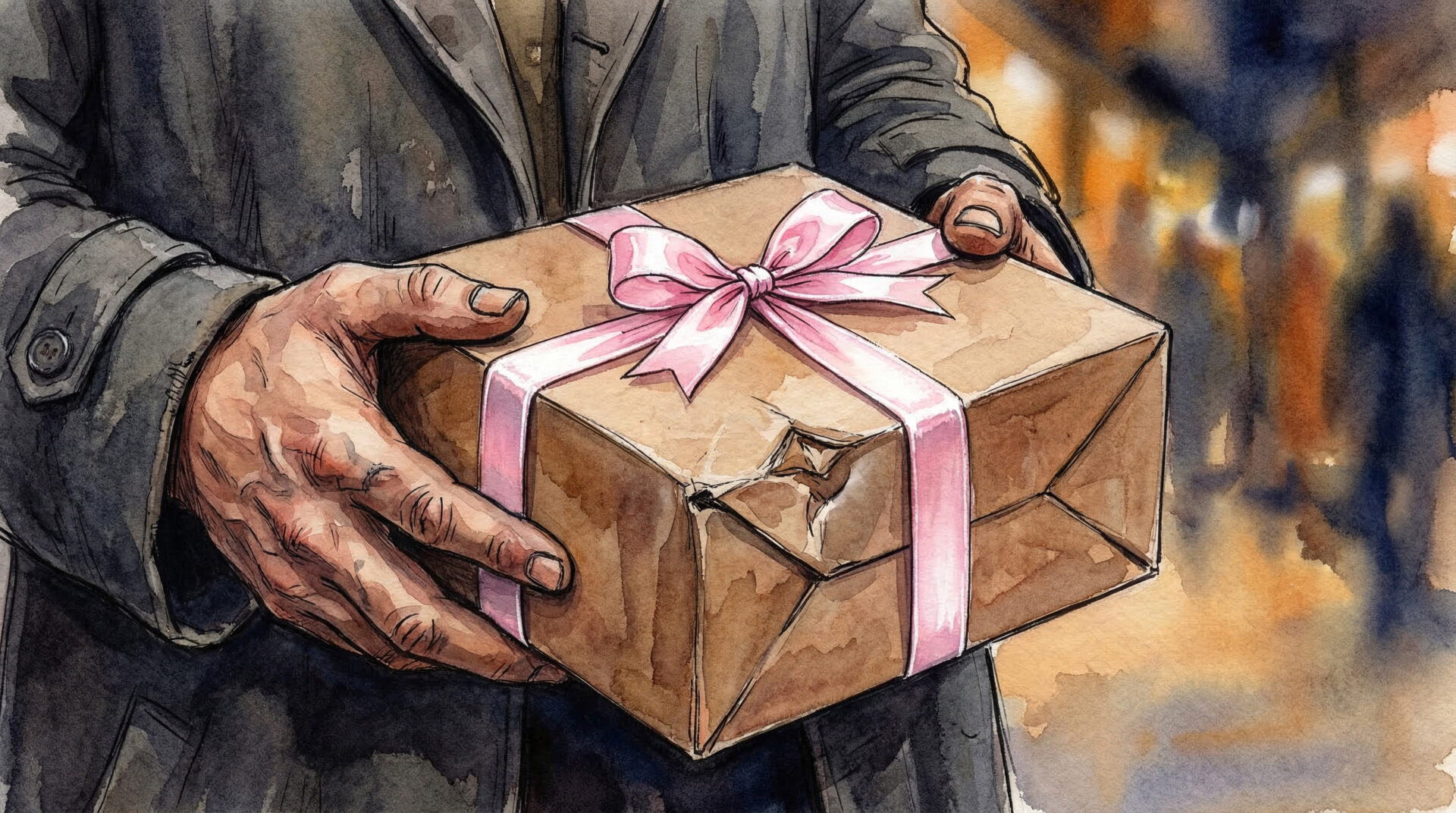
He put it down. She cut the brown string with scissors that appeared from nowhere, wound the pink ribbon around the box with the speed of fifty years of practice, and tied a bow that was small, exact, and emphatic.
“There,” she said. “Now it looks like something a person would want to receive.”
He picked up the box. The pink ribbon caught the light.
“Come back sooner,” she said. “And tell Hani to call me on Wednesdays too.”
He walked east through the market with the box under his arm. The bow sat on top like a small declaration. He didn’t adjust it.
Four-twenty-one. The margin was gone.
The Warren Gate was three blocks from the square. A steel door in the basement of a building that had been a textile warehouse sixty years ago. The door was unmarked. The lock required a sequence, not a key. He entered it one-handed, the box under his left arm, and descended.
The Underbelly opened around him. Victorian brick, condensation on the walls, the smell of stone and iron and the slow underground rivers that fed Vesper’s oldest infrastructure. He knew these tunnels the way most people knew their own hallways. The route from Warren Gate to the Old Town Descent ran roughly northeast, passing through three junction points, crossing under the Meridian at the deep-bore section where the tunnels dropped to forty meters below street level.
He moved at pace. The box was stable under his arm. The pink ribbon was slightly damp from the condensation.
At the second junction, he stopped. There was a dead drop here, a loosened brick at shoulder height, behind which messages could be left for a Waker logistics contact. He checked it. Empty. He left the message he’d brought, a folded slip, coded, containing updated safe-house rotation schedules, and replaced the brick.
He kept moving. The tunnels narrowed as they approached the Meridian underpass. The brickwork transitioned from Victorian red to older stone, grey and slick.
The man stepped out of the maintenance alcove twenty meters ahead.
He was young, mid-twenties, shaved head, a scar running from his left ear to his jaw. He carried a crowbar loosely at his side. Behind him, from the alcove and from a side passage, two more. Then a third, further back, bigger than the others, standing with his arms crossed.
Four total. Three in front, one behind. He heard the fourth’s footsteps settle into position.
The one with the crowbar smiled. “Been a while.”
The Fixer stopped. The box was under his left arm. The pink ribbon was catching what little light came from the chemical strips on the tunnel ceiling.
“Denic,” he said.
“You remember. That’s nice. I remember too. I remember very clearly the night you broke my cousin’s wrist in three places in a warehouse in Driftwood and told him if he came back to the processing corridor he’d leave in a bag.”
“Your cousin was selling children’s intake data to a Bliss recruiter.”
“My cousin was making a living. In a city where that’s getting harder every year. And you put him out of work.” Denic took a step forward. The crowbar shifted from loose to ready. “We’ve been waiting for you to come through here. Not every day. Just Thursdays, because that’s when you visit the old man, and Thursdays you take the western route back, which means junction three. Took us eleven weeks.”
The two beside Denic were armed. One had a blade, short and functional. The other carried something improvised, a length of pipe wrapped at one end. The fourth, behind, carried nothing visible. He was the size of a problem.
Denic’s eyes dropped to the box. The pink ribbon. Two of his men exchanged a look.
The Fixer shifted the box to his right arm. His left hand was free.
Denic came first. The crowbar swung lateral, aimed at the ribs, a committed strike from a man who’d thrown this swing before and landed it. The Fixer stepped inside the arc. His left hand met Denic’s wrist at the peak of the swing, before the weight transferred. He redirected the force past his body, the open door, the energy flowing through and past, the way Spiros had drilled it a thousand times. Denic’s own momentum carried him forward. The Fixer’s hand moved from the wrist to the elbow, folded the joint against its hinge, and Denic went down. The crowbar rang on the stone.
The box hadn’t moved.
The blade and the pipe came together. The pipe-man was faster, an overhead swing, heavy, telegraphed by the right shoulder dropping before the arm moved. The Fixer stepped left, toward the blade, and caught the pipe-man’s swing on the redirect. The pipe sailed past his head and its wielder stumbled forward, off-balance, directly into the path of the blade-man who had to pull his thrust to avoid cutting his own partner.
That half-second was enough. The Fixer drove his left elbow into the pipe-man’s sternum, folding him, and used the collapsing body as a screen. The blade-man came around the falling body with the knife low. The Fixer caught the wrist, rotated it inward, felt the joint reach its terminus, and kept rotating. The blade-man screamed. The knife dropped.
Behind him, Denic was getting up. Crowbar recovered, blood on his lip, coming from the right. The pipe-man was rising too, slower, one hand on his sternum, the pipe still in the other.
Three on their feet. One closing from behind, two in front.
The pipe-man swung. The Fixer redirected the blade-man’s body into the swing. The pipe connected with his partner’s shoulder instead and the blade-man went down hard. Denic came in with the crowbar. The Fixer stepped inside the arc again, but Denic had learned. He shortened the swing, changed the angle, brought the crowbar down toward the box.
The Fixer turned his body. The pipe, coming from the other side, caught his left ribs. A solid hit, glancing because he’d started to rotate, but enough to crack the air from his lungs. He took the hit to keep the box clear. The crowbar missed the box by inches and rang off the tunnel wall.
The pipe followed through and clipped the corner of the box.
Everyone stopped.
The Fixer looked down at the box. The dented corner where the pipe had caught it. Inside, the weight shifted. He could feel it, the slide of something that had been carefully placed moving to somewhere it shouldn’t be.
He looked up. Denic saw his face. The pipe-man glanced at Denic.
What happened next took less than three seconds. The Fixer set the box on the ground. The pipe-man swung again. The Fixer caught the pipe mid-arc, stripped it from his hands, and drove the butt of it into the man’s solar plexus. The pipe-man folded. Denic came in and the Fixer used the pipe to hook the crowbar out of his grip, sending it spinning into the dark, then hit Denic twice, the shoulder and the knee, precise, and Denic went down and didn’t get up.
The blade-man was crawling toward the alcove. The Fixer let him crawl.
The fourth man, the big one, was still standing. He’d watched the whole thing from the back. What had been in his hand behind his back was now visible. A sidearm. Compact, matte black, military-grade. A weapon that didn’t belong in a tunnel in the hands of a man who worked for someone’s cousin.
The muzzle came up.
The Fixer’s left hand went into his coat. His fingers found the device, small, palm-sized, a thing that didn’t have a name in any catalog. He brought it up and pressed the activation. No sound. No flash. A pulse, electromagnetic, focused, that crossed the seven meters between them faster than thought.
The sidearm’s display flickered. Went dark. The trigger mechanism, electronic, refused to fire. The big man looked at the dead weapon in his hand, and at the three men on the ground, and at the thing in the Fixer’s hand that had just turned his weapon into furniture. He ran.
The Fixer picked up the box. The corner was dented. The weight inside had shifted left.
His left side ached where the pipe had caught him. He touched his ribs through the coat. Sore, not broken. He’d had worse from Spiros on a slow Thursday.
He kept moving. Four-forty-one. An hour and four minutes.
The call came as he reached the third junction.
A vibration against his chest, the encrypted channel that only four people had access to. He checked the identifier. Mila, from the Waker logistics cell.
He answered.
“We have a problem. Junction seven, the old maintenance cluster under the Meridian’s east section. Kolya went through forty minutes ago running supplies to the northern cache. He hasn’t reported in.”
“What’s at junction seven?”
A pause. “Something moved in last week. We’ve lost two sensor units in the area. The scouts say it’s biological. Large. We’ve been routing around it but Kolya didn’t get the update.”
“What’s his status?”
“His transponder’s active but he’s not responding to comms. He’s either unconscious or pinned.”
“I’ll check.”
“You’re close?”
“Five tunnels.”
He ended the call. Junction seven was northeast, a detour of fifteen minutes each way plus whatever time the problem took. The hour and four minutes would become thirty, possibly less.
He could route around. Send someone else. There were Waker combat teams for exactly this kind of thing.
Kolya was twenty-three. He’d been running supply routes for six months.
He turned northeast.
The maintenance cluster was Victorian-era, a series of connected chambers where the city’s original sewer engineers had built service access points. The ceilings were high, four meters in the central chambers, vaulted brick, the kind of architecture that made you forget you were underground until you remembered.
He slowed at the approach. The tunnel was quiet in the wrong way. Not empty-quiet. Held-breath quiet. The ambient sounds that lived in the Underbelly, dripping water, distant machinery, the low hum of the city’s weight above, were absent.
He smelled it before he saw the signs. Organic, marine, wrong for a tunnel. Salt and ammonia and something underneath that was older than either.
On the tunnel floor, a supply pack. Kolya’s. The strap was torn. Beside it, a drag mark that led toward the central chamber. From inside the chamber, a voice, young, strained: “Don’t come in. It’s on the ceiling. It’s—”
It dropped on him.
The chromatophores broke as it fell, the body rippling from brick-pattern to mottled grey-brown as it hit his shoulders and wrapped. It was the size of a leopard, dense, muscular, heavier than it looked. The tentacles came around him immediately, four of them, two around his torso and arms, one around his neck, one reaching for his head. The beak was above his skull, chitin clicking, trying to angle down toward the crown of his head.
He was still holding the box.
The tentacle around his neck tightened. He tucked his chin, buying himself a half-second of airway. The ones around his arms were constricting, crushing inward, and he could feel the pressure on the box under his right arm, the cardboard flexing, the structure starting to give.
He ran backward.
Three steps, four, and he drove the creature into the nearest column. The Lurker’s body took the impact, the mass of it compressing between his back and the stone. The beak snapped shut an inch from his ear. The tentacles loosened for a fraction of a second, just enough.
He got his left arm free. The knife was inside the coat. He pulled it and started cutting. The first tentacle parted, thick, fibrous, the texture of wet rope. The Lurker made a sound, a deep wet compression, and the remaining tentacles tightened. The one around his neck contracted. He cut it and air came back in a rush.
The creature recovered from the impact and pulled itself higher on his body, the beak coming down toward the crown of his head. He ducked, felt the chitin scrape along his scalp, and drove the knife upward into the junction where the tentacles met. The blade went in. The creature seized. A tentacle whipped out and caught a piece of rebar jutting from the column, anchoring itself, and pulled. His legs went out from under him and they both went down hard, the tunnel floor hitting his shoulder and hip, the box landing on its side.
On the ground, the tentacles found him again. One wrapped his knife hand at the wrist, squeezing. Another came across his midsection, and he felt something along the underside of it, a ridge, hard and sharp, not a sucker but a blade-like edge where the tentacle’s muscle had calcified. It sliced through his shirt and into the skin along his side, a long shallow cut that burned.
The rebar. It was still there, jutting from the base of the column at a rough angle. He pushed off the floor with his free hand, twisting his body, driving them both toward it. The Lurker was underneath him now, between his back and the column, and the rebar went into the creature’s head with a sound like a boot going into mud.
The tentacles locked rigid. Every one of them, taut, trembling. Then they released, all at once, and the creature slid down the column to the floor and didn’t move.
He stood up. His side was bleeding, the cut from the calcified ridge running from his hip to his lower ribs. Not deep. But enough. He pressed his hand against it and his shirt went warm and wet.
His left forearm, where the tentacles had gripped hardest, was marked. Bruises in the shape of the suckers, and underneath one of the deepest marks, the tissue was doing something wrong. The bruise was fading already, the discoloration retreating at the edges, the skin drawing tight in a way that was too fast and too organized. Something underneath moved, briefly, like a current beneath ice.
He pulled his sleeve down. Buttoned the cuff.
Kolya was in the chamber, pressed against the far wall, his left leg at a bad angle. He was conscious. His eyes were wide.
“How long have you been here?” the Fixer said.
“Twenty minutes. Maybe thirty. It dropped on me and I kicked free but my leg—”
“Can you move?”
“I can crawl.”
“Don’t crawl. Stay still. Help is coming.”
He sent Kolya’s location to Mila on the encrypted channel.
The boy was looking at the dead creature on the floor and at the Fixer’s side, where the blood was soaking through his shirt and through the hand he was pressing against it.
“You’re hurt.”
“I’m fine.”
“You’re not fine. You’re bleeding a lot. The team will be here in—”
“Tell them I went north.”
He picked up the box. It had been on its side. The dented corner was now a dented corner and a crushed edge. The bow had pulled to one side. He held the box level. The weight inside shifted, settled, and stayed.
He walked north. Behind him, Kolya said something he didn’t hear.
Five-eighteen. Twenty-seven minutes.
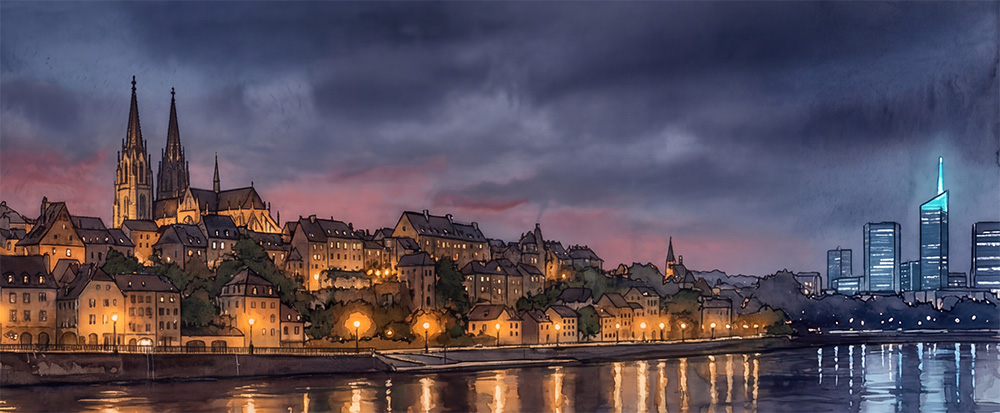
The Old Town Descent was a spiral staircase cut into stone, emerging through a trapdoor in the floor of a storage room behind the cathedral. He came up into the late afternoon light and the smell of Old Town in spring. Stone, river water, the first green pushing through the cracks in everything.
He walked through the Scholars’ Mile. Past the Bookmark, where Mia was visible through the window arranging something on a shelf. Past Café Elodie, where the chairs were outside for the first time this year. Past the print shop, the alley at nine, the narrowing streets toward the Riverside.
At the pump in the courtyard near lamp twenty-three he stopped. Took off the coat. The shirt underneath was torn on the left side, the blood dried to a dark line from hip to ribs. He buttoned the coat over it, hiding the shirt. Washed his hands and face. The water was cold and it stung the places where his knuckles had hit bone.
He dried his hands on the inside of the coat. Checked the time.
Five-thirty-nine. Six minutes.
The cottage was ahead.
The garden was in the first serious effort of spring. Crocuses along the path, the climbing rose on the trellis showing new growth. The gate was unlocked. It was always unlocked now.
She opened the door before he knocked. She’d heard the gate. She was dressed for the route: jacket, boots, hair tied back.
“You’re early,” she said. “I haven’t started the—”
She saw the box.
He held it out. The pink ribbon. The dented corner. The crushed edge. The bow pulled sideways. A box that looked like it had been through something it didn’t want to talk about.
“What is this?” she said.
“Open it.”
She took the box from his hands. She looked at it. Looked at him. He stood on the step with his coat buttoned to the throat and his face that gave nothing away.
She opened the box.
The cake had collapsed on the left side. The frosting was smeared across the lid, a pale green mess, and the jasmine blossoms had scattered and broken, pressed into the surface by impacts the box had absorbed over the course of what appeared to have been a very eventful journey. One side was an inch lower than the other. The overall shape was, generously, oval. It did not look like something Tarek Karim would have allowed out of his shop.
Zara stared at it.
“It’s a cake,” he said.
She laughed. A short sound, surprised, looking at the smeared frosting and the crushed blossoms and the battered box with its pink bow.
“There was a small problem on the way,” he said.
Then the jasmine hit her. The scent rising from the box, warm and sweet in the spring air. Jasmine and vanilla and orange blossom. Her grandmother’s kitchen in a village she’d never been to, described so many times it lived in her memory like a place she’d lost. The smell of jasmine on the wall outside the window, the vine her grandmother tended, the one her mother talked about before she stopped talking about anything.
Zara covered her mouth with her hand.
The tears came down her face. Not sobbing. Quiet tears that arrived without permission. She held the box and the jasmine rose from it and she pressed her fingers against her lips.
“How did you know?” she said, behind her hand.
He didn’t answer. Zara had told Mia, at the Bookmark, three months ago, looking at a botanical atlas of the Levantine coast. The jasmine on the wall. The kitchen. Memories of her grandmother.
Mia had mentioned it to him. Just once, in passing, then given him a look. He’d let it pass.
“How did you even know it was my birthday?” she said.
“Municipal records are accessible if you know where to look.”
She laughed again, the laugh catching on the tears, and she set the box on the step and sat down beside it. The spring evening was soft around them. The garden was green and the gate was open and the kitten appeared from somewhere inside the cottage and wound between the step’s posts, investigating.
She went inside and came back with a knife, two plates, and a serving spoon because a knife alone was not going to manage what had happened to this cake. She scooped a portion onto each plate. The crumb was lemon. The frosting was jasmine and vanilla. They sat on the step and ate it.
It was, despite everything, the best thing either of them had eaten in a long time. Tarek had not been wrong. What was in that box was good.
The kitten got a generous piece on a saucer. Zara wiped frosting from the corner of her mouth with her thumb. The light was going gold the way it did in Old Town when spring and dusk arrived at the same time.
She looked at him.
He was eating cake on a step. He was holding the plate with both hands, the way he held everything. Coffee, cups, the lamplighter’s pole. Both hands. As if the thing might leave if he didn’t.
She looked down. At the step between them. At the small dark spot that hadn’t been there when she’d swept this morning.
Another spot. Then a thin line, tracking from the first spot to the edge of the step.
Blood.
She set her plate down.
“Open the coat,” she said.
He didn’t move. The cake was still in his hands. The evening was still soft.
“Open the coat.”
He set the plate down. He looked at her. She looked back. Her face had changed. The tears were dry now and what was in their place made the Lurker seem approachable.
He unbuttoned the coat. Opened it.
The shirt told the story he didn’t want to tell. The cut along his left side, hip to ribs, the fabric stiff and dark with dried blood. The bruising on his ribs from the pipe, a spread of purple visible where the shirt had torn. She pulled the coat open wider. His forearm, where the sleeve had ridden up: circular bruises, deep, patterned, not from any fist she’d ever seen.
And the cut on his side. The edges were too close together. Not stitched. Not taped. The skin had drawn itself shut in a way that was too neat and too soon.
“It looks worse than—” he said.
She shot him a look that shut the sentence down before it was finished, and he knew better than to start another one.
She stood up. Went inside. He heard the cupboard, the kit, the water running. The sounds of her father’s house doing what her father’s house had always done.
She came back. Sat down beside him. Opened the kit. Set out the antiseptic, the gauze, the tape.
“Shirt up,” she said.
She cleaned the wound along his side. He didn’t flinch. She worked the way she worked on everything, methodical, precise.
She was not gentle. She was not in the mood to be gentle with him right now.
“If you ever,” she said, taping the gauze, “hide something like this from me again—”
She didn’t need to finish. She wrapped the bandage tight, tighter than it needed to be, and he winced. Slightly. She saw it and didn’t apologize.
Then her hands slowed.
She was looking at the bandage, the white gauze against his skin, her fingers still holding the last piece of tape. Something in her face shifted. The anger didn’t leave, but something came in alongside it, the way light comes in alongside shadow.
She tied off the bandage. Her hand rested on it for a moment.
“Thank you,” she said. She was looking at the bandage, not at him. “For the cake.”
He looked at her. She looked up.
“It was on the way,” he said.
She allowed herself the ghost of a smile. Then she stood up.
“I have to do the route,” she said. She looked at him, at the bandage, at the coat pulled closed over the damage. “Stay. Have more cake. You should rest.”
“I’ll walk with you.”
She studied him for a moment, weighing something.
“If you want,” he said.
She put the kit away. She got the lamplighter’s pole from the hall. She came back to the step, where he was standing now, the coat pulled closed.
“I want,” she said. “But we go slow.”
He buttoned the coat.
They walked to the garden gate. She went through. He held it, scanning the street the way he always did, automatic, the quick read of sightlines and shadows that was as much a part of him as breathing. Then the cottage behind them. The locked door. The sensors blinking green on the doorframes.
Then his eyes rested on the kitten, sitting on the step beside the cake box with its crushed corner and its lopsided pink bow.
He gave a small nod. Almost to himself.
He closed the gate behind him.