



Day One
The first anomaly arrived at 7:14 AM in the form of an absence.
Severan noticed it during his morning review, the fifteen minutes between his second espresso and his 7:30 briefing call that he used to scan overnight reports from his district sources. Eight districts. Sixty-eight regular contacts. Each one filed through encrypted drops that funneled into his private server: separate from Bliss systems, air-gapped, his own architecture, housed in a rack cage on the Meridian’s service level.
Sixty-seven reports had arrived. The sixty-eighth — Old Town, the Lamplighter’s route, source designate Corten — was missing.
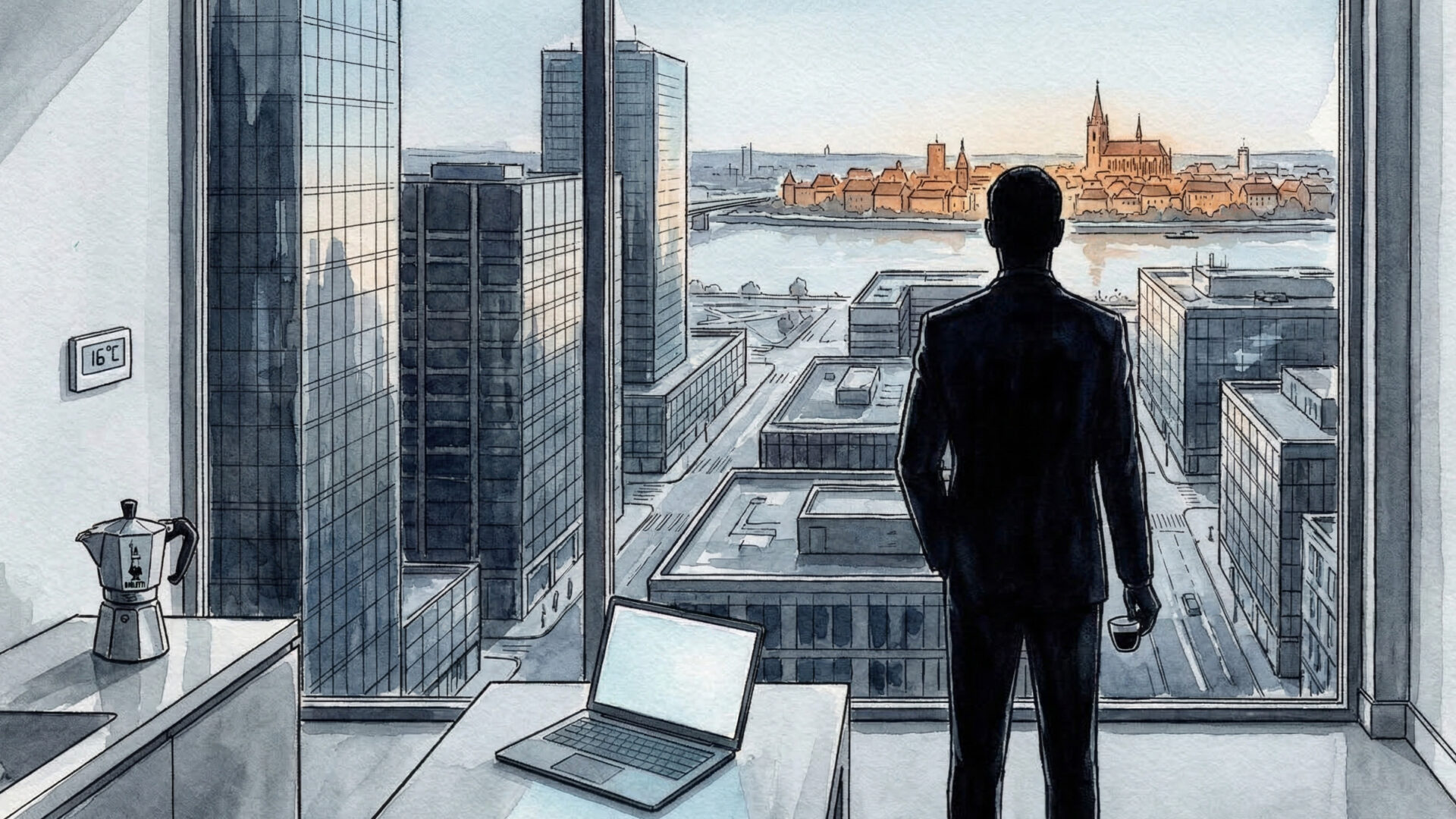
Severan sipped his espresso. The Bialetti sat on the counter behind him, still ticking as the steel cooled. The apartment was sixteen degrees, the thermostat untouched since he’d moved into The Prism four years ago. Cold houses focused the mind. His father’s estate outside Turin had never risen above seventeen, and his father had been the sharpest man Severan knew until the Bright took him in 2058 and made sharpness irrelevant.
He pinged Corten on the secondary channel. No response.
Corten was a night clerk at a printing shop off the square near lamp nine. He’d been selling route information for fourteen months: the lamplighter’s schedule, the Bloom activity, the foot traffic through Old Town’s eastern edge. Low-level intelligence. Background texture. Corten had never missed a filing. He wasn’t important enough to be unreliable.
Severan noted the absence, logged a follow-up, and took his briefing call.
The call was with his handler at Bliss, a woman named Hargrove whose voice carried the warmth of an automated checkout. The Whisper deployment against the Old Town route had been filed as a partial success. The target assets, Bloom specimens showing advanced stabilization, had evaded retrieval.
“The field report mentions resistance,” Hargrove said. “Do we have identification?”
“I’m working on it.”
“Prioritize. R&D wants those specimens before they stabilize further. And Luca — don’t let this become another Kask.”
“It won’t,” Severan said.
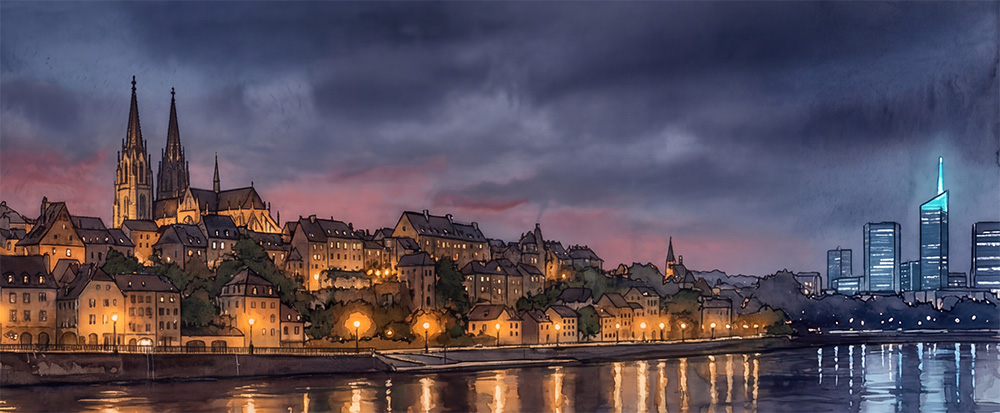
He ended the call and stood at the window. His apartment was on the thirty-eighth floor, the view north looking across the river to Old Town. Morning light caught the roofline: medieval stone, Gothic spires, the Silver Bridge connecting the districts like a suture between centuries. From this height, Old Town looked manageable. A contained problem in a contained district.
He dressed. Dark suit, good shoes, the cologne his sister had bought him in Lyon before she stopped answering. He checked his reflection the way he’d check a report, for accuracy, not admiration.
At his terminal, he queried his data broker in the Night Market, not the Confessor, that source was too expensive and too unreliable, but a smaller operator named Voss who sold district surveillance packages from a stall near the Memory Merchant’s alcove. Severan submitted the standard encryption and the payment flag.
The response came within the hour: Package unavailable. No current data on requested sector.
Severan read it twice. In fourteen months, Voss had never returned empty. Voss didn’t go empty. His business model was total coverage: aggregated from dozens of sub-sources, sold as consolidated packages. For an entire sector to go dark meant every sub-source in that sector had stopped producing simultaneously.
One missing report was a glitch. Two dead channels on the same sector in the same morning was a pattern.
Severan opened the operational file on his private server, the master document for Old Town, containing the route surveillance, the Bloom asset locations, the deployment authorization he’d signed to activate the Whisper. He scrolled through, confirmed the contents, and closed it.
A pattern. Not a crisis. Corten might have been arrested; the Old Town constabulary still made token gestures toward law enforcement. Voss might have a sourcing problem; sub-sources went dry, suppliers got nervous. The Whisper engagement had stirred the district. People went quiet when violence happened nearby.
Severan filed it and moved on.
Day Two
The Whisper handler was gone.
Severan learned this at 6 AM from his Underbelly contact, who reported that the logistics facility where Whisper units were staged had been vacated overnight. Not raided. Vacated. The equipment was still there: staging pods, calibration rigs, the nutrient systems that kept the Whispers’ biological architecture viable between deployments. The handler, a technician named Briggs who’d managed Whisper logistics for the Old Town and Warrens sectors for three years, had cleared his personal effects and left.
When Severan checked Bliss internal HR, the system showed Briggs as active and present at the facility his own contact had confirmed was empty.
Two systems showing two realities. One lying.
Severan cancelled his morning schedule. He pulled the blinds against the river view and worked at the dining table he never used for dining, spreading his network across its surface in handwritten notes. Paper couldn’t be remotely accessed, and the comfort he’d taken in his air-gapped server was eroding. He turned the brass lighter between his fingers while he thought. An old Ronson, engraved with initials that weren’t his. Found in the back of his desk drawer when he’d taken over the Old Town sector from Kask two years ago. One of the few things left behind after Kask disappeared. Severan didn’t smoke. He liked the weight of it.
In forty hours:
- One human intelligence source in Old Town: silent.
- One data broker in the Night Market: empty.
- One Whisper logistics handler: vanished.
- Bliss internal systems: contradicting reality.
Someone was switching off nodes in his network.
He ran threat profiles. The Wakers had motive but not capability; their operations were ideological and underfunded. Bliss internal security could access the server but had no reason to pull a single handler off-station. A corporate competitor would move differently. Louder, with a signature he could read.
This had no signature. Someone was moving through his architecture the way water moves through limestone: following existing channels, leaving no trace except absence.
Severan stopped reacting. He started hunting.
Three calls. The first to The Prism’s security office: pull building access logs for the past week. The second to a private security contractor named Daan, ex-intelligence, who ran electronic countermeasure sweeps for corporate clients. The third to a contact at Bliss Tower security: lobby camera archives, seventy-two hours.
Then the real work.
If someone was dismantling his Old Town network, that someone needed information about its architecture: his sources, the server location, Briggs’s facility. That information existed in very few places. One was the operational file on his server. Another was a dead drop he maintained in the Night Market, a rented locker near the Apothecary’s fold in the Folds section, containing paper records he updated monthly. Physical. Unmarked. Old tradecraft in a digital age.
He checked the locker through the market’s crude messaging system. Intact. Undisturbed.
Severan set his first trap.
He updated the dead drop with false information: a fabricated report describing a second Whisper unit being prepped for deployment against the Lamplighter’s route, scheduled for activation in forty-eight hours. Anyone accessing the drop would find this and be forced to respond: to accelerate their operation, to warn the route, to make a move Severan could see.
He installed a passive pressure sensor on the locker, film and battery, no network signature, old technology that didn’t exist on any system his opponent could monitor. Then he left the Night Market through the main entrance, past Mama José’s stall where the smell of cumin and slow-cooked pork fat hung in the tunnel air like a warm hand on the chest.
The results from his three calls arrived by late afternoon.
The Prism’s access logs: clean. Every entry and exit accounted for.
Daan’s countermeasure sweep of Severan’s apartment: nothing. No devices, no signals, no compromised hardware.
The Bliss Tower lobby cameras: a different story.
The security contact sent a footage compilation from the past seventy-two hours. Severan reviewed it on his personal device, scrubbing through hours of lobby traffic. At timestamp 02:47 on the night of the Whisper engagement, three hours before the field report landed on his desk, a figure appeared in the lobby.
Dark coat. Unhurried gait. A slight asymmetry in the stride, favoring the left side. The figure crossed from the main entrance to the elevator bank in eleven seconds.
The face wouldn’t resolve.
Severan ran it through Bliss Tower’s identification suite: not just facial recognition but neural-gait analysis, thermal signature matching, the proprietary biometric mesh that cross-referenced bone structure, stride cadence, and body-heat distribution against every employee, contractor, and registered visitor in the system. The suite returned nothing. Not a negative match. Nothing. The query completed without generating a result, as if the figure occupied the lobby without producing the biometric data a human body should produce.
The figure entered the elevator. Ascended to the thirty-fourth floor, Severan’s floor, the field liaison suite. The corridor camera tracked it for nine seconds before the feed degraded into static lasting fourteen minutes.
When the feed returned, the corridor was empty.
Fourteen minutes on the floor with his air-gapped server. The hardware key was in his pocket — but the server was physically accessible from the terminal on that floor. Fourteen minutes was enough to sit down, access the system, and take whatever you wanted.
Severan opened the Old Town operational file remotely. The route surveillance was there. The Bloom asset locations were there. The Whisper deployment authorization, the document he’d signed, tying the strike to him personally, was gone.
Severan poured a glass of the 2041 Lagavulin, the oldest bottle on the walnut shelf, reserved for moments that required clarity rather than comfort. He drank it the way his father had taught him, slowly, the glass held at the base.
And then he set his second trap.
He called Daan back. “The man on the lobby footage. I want a physical surveillance package. Three operatives. He’s got Old Town connections — there’s a woman on the Lamplighter’s route. If our man is protecting her operation, he’ll need to check in. She walks the route at dusk. He’ll be somewhere nearby.”
“The image—”
“I know. The cameras can’t hold him. Forget cameras. I want human eyes. Three shifts, twelve hours each. Old Town, the route from lamp one to lamp forty. Any male, coat, alone, moving at night. I don’t need his face. I need his pattern.”
Daan’s operatives were in position by nightfall.
Severan also placed a call to a contact in the Underbelly, a Waker sympathizer named Erdo who played both sides for cash. Erdo had sold Severan information about Waker safe houses in exchange for protection from a debt he owed in the Warrens. Severan gave him a simple task: spread the word, quietly, through the Waker channels he had access to, that Bliss was preparing a second Whisper deployment against the Old Town route. If the Fixer was using Waker contacts or infrastructure, the panic would flush movement Severan could track.
Two traps. One physical, one informational. The dead drop would catch anyone accessing his intelligence. Daan’s operatives would catch anyone approaching the route. And Erdo’s disinformation would destabilize whatever support network the Fixer was using.
Severan went to bed at midnight. Set an alarm for five.
He was, he realized as sleep took him, enjoying this. The anomalies had alarmed him, but the response was clean, layered, professional. His opponent had moved first. Severan was moving better.
At 6 AM, Daan called.
“One of my people saw something. Lamp fourteen, 2:30 AM. Male, dark coat, alone. He came from the direction of Old Town Square and walked the route south, fourteen, fifteen, sixteen, checking sightlines at each lamp. Didn’t light them. Just walked and looked.”
“Description?”
“She couldn’t hold it. Same issue as the cameras. She saw him, she watched him for ninety seconds, she tried to write the description and her notes didn’t match what she’d seen. Height, build, coat, that she’s sure of. The face, the features, she’s got nothing. She says it’s not that she can’t remember. She says there’s nothing to remember.”
“Where did he go?”
“South along the route to lamp thirty-one. The cracked step. He stopped there for several minutes. Then east, into the alley network toward the Meridian border. She lost him at the edge of Old Town.”
Toward the Meridian border. Toward the Underbelly access points. Toward the Night Market.
The pressure sensor on the dead drop hadn’t triggered. But the Fixer — if this was the Fixer — was moving in the right direction.
Severan’s second call came at 8 AM. Erdo. Agitated.
“The word went out, like you said. The Waker channels picked it up: second Whisper deployment, Old Town route, forty-eight hours. It spread fast. And an hour after it spread, a Waker logistics contact named Reis tried to make an emergency call to a disposable number she’d never used before. We traced the number. It’s a dead line, no owner, no history, but the call originated from a relay node in the Underbelly, Midlevel section, near the old Maintenance Bay cluster.”
“Did the call connect?”
“It connected. Four seconds. No voice data. She was cut off. But here’s the thing. Twenty minutes after the call, Reis packed a bag and left her safe house. She walked to Terminus Null and took the Glass Line south.”
“The Glass Line is compromised. Bliss sensors—”
“Exactly. She tripped two sensors. Bliss security logged her passage. She’s on record now.”
Severan had flushed a Waker asset, compromised an enemy logistics chain, and generated actionable intelligence. All from a single piece of disinformation planted through a double agent. This was what fifteen years of network architecture produced.
He spent the morning building a profile. The Fixer, Severan was now confident, was the individual referenced in Bliss’s fragmentary files under the designator VARIABLE. The thinnest file in the system. Accumulated over years from incidents that never cohered: a Whisper disabled in the Warrens in 2061, a surveillance network in Driftwood that went dark overnight in 2063, a string of Bloom extractions across three districts that shared no pattern except perfection. Severan had reviewed the file twice before and dismissed it, not because the incidents were insignificant, but because the file contained nothing actionable. No photograph had ever resolved. No biometric suite had returned a match. No informant had produced a usable description. The file was a collection of effects without a cause, and Severan’s profession ran on causes. A threat you couldn’t photograph, couldn’t describe, couldn’t model, that wasn’t a threat. That was a rumor.
The rumor was sitting in Bliss Tower’s lobby footage.
VARIABLE operated through a thin layer of Waker contacts for logistics support: safe houses, supply caches, communication relays. The Waker connection explained how the Fixer moved through the Underbelly.
Sever the Waker connection and the Fixer lost his logistics.
Severan placed Reis’s information, her route through the Glass Line, her safe house address, her communication logs, into the Bliss security system with a flag for active monitoring. Then he fed Daan’s team an updated brief: the target was operating from the Underbelly, likely Midlevel, near the Maintenance Bay cluster. Adjust surveillance accordingly. And he sent a message to Hargrove: Recommend immediate activation of Glass Line monitoring protocol for the Underbelly Midlevel transit network. Target designation VARIABLE. Priority: high.
By noon, Bliss had three sensor teams in the Underbelly’s upper transit corridors, monitoring for the movement signature Daan’s operative had described: male, coat, favoring left side.
The net was closing.
And at 2:17 PM, the pressure sensor on the dead drop triggered.
Severan received the alert on his personal device while eating lunch in the Bliss Tower executive dining room, a plate of bass and fennel he didn’t taste, surrounded by colleagues he didn’t like, performing the midday ritual of corporate fellowship. He glanced at the alert, finished his coffee, excused himself, and walked to his office.
Someone had accessed the dead drop and read the false deployment report.
Severan leaned back in his chair. The office windows showed the Corporate Plaza, the holographic display cycling through images of transcendent joy, the Bliss logo pulsing with slow blue light calibrated to match the resting heart rate of a person in REM sleep.
He was winning. The deployment authorization was gone. That was a loss. Corten, Voss, Briggs. Losses. But Severan had identified the threat, compromised an enemy asset, activated institutional resources, and baited his opponent into accelerating. Speed meant visibility. Visibility meant the sensor teams would find him.
He poured himself a glass of water and waited.
Day Three
Severan woke to a message from Daan, timestamped 3:41 AM:
Movement in the Underbelly. Sensor team B3 flagged a transit event at the Midlevel junction near Maintenance Bay 4. Single individual, matching profile, moving south at speed. Pursued for 200 meters before contact was lost at a junction with the Victorian brick system. Individual appeared to be injured — gait degradation, right hand braced against the tunnel wall at one point. Approximately 90 seconds after losing contact, sensor team reported a localized interference event — comms went dark for four seconds, then restored. Individual not reacquired.
Severan read the message three times, parsing each sentence.
The Fixer had been in the Underbelly, moving fast. The false deployment report was working. He was accelerating.
And he was compromised. Gait degradation. Hand braced against the wall. The wound from the Whisper fight was slowing him.
Then the four-second comms blackout, the same phenomenon as the camera disruption. Some capability that interfered with electronic systems at close range, deployed at the moment of greatest vulnerability to break contact.
But he’d had to use it. A man burning defensive capabilities to stay ahead of a sensor team he hadn’t expected.
The second message arrived at 7 AM, from Erdo:
Reis has been picked up by Bliss security at the southern checkpoint. She’s being processed. Do you want me to extract anything from the interview?
Reis was in custody.
Severan felt the hunt settling into its final shape. The Fixer’s information sources on Severan were dismantled: dead drop compromised, broker dark, informant silent. His logistics were collapsed, Reis in custody, the Waker channels poisoned. The Fixer himself was wounded and accelerating.
A man who could walk through walls still needed to eat, sleep, and heal. Severan had made all three harder.
He spent the morning in meetings, performing his role with the elevated focus that came from knowing the real work was happening elsewhere. At lunch, he called Daan and authorized a final deployment: two operatives in the corridor outside his apartment at The Prism, starting at 8 PM. If the Fixer’s pattern held — Bliss Tower at 2:47 AM, the route at 2:30 AM — he operated between midnight and dawn. Severan wanted eyes on his own door during those hours.
“Full close-protection protocol,” he told Daan. “If anyone approaches the apartment who isn’t me, detain and hold.”
He spent the afternoon at his desk, drafting the memo to Hargrove that would close the operational loop. VARIABLE identified as primary threat to Old Town sector. Recommend second Whisper deployment with enhanced sensor support. Target has Waker logistics contacts. Suggest coordinated sweep of Underbelly Midlevel network concurrent with deployment. A clean plan. Comprehensive. The kind of work that earned commendation.
He left Bliss Tower at 11 PM, later than usual. Drove through the Meridian’s empty streets, the glass towers reflecting each other into infinity. Passed the checkpoint at Executive Row. Parked in The Prism’s garage.
In the elevator, he checked with Daan’s team. Both operatives in position. Corridor clear. No activity since 8 PM.
“Stay sharp,” Severan said. “Two more hours.”
He rode to the thirty-eighth floor. Walked the corridor — and there they were, Daan’s people, two professionals in dark clothes positioned at either end of the hallway. One nodded. The other raised a hand. All clear.
Severan put his key in the lock. Opened the door. Reached for the light.
“Leave it off,” said a voice from the chair by the window.
His hand froze. The corridor light behind him spilled into the apartment’s entry and died three feet in, swallowed by the darkness of the living room. The windows were uncovered, the city light came through, amber and cold, enough to show the shape of furniture and a figure in the chair by the window.
Severan looked at the corridor behind him. Daan’s operative, ten meters away, watching. Severan held up a hand — hold — and stepped inside. Closed the door.
“I have two armed men in the hallway,” Severan said.
“I know.”
“And you’re here.”
“I’ve been here since six.”
Since six. Five hours before Daan’s operatives took position. The Fixer hadn’t walked past them. He’d been inside before they arrived. Waiting. For five hours. In the dark.
Severan’s eyes adjusted. The chair by the window. He’d bought it for the space, had never sat in it, a Le Corbusier reproduction that faced north toward Old Town. The Fixer was sitting in it the way a man sits in a chair he’s familiar with, one hand on the armrest, the other holding a glass. A crystal glass from Severan’s set, containing an inch of whiskey. The bottle beside it was the 2041 Lagavulin.
“You’ve been in my whiskey,” Severan said.
“I’ve been in your apartment.” A pause. “The whiskey seemed secondary.”
Severan moved to the sideboard. Slowly. He poured from the 2048 Talisker, a different bottle, deliberate. He sat on the sofa, four meters from the chair. The distance was decorative.
“Your dead drop in the Night Market,” the man said. “The locker near the Apothecary. That was good tradecraft. Physical records, no network signature. I particularly liked the pressure sensor, old technology, no emissions. Very clean.”
“Clean enough to catch you.”
“Clean enough to tell you I’d been there. That’s different from catching.”
“You read the deployment report.”
“I read your deployment report.”
Something in the emphasis. Severan turned the word over. Your deployment report. Not the deployment report.
“You knew it was false,” Severan said.
“A second Whisper activation against a sector where you’ve lost your handler, your surveillance, and your deployment authorization? It read like bait.” The man turned the glass slowly. The city light caught the whiskey. “I triggered the sensor deliberately. I wanted you to think the trap was working.”
Severan set his glass down.
“While your sensor teams were chasing a Waker volunteer in a borrowed coat through the Underbelly Midlevels, I was already above ground.”
The gait degradation. The hand on the wall. A performance in a borrowed coat, played for the sensor teams’ benefit while the real target moved north.
“And Reis,” Severan said. The name came out flat.
“Reis is a problem.” For the first time, something in the man’s voice shifted — not quite concern, but weight. “Your disinformation flushed her. She panicked and ran through the Glass Line, which I’d told her never to use. She’s in Bliss custody because of your operation. That wasn’t something I planned for.”
The room was quiet. The city hummed below.
“I’ll need her back,” the man said.
“That’s not something I can—”
“You fed the Waker channels specifically to flush contacts. You know Reis’s name. You put her on the Glass Line sensors. You can take her off.” He looked at Severan. Or at the space where Severan was. The light was wrong for eye contact, the face still half-dissolved in shadow. “You flushed an innocent woman into a system that will interrogate her, categorize her, and file her in a database she’ll never escape. She ran a supply line for people living underground. That’s her crime.”
Severan drank. The Talisker was bright and peaty and tasted like itself, which was the only fixed point available. “You’re asking me for a favor.”
“I’m asking you to undo damage you caused.”
“You dismantled my network.”
“Your network surveils a woman who lights gas lamps and feeds children that your corporation would rather bury. I removed the parts that pointed at her.” A pause. “The Whisper shouldn’t have reached that route. That was my failure. Yours was sending it.”
Severan looked at the view. Old Town across the river. The gas lamps dark. From up here, the district looked like something you could cover with your hand.
“Your apartment has good bones,” the man said. “High floor. Single access. The windows are seismic-rated. The lobby runs a biometric mesh: facial, gait, thermal, pulse-rate variance. The apartment door is neural-keyed. It’s a good system.”
“You’re inside it.”
“The service elevator from the parking level bypasses the lobby mesh entirely. Maintenance exemption. Your building management filed it three years ago.” He turned the glass again. “And neural keys authenticate presence, not identity. There are ways to persuade them.”
Severan’s jaw tightened.
“How long?” Severan said.
“How long what?”
“How long have you had access to this apartment?”
The man didn’t answer directly. “You’ve been buying whiskey from Macalister & Webb for three years. Glass Canyon, lower level. You go in person. The owner knows your preferences.”
“That’s not what I asked.”
“You changed your access code four months ago. Before that, the same code for eighteen months. Before that, twelve months. You update on impulse, after an article, or a colleague’s breach. Not on a schedule.”
“How long?”
“The dead drop. The locker near the Apothecary. You’ve used it for eleven months. Paper records, updated monthly. I’ve been reading it since March.”
Nine months. Severan’s own handwriting, reviewed by someone else before he opened it. Every trap he’d set in the past three days built on intelligence his opponent had been reading for nine months.
“I triggered the sensor because I wanted you out of this apartment tonight. While you were hunting, I was here.” He set the glass down. “I’ve been here many times, Severan. I chose tonight to let you know.”
Severan stared at the glass on the side table. His crystal, his whiskey, his apartment. A man had been sitting in this chair while Severan slept ten meters away — reading his thermostat, cataloguing his whiskey, mapping the dimensions of his life — and choosing, each time, to leave everything undisturbed.
“What do you want?” The Italian was under the English now, the Turin boyhood surfacing.
The man stood. The silhouette shifted: the damaged coat, the favoring of the left side, the posture of someone carrying pain he’d decided wasn’t worth discussing. He moved toward the door without sound.
“The lamplighter walks the route at dusk,” he said. “She’ll walk it tomorrow. And the next night. And the next.” He opened the door. The corridor light spilled in. Severan saw Daan’s operative at the end of the hall — still in position, still watching, having seen nothing, having heard nothing. “Decide what you want that to mean.”
The door closed. The corridor light cut off.
Severan sat in his apartment. The Talisker went warm in his glass.
Calling Hargrove was the professional thing. Reporting the breach. The nine months. But Bliss did not retain people who’d been shown to be permeable. The call would end his career.
Reis was in a processing center. Zara Haddad was in a cottage in Old Town, waiting for dusk.
At 5 AM, he opened his terminal. He drafted two memos.
The first: reassignment of the Old Town Whisper unit to a different sector. Operational justification: asset reallocation based on revised threat assessment.
The second: a request to Bliss internal security to release a detainee designated Reis, A., currently held at the southern checkpoint processing center. Justification: mistaken identification; subject cleared of involvement in flagged activity.
He filed both. Closed the terminal.
He went to the window. Old Town across the river, the gas lamps dark. In twelve hours, she’d walk the route and light them again.
Severan pulled the blinds. He washed both glasses with the same care and set them upside down on the counter.
The brass lighter was on the entry table where he left his keys. He picked it up. Turned it over. The engraved initials caught the light.
He set it down and left.