




1. The Latch
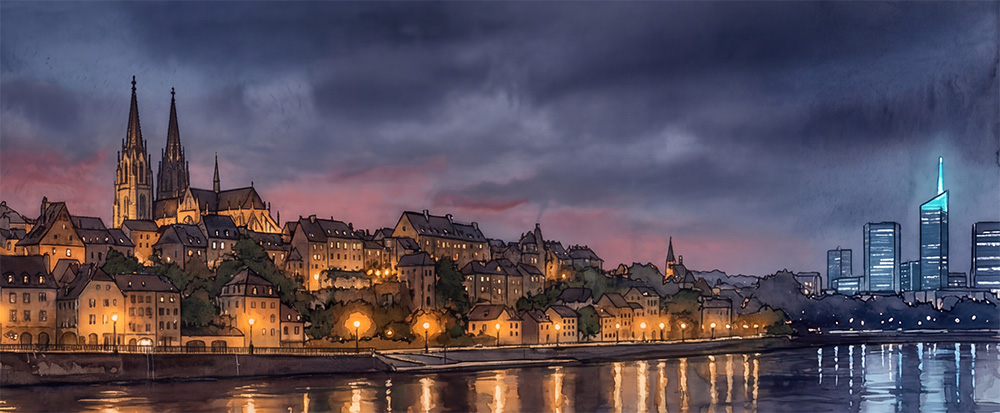
Bliss Technologies Applied Research Division — Meridian District
At 2:47 AM, the east wall of the loading bay buckled inward.
The shaped charge punched a hole two meters wide, and before the dust had crossed the hallway, figures were through it — dark gear, no insignia, moving in a formation that was military-grade but not military. Private. Expensive.
Bliss security responded in eleven seconds. The facility’s automated defense grid responded in four. The hallway between the loading bay and the first checkpoint became a place no one wanted to be.
Four floors above, behind three locked doors and a biometric seal, the alarms registered as a low vibration in the walls. Dr. Lena Voss set down her coffee and pulled up the security feeds. Her hand was steady. She’d run evacuation drills twice a month since arriving at this facility, and the coffee was still hot, and she intended to finish it.
The feeds showed smoke, tactical lights, the staccato flicker of suppressive fire. Whoever was breaching hadn’t touched the server rooms. They were pushing up the east stairwell toward the observation labs.
Toward her floor.
“Containment protocol,” she said.
Her assistant moved to the console. On the screens behind him, eight enclosures showed eight subjects. Seven were dark — dormant, sedated, the biological systems idling in regulated sleep. One was not.
In the eighth enclosure, a small shape was pressed against the glass wall, watching the hallway lights flash red.
Subject 7 was awake.
Voss had thirty seconds to initiate hard lockdown. She used twenty-eight of them on the feeds, assessing, calculating which assets the intruders would prioritize. The enclosures locked. The redundant seals engaged.
What she couldn’t see — what the corridor cameras had already lost to smoke — was the pressure wave from a second charge hitting the stairwell door one floor below. The vibration traveled through concrete, through steel framing, through the bolts anchoring the enclosure racks to the floor.
Enclosure eight had been flagged for maintenance on its secondary latch. The work order was in the system. It had been there for six days.
The vibration, the latch, six days of deferred maintenance. That was all.
The secondary latch failed. The primary held — but the glass panel flexed outward at its base, opening a gap of perhaps five centimeters. Wide enough for a hand. Not wide enough for a body.
Subject 7 weighed six hundred and thirty grams.
Four seconds to find the gap. Two seconds to compress its body through — ribs flexing, dense fur compacting, the skull with its hard ridge at the base turning sideways to clear the frame. The edge of the glass caught its shoulder. The pain was new — not the dull pressure of a blood draw or the cold of a sensor probe, but bright, sharp, specific. Blood on golden fur.
It dropped to the lab floor, crouched low, ears flat, and ran.
Not toward the intruders, not toward the security team. Toward the maintenance corridor it had watched technicians use for four months. Through the utility passage. Past the vent stack. To the ventilation panel on the east wall — a service access that opened onto the building’s exterior, latched from the inside.
The creature looked at the latch. A handle, a twist mechanism. It had watched hands operate latches for four months.
It reached up, gripped the handle, and turned.
The panel swung open. Night air hit it — rain and river and diesel and a hundred thousand lives being lived in the dark. Its eyes — amber, wide, all pupil — saw distance for the first time. Not the ten meters of an enclosure. Distance that went on and on, lights receding into nothing, the sky an impossible black depth.
It climbed through the panel. The exterior wall of the building was a grid of pipes and cable runs, and three meters to the right, a maintenance ladder descended to the access road. The creature reached the ladder and went down — fast, hand over hand, the rain slicking the rungs, its wounded shoulder burning.
At the bottom, it dropped the last meter to wet asphalt. Crouched. The city was enormous and dark and loud and nothing in its four months of existence had prepared it for any of this.
Then the building behind it made a deep structural sound — something giving way — and Subject 7 ran into the dark.
2. Three Languages
Little Hanoi — The Warrens
The apartment was on the fifth floor, and on mornings when the window was open, Linh could hear three languages before her feet hit the cold tile.
Vietnamese from the phở shop below, where Bà Nội, her grandmother, had been since four-thirty. Turkish from the Yilmaz place across the alley, Mr. Yilmaz arguing with a supplier the way he did every Tuesday and Thursday. Portuguese from the Brazilian family on the third floor, their radio tuned to a station that didn’t exist anymore but still played cached music through the building’s patchy network.
She lay in bed and listened. The languages braided together with the market sounds rising from the street — cart wheels on broken pavement, the hiss of the noodle steamers, someone calling a name she couldn’t quite hear. This was the sound of a place that was still alive, and she tried to feel grateful for it rather than restless.
She didn’t succeed.
“Linh.”
Tâm’s voice from the kitchen. Not loud — he never raised his voice in the apartment — but with the particular flatness that meant he’d already called her once.
“I’m up.”
“You’re not up. I can hear you lying there.”
She swung her legs off the bed. The tile was freezing. The heating had been unreliable since October, and Bà Nội’s solution was more blankets and less complaining. Linh pulled on her school uniform — grey skirt, white blouse going yellow at the cuffs, the blue sweater that had been Tâm’s before it was hers — and found her shoes under a pile of drawings she’d pulled from her notebook and spread across the floor. Studies of the cat that lived behind the dumpster on Lê Lợi Street. She’d been trying to get the ears right. Cats’ ears did more than people thought.
In the kitchen, Tâm was already dressed, already eating, already checking something on his phone. His school bag was packed and by the door. His jacket — the one with too many pockets, the one that made him look like he was expecting to repair something at any moment — was hanging on the hook where their father’s coat used to hang.
He’d made congee. Two bowls, one covered for Linh, the other half-empty in front of him. The rice cooker ticked.
“Bà Nội left early,” he said without looking up.
“She always leaves early.”
“Earlier than usual. Mrs. Nguyen’s sick, so she’s covering the whole morning shift.”
Linh sat down and pulled the bowl toward her. It was good — Tâm’s congee was never as good as Bà Nội’s, but he’d learned the basics and he made it without being asked, and she’d stopped pointing out the difference two years ago.
On the refrigerator behind him, Bà Nội’s rules were posted in Vietnamese on a sheet of paper that had been there so long the tape had yellowed:
Shoes off at the door. Homework before screens. Dinner together. Temple on Sundays. Call if you will be late. Do not make me worry.
The last line was underlined twice.
“You have practice today?” Linh asked.
“Babić wants me at the shop after school.” Tâm pushed his glasses up. He was frowning at his phone — not at a message but at something on the screen that looked like a grid of colored lines. “I’m stuck on the second layer of his mesh test. He’ll be annoyed.”
“Tell him it’s hard.”
“He knows it’s hard. That’s why he gave it to me.” He pocketed the phone. “You?”
“Nothing.”
“Straight home then.”
It wasn’t a question. It was never a question. Tâm tracked her the way the building’s old cameras tracked the hallway — not because he suspected anything, but because the habit had become part of how they held things together. He knew where she was. He needed to know. This was their life since their father had walked into a Bliss Haven three years ago and sat down in a chair and put on a headset and never walked back out.
Linh ate her congee and didn’t argue, because arguing about the straight-home thing never changed anything and she was going to take the long way regardless. She’d been taking the long way home since she was ten. Tâm knew. He pretended not to.
“I’ll text you when I’m leaving school,” she said, which was their deal. She’d tell him when she left. She wouldn’t say which route.
He nodded. Close enough.
They walked to school together, which meant Linh walked and Tâm walked slightly ahead and to her left, between her and the street. He’d been doing this since he was thirteen. She’d noticed and never mentioned it.
The morning Warrens was a sensory event. Steam from the phở shops, the sweet-grease smell of bánh mì carts, Mr. Yilmaz’s spices from across the street competing with the fish stink drifting up from the harbor. The market on the main road was already open — vendors setting up under awnings, the old men arranging themselves at the chess tables in the park like they’d never left. Mrs. Trương, who sold fruit from a cart and knew everyone’s business, called out to them.
“Tâm! Tell your grandmother I have the dragonfruit she wanted.”
Mrs. Trương’s cart was the center of the market’s information economy. She sold mangoes and gossip in equal measure, and her position at the market’s main crossroads meant she saw every face that came through. The kids from the Square — the loose network of children who worked the market running messages, watching stalls, knowing everything — orbited her cart the way satellites orbit a planet.
Tâm raised a hand in acknowledgment. Linh waved with the hand that wasn’t holding her notebook.
The school was eight blocks away, which in the Warrens meant eight blocks of alley shortcuts, market detours, and the particular navigation required when buildings had been added to and built over so many times that the street grid was more of a suggestion. Linh knew every shortcut. She knew which alleys had cats and which had rats and which had the old man who fed pigeons from his window and whistled songs she didn’t recognize.
At the intersection of Lê Lợi and the market road, she stopped.
A beetle was making its way across a crack in the concrete. Small, black-green, its carapace catching the morning light. It had reached a gap where the sidewalk had shifted and was navigating the edge, one careful leg at a time, testing the surface before committing.
Linh crouched and opened her notebook.
“Linh.”
“One second.”
“We’re going to be late.”
“We won’t be late.” She was already sketching — the beetle’s shape, the angle of its legs, the crack it was negotiating. She drew fast, the pencil moving in short confident strokes. The beetle didn’t notice or didn’t care.
Tâm stood over her, backpack straps in both hands. He didn’t rush her. He’d learned that rushing was slower than waiting, because she’d argue and the argument took longer than the drawing.
“It’s trying to get across,” she said.
“It’s a beetle.”
“It’s figuring it out. Look — it won’t step on the part that crumbles. It tested it and now it goes around.”
“We’re going to be late.”
She finished the sketch — quick, rough, the kind she did when she was catching something she might not see again — and stood up. The beetle reached the other side of the crack. She watched it disappear under a bottle cap and felt the small private satisfaction of having been the only person to witness that crossing.
Tâm was already walking.
She caught up and fell into step beside him, notebook in one hand, the other holding her backpack strap. The school appeared at the end of the block — Warrens Comprehensive, a building that had been a factory and then a warehouse and then a school, its architecture reflecting all three careers. Half the windows were lit. Last year, all of them had been.
“Straight home,” Tâm said at the gate.
“I heard you the first time.”
“Straight home, Linh.”
She gave him the look — the one that said I love you and you’re ridiculous and I will do exactly what I want — and went inside.
3. The Sound in the Alley
The school day was a school day. Math that she was good at and didn’t care about, science that she cared about slightly more, literature that she loved because the teacher, Mrs. Okafor, read poems aloud and made them sound like they mattered. Lunch in the half-empty cafeteria with Hoa, who was her closest friend by default because most of the other girls in her year had moved or drifted or transferred to schools in Ashfield that had working heating.
Hoa talked about a show she’d been watching on her Companion — one of the Bliss-produced series that ran inside the entertainment layer. Linh didn’t have a Companion. Bà Nội didn’t allow Bliss devices in the apartment. This made Linh unusual at school and invisible in most conversations about entertainment, which was most conversations.
“You’d like it,” Hoa said. “There’s an artist character. She draws everything.”
“Sounds good.”
“I can get you a guest pass. My parents wouldn’t care.”
“Bà Nội would care.”
“Bà Nội doesn’t have to know.”
Linh shrugged, which was easier than explaining the thing she couldn’t quite say — that the things she wanted to draw were here. In the cracks and the cats and the way the light fell through the gap between buildings at four in the afternoon. She didn’t want to draw things on a screen. She wanted to draw things that were real, and then she wanted someone to look at her drawings and see what she’d seen.
She didn’t have that person. She had Hoa, who was kind and talked about shows. She had Tâm, who would say “that’s good” without looking. She had Bà Nội, who would say “very nice, eat your dinner.”
The bell rang. She packed her bag and said goodbye to Hoa and walked out the school gate and turned left instead of right.
The long way home went through the back alleys behind the market, past the loading docks where the delivery trucks came in from Driftwood, along the canal path that smelled like rust and rain, and then through the maze of residential alleys that connected Lê Lợi Street to the park. It added twenty minutes. Tâm would text at 3:45 and she’d text back on my way and he wouldn’t ask which way.
She walked slowly. The afternoon light was doing the thing it did in the Warrens at this hour — coming in low between the buildings, hitting the west-facing walls so the brick turned amber and the laundry on the lines above glowed like flags. She stopped twice. Once to draw a pipe joint where three different plumbing systems had been connected over decades, the joints visible like layers of rock. Once to watch a woman on the second floor hang sheets while singing something Linh couldn’t identify.
She was on Lê Lợi, three blocks from home, when she heard the sound.
A single note — rising, musical, with a quality she couldn’t place. Not a bird. She knew the birds in this alley: pigeons, the occasional crow, the starlings that nested in the air conditioning units. This was none of those. This was a sound made by a throat that was trying to ask something.
She stopped walking.
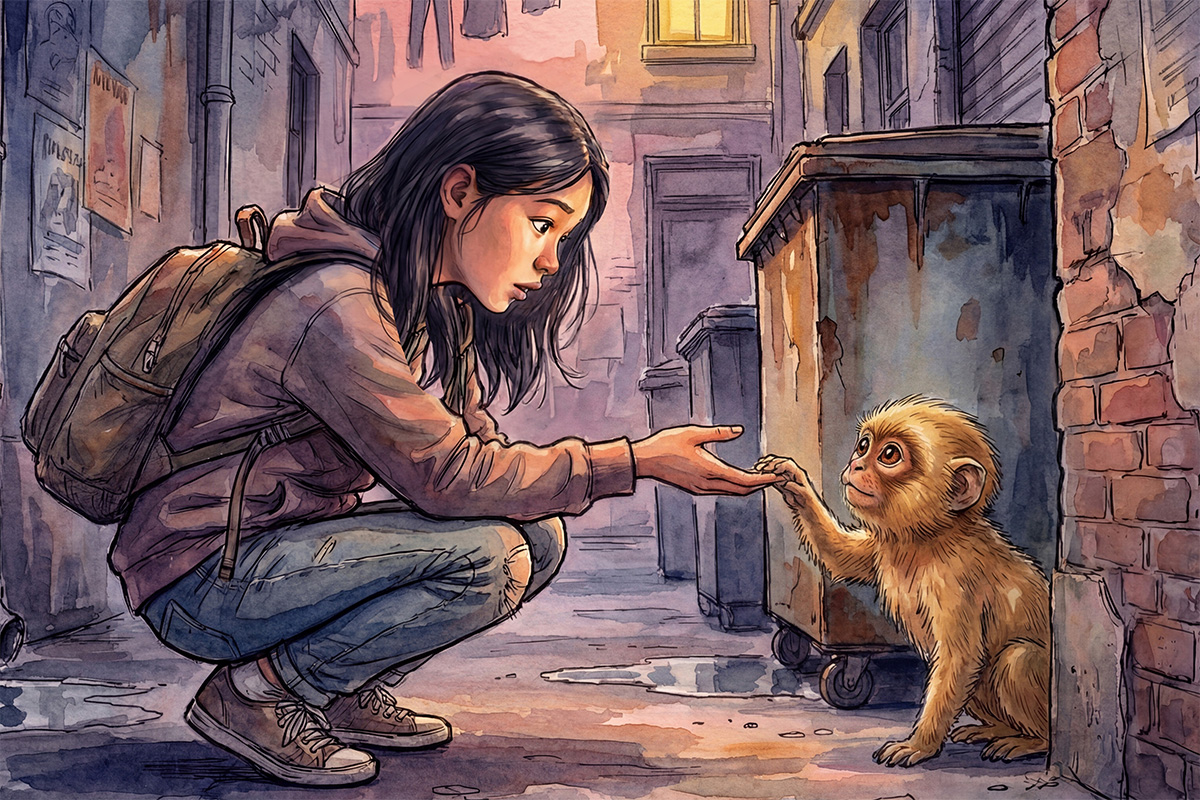
The alley to her right was narrow — two meters between a tenement wall and the back of the market building. A dumpster halfway down, green, rusted at the bottom. Pipes running along the wall. The ground wet from the morning’s rain, a puddle reflecting the strip of sky above.
The sound again. Higher, shorter. Not a song. A question.
Linh stepped into the alley.
She moved the way she moved when she was approaching the cat on her block — slowly, weight on the balls of her feet, making herself smaller. Behind the dumpster, in the gap between its rusted side and the brick wall, something was alive.
She crouched.
It was small — smaller than a cat, bigger than a rat. Golden-brown fur, matted and damp. It was pressed into the corner where wall met ground, body drawn tight, tail wrapped around itself. She could see ribs through the fur. It was shaking — a fine, constant tremor she recognized from the strays she’d fed in winter. Cold. Exhaustion.
Then it turned its head and looked at her.
The eyes were amber. Large, round, set in a face that was flat and soft — not a rat’s face, not a cat’s face. Something else. A mane of golden-brown fur framed features she didn’t have a word for except open. A small damp nose. A mouth shaped in a way that wasn’t quite smiling, wasn’t quite anything.
But the eyes.
She’d looked at a lot of animals. She’d drawn them, studied them, spent hours watching the way a pigeon’s gaze tracked movement and a cat’s gaze tracked intent. She knew what animal eyes looked like. She knew the flatness of them — the way an animal’s attention slid across you, assessing for threat or food, never settling.
This animal’s eyes settled. They found hers and they stayed.
Something behind the eyes was looking at her. Not assessing. Looking. The way a person looks at another person when they’re deciding whether to be afraid.
Her heart was going fast. Her hands were steady. She extended her right hand, palm up, fingers slightly open, and held it low between them.
“Hey,” she said. “It’s okay.”
The creature’s ears moved — small, rounded, flattened against its head. One lifted toward her. The other stayed flat, monitoring behind.
“You’re hurt,” she said. She could see it now — on its shoulder, through the golden fur, a dark gash. The fur around it was matted with dried blood. The wound was real and recent and it looked like it had come from something sharp, not something with teeth.
The creature was still looking at her. The trembling had slowed. Not stopped — slowed.
She held her hand steady. Between her fingers and the creature, maybe fifteen centimeters.
“I’m not going to hurt you,” she said.
The creature extended one hand.
Not a paw — a hand. Small, with four slender fingers and a shorter opposing digit, the kind of structure she’d seen in pictures of primates in her biology textbook. But the motion wasn’t a monkey’s quick grab. It was slow. Deliberate. The fingers spread slightly as they reached toward hers, the way you reach toward someone when you’re not sure they’re real.
Its fingers touched her palm.
The touch was light and warm. Not a grasp. A contact. Its fingers rested against her skin and it looked at her face while it touched her hand, and the thing in its eyes — the thing that was not animal — held steady.
Linh didn’t move. The alley was quiet. Dusk light fell between the tenement walls and turned the puddle on the concrete into a mirror of the sky.
“Okay,” she whispered. “Okay.”
She reached into her backpack with her free hand and pulled out the remains of her lunch — half a bánh mì, wrapped in paper. She tore a piece and held it out.
The creature took it with both hands. Ate in small, precise bites, holding the bread the way a person holds a piece of fruit — not wolfing, not snatching. Eating carefully, like someone who hadn’t eaten in a long time and knew not to rush.
When it finished, it looked at her again. The trill came from its throat, softer now. Not a question about who she was. A question about what happened next.
Linh looked at the creature. The wound. The ribs. The eyes that looked at her the way nothing had ever looked at her.
She unzipped her backpack and held it open.
“Come on,” she said.
The creature looked at the backpack. Looked at her. Looked at the backpack.
Then it climbed in.
The weight settled against her back — warm, solid, heavier than she expected. Its tail came through the half-open zipper and curled around her wrist once before tucking inside. She zipped the bag most of the way, leaving a gap at the top for air.
She stood up. Adjusted the straps. Her heart was hammering so hard she could feel it in her teeth.
She walked home trying to look normal. The creature’s head poked up once — she pushed it gently down. It trilled, softer. A question becoming a statement.
4. The First Night
The apartment was empty. Bà Nội wouldn’t be home until six. Tâm was at Babić’s until five-thirty. She had ninety minutes.
She locked the front door — Tâm’s habit, now hers — and went straight to her room. She closed the door, set the backpack on the bed, and unzipped it.
The creature emerged slowly. Head first — the round face, the amber eyes blinking in the light. Then the body, golden-brown, the mane ruffled from the bag. It sat on her bed and looked around.
It looked at everything.
Not the way a cat does, scanning for threats and high ground. Its gaze moved across the room and stopped on things. The window. The desk. The drawings pinned to the wall above her bed — cats and beetles and pipe joints and faces. It looked at the drawings for a long time. Its head tilted. One ear forward, one to the side.
Then it looked at the window.
The late afternoon sky was visible through the glass — amber fading to blue, the silhouette of the tenement across the alley, a clothesline with shirts in the wind. The creature climbed down from the bed and crossed to the windowsill — no hesitation, no false steps, the movements of something that had mapped the distance in the time it took to look — and pressed both hands flat against the glass.
It stayed like that. Both palms flat, face close, watching the sky change color.
Linh sat on the edge of the bed and watched.
She got the first-aid kit from the bathroom — the basic one Bà Nội kept under the sink. Antiseptic, gauze, tape. She sat on the floor near the window.
“I need to look at your shoulder,” she said.
The creature turned from the window. Looked at the kit. Looked at her hands. Looked at her face.
Then it climbed down and sat in front of her and turned its wounded shoulder toward her.
The wound was a clean cut, maybe four centimeters, through the fur and into the skin beneath. She cleaned it with antiseptic. The creature flinched — a small full-body tightening — but didn’t pull away. It held still and watched her hands with an attention that felt like it was measuring her work.
She taped a small gauze pad over the cut. The creature touched the bandage with one hand, feeling the edges. Then it looked at her and trilled — the soft rising note — and put its hand on top of hers.
She sat on the floor of her room with a creature she couldn’t name holding her hand, and she smiled, and her eyes were wet, and she didn’t know why.
She gave it water in a small bowl. It drank carefully, both hands on the bowl’s edge, a sip at a time. She gave it the rest of the bánh mì and a segment of the orange from her bag. It turned each orange segment in its fingers, examining the membrane before biting through.
Then it began to investigate. It opened the drawer of her desk and looked at the contents. Pencils, erasers, a ruler. It picked up a paper clip, turned it over, bent it slightly, put it back. Found the drawer with her notebooks, opened one, looked at the blank pages, put it back. It found the latch on her window and tested it — pushing, pulling, then lifting. The latch rose. The creature looked at the open window, at the outside air coming in, and carefully lowered the latch again. Closed.
Linh watched all of this. The latch especially. It had taken it four seconds to figure out a mechanism it had never seen.
She was drawing. She had her notebook open and she was drawing the creature — its shape on the edge of the desk, the light from the window behind it. She got the body right, the proportions, the mane and tail and small hands.
She couldn’t get the eyes right.
She tried three times. Each time, the shape and size were correct. But the thing she’d seen in the alley, the thing that had stopped her — she couldn’t transfer it to the page. It was like trying to draw the difference between a window and a mirror. The shape was the same. What was behind it was everything.
A sound from the kitchen. Linh went rigid.
The front door opening. Keys on the hook. Footsteps — Bà Nội’s footsteps, the shuffle-step of a woman who’d been on her feet since before dawn.
The creature heard it too. It went still on the desk — absolutely still. Its ears flattened. Its tail curled tight.
“Linh? You’re home?”
“Yes, Bà Nội!”
“Good. Come help me with the bags.”
Linh looked at the creature. The creature looked at her. She put her finger to her lips — a human gesture, automatic — and the creature went silent in a way that felt like agreement.
She closed her bedroom door and went to help with the groceries.
In the kitchen, Bà Nội was unpacking vegetables. She was smaller than Linh remembered, which was impossible, but there were days when her grandmother seemed to be getting compressed by everything pressing down on her — the shop, the bills, the grandchildren, the world.
“Mrs. Nguyen’s fever is worse,” Bà Nội said. “I’ll go back tonight to help with the evening prep.”
“Okay.”
“There’s soup in the pot from this morning. Heat it for you and Tâm.”
“Okay.”
Bà Nội looked at her. The look she gave when she was reading something in Linh’s face.
“You look flushed. Are you getting sick?”
“No. I walked fast.”
Her grandmother held her gaze a beat longer, then turned back to the vegetables. “Eat the soup. Both of you. Don’t let Tâm skip.”
“I won’t.”
From behind Linh’s closed door, no sound at all.
Tâm came home at five forty-five and found Linh sitting on the floor of her room with the door closed, which was normal, and a creature the size of a large kitten sitting on her desk examining a pencil, which was not.
He stood in the doorway. His backpack was still on. He’d come straight from Babić’s — his fingers had the stains they always had after a day of handling components, and his jacket pockets were bulging the way they did when Babić sent him home with spare parts to practice on.
His face went through several things quickly — confusion, alarm, a hard look at the bedroom window and then the front door — and arrived at a single word.
“No.”
“Tâm—”
“Absolutely not.”
He stepped in and closed the door. The creature looked up from the pencil and regarded him with the amber eyes. It didn’t flinch. It set down the pencil and watched him.
“What is it?” he said.
“I don’t know.”
“Where did you find it?”
“The alley behind the market. Near Lê Lợi.”
“It’s — what is it, some kind of monkey?”
“I don’t know. It’s hurt. Look.” She showed him the bandage. “Something cut it. Not an animal bite. Something sharp and clean.”
Tâm crouched, keeping his distance. He looked at the creature the way he looked at a component he was troubleshooting — testing connections, checking for damage. The creature looked back.
“It can’t stay here,” he said.
“It’s hurt.”
“I can see that. Bà Nội will—”
“Bà Nội’s going back to the phở shop tonight. Mrs. Nguyen is sick.”
“That doesn’t—”
“One night,” Linh said. “One night, and tomorrow we figure it out.”
Tâm pushed his glasses up. He was quiet for a moment, running through options the way he always did — what could go wrong, how to contain it.
“One night. It stays in your room. Door closed. If Bà Nội comes back early, it goes in the closet. Tomorrow we take it to Dr. Vasquez at the community clinic.”
“It’s not a dog, Tâm.”
“No, it’s a monkey. And don’t name it.”
The last part came out fast, almost before she’d said anything. He was looking at her face and he could already see it happening.
“I’m serious. Don’t give it a name. Names make things yours. It’s a stray monkey and tomorrow it goes to Vasquez.”
“Okay,” Linh said.
He left the room. She heard him in the kitchen, reheating the soup, checking the locks on the front door. The locks clicked twice — he always checked them twice.
The creature was watching the door he’d closed. One ear forward, one back. Then it turned to her and trilled — the soft question — and reached for the pencil it had set down.
It picked the pencil up. Looked at her notebook, open on the floor to the page where she’d been drawing it. Looked at the pencil.
Then it climbed down from the desk, crossed to the notebook, and made a mark.
Linh didn’t breathe.
A line. Short, deliberate, angled. The creature adjusted its grip — three fingers and the opposing digit, clumsy but working — and made another line. And another.
It was drawing the window. The rectangle of the frame. The shape of the sky it had pressed its hands against an hour ago. The lines were crude and the proportions were off and it didn’t matter, because the creature looked at the page with an expression she recognized.
She wore it herself, every time she couldn’t get the eyes right.
She sat on the floor beside it, very close, and watched it draw.
She slept with it on the pillow beside her head.
She’d made a nest in the bottom drawer of her desk — a folded towel, a square of the soft cloth Bà Nội used for wrapping bánh chưng. The creature had investigated the nest, turned around in it twice, and climbed out. It climbed the blanket, crossed the pillow landscape, and settled in the space between Linh’s pillow and the wall.
Its tail curled loosely around her wrist.
She lay in the dark and listened to it breathe. Small breaths, rapid. In the dark, with the streetlight filtering through the curtain, she could see the creature’s shape on the pillow and something at its ears — the thin translucent tissue catching the light differently than it should. A warmth in the skin that wasn’t quite a glow. She stared until her eyes adjusted and then she wasn’t sure she’d seen it at all.
The creature’s hand tightened once on her wrist. A sleep-motion. Fingers flexing and holding, the way a child’s hand finds something in the night.
Tomorrow, Tâm would want to take it to Dr. Vasquez. Tomorrow, the right thing, the responsible thing.
She closed her eyes. The creature breathed beside her.
She fell asleep faster than she had in months.
5. Specimens
In the morning, two things happened.
The first: Linh woke to find the creature on the windowsill again, watching the dawn. It had been awake for a while — she could tell from how it sat, calm and settled. It was watching the clothesline across the alley. A woman was hanging laundry — sheets, a child’s shirt, dark trousers. The creature was watching the woman’s hands, the rhythm of the work. Studying it. Not the way a cat watches movement. The way someone watches a person do something they’ve never seen done before.
The second: Tâm knocked on her door at six-thirty and said, “We need to leave in twenty minutes,” and when she opened the door he was holding his phone with a news alert.
Bliss Technologies confirms security incident at research facility. No public safety risk. Company offers reward for return of laboratory specimens.
She read it twice.
“Laboratory specimens,” she said.
“There’s a reward. Five thousand credits.”
They looked at each other. Behind Linh, on the windowsill, the creature turned from the dawn light and looked at both of them.
“We’re still taking it to Dr. Vasquez,” Tâm said.
“After school.”
“After school. Don’t—”
“I know. Don’t name it.”
He gave her a look. She kept her face neutral.
They ate breakfast. Linh fed the creature in her room — rice from her bowl, a piece of the banana Bà Nội had left. It ate with the same careful precision. When she went to get her bag, it watched her. When she picked up the backpack, it climbed off the windowsill and stood at her feet, looking up.
“I can’t take you to school,” she said.
It looked at the backpack. Looked at her.
“No. Stay here. I’ll come back.”
She closed the bedroom door. In the hallway, she paused. Through the door, the trill — the rising note. The question.
She pressed her palm against the door for a moment. Then she left.
The school day was long and she drew nothing. She sat through math and science and Mrs. Okafor’s class without hearing any of it, her notebook open to a blank page. She was thinking about the creature’s eyes. About the way it had drawn the window. About the news alert — laboratory specimens — and the wound on its shoulder that was clean and sharp and not from anything with teeth.
At lunch, Hoa talked about something. Linh nodded at the right times.
“You’re somewhere else today,” Hoa said.
“Sorry. Didn’t sleep well.”
After school, she met Tâm at the gate. He was coming from the direction of Market Square — he’d stopped at Babić’s on the way. His expression was the one he wore when he’d been thinking all day and hadn’t liked the conclusion.
“I got through the second layer,” he said.
“Of what?”
“Babić’s mesh test. The security thing. I cracked the second layer during lunch, on my phone. Two down, two to go.” A brief flash of something — pride, excitement — before he buried it. “Anyway. We go home, we get the monkey, we take it to Vasquez before Bà Nội’s back.”
“Okay.”
“Linh.”
“I said okay.”
They walked. The afternoon was grey, the light flat, no amber on the walls today. They were on Lê Lợi, two blocks from home, when Tâm stopped.
A van was parked on the street.
Dark grey, unmarked. Not a delivery vehicle — too clean, no markings, parked where vans didn’t park. Between the tenement entrance and the alley where Linh had found the creature. A man stood beside it — tall, shaved head, heavy coat. He was holding a tablet, looking at the screen, then at the buildings, then at the screen. His movements were unhurried. Patient. The patience of someone with resources and time.
Tâm’s hand found Linh’s arm.
“Walk,” he said. Quiet. The word that meant don’t run, don’t look, just walk.
They crossed the street. She didn’t look at the van. Didn’t look at the man.
They turned the corner, went into the stairwell, and went up fast. Fifth floor. Door. Keys. Inside.
Linh went straight to her room.
The creature was on her desk, exactly where it had been that morning. But it wasn’t watching the window. It was pressed flat against the desk surface, ears down, body rigid. The trembling from the alley was back.
“It’s scared,” Linh said.
Tâm was at the living room window, looking down at the street. “The van’s still there. The guy with the tablet is heading toward the market.”
“Tâm, it’s scared.”
He came to the bedroom door and looked at the creature. It was watching him, eyes wide, body tight. It looked past him — toward the front door, the hallway, outside.
Then it looked at the backpack on Linh’s bed.
It looked at the backpack the way it had looked at her hand in the alley. With a request it couldn’t say.
“No,” Tâm said. “We’re not running.”
“I’m not leaving it here for them to find.”
“We don’t know they’re looking for it.”
“Laboratory specimens. A reward. A van with somebody scanning our street.” She was already clearing out her school things, making room in the bag. “A cut on its shoulder from something surgical.”
Tâm was quiet.
“Where,” he said.
She didn’t have an answer.
“School,” she said. “We left something at school. That’s what Bà Nội hears if she calls.”
“And really?”
“I don’t know yet. Not here.”
The creature climbed off the desk and crossed to the backpack and climbed in.
Tâm watched it settle into the bag. Watched its tail curl through the zipper gap. He pushed his glasses up.
“I check the route first,” he said. “Back stairs. Not Lê Lợi.”
The back stairs smelled like cooking oil and concrete. Tâm went first. At the ground floor, he checked the alley exit. Clear.
They moved through the back alleys — a different path, one that avoided Lê Lợi entirely. Through the gap between the laundry and the hardware store. Past the courtyard where the old men played chess, empty now. Along the wall of the temple — Chùa Từ Bi, the incense smell drifting over the wall.
At the corner of the market road, Tâm stopped.
A second van. Same dark grey. Different street.
“Two of them,” he said. His voice was flat. Not afraid — working through it. “Two vans means they’re covering the blocks.”
“Can we go around?”
He pulled his phone out — not for calls, for the mesh analysis tool he used at Babić’s. The screen showed the local signal traffic, the background noise of the Warrens’ independent mesh network. Among the normal signals, something else. Clean. Strong. Encrypted with a carrier signature he didn’t recognize.
“They’re running active sweeps,” he said. “Probably biological — heat signature, movement. Looking for something small and warm.”
“Can they find it through the bag?”
“Through fabric? Probably.” He put the phone away. “The market. Through the crowd. Too many bodies, too much heat. They can’t isolate a single signature in that.”
They walked into the market. The afternoon sellers were out — fruit carts, a bánh mì stand, the woman who sold phone cases from a blanket on the ground. The crowd wasn’t thick but it was there, bodies and bags and movement, and Tâm kept Linh in the middle of it, moving at the pace of the shoppers.
At the far side, where the market road met the park, Linh saw the man.
Standing by the chess tables. Same build as the one by the van — tall, heavy, the posture of someone looking for something specific. He was scanning faces. Not aggressively. Patiently.
His gaze passed over them and moved on. Two kids with a backpack. Nothing.
They went through the park, past the temple wall, into the residential blocks beyond. Walked for ten minutes without speaking. The creature was silent in the bag, its weight against Linh’s back the only proof it was there.
They ended up at the loading dock behind the school — the empty space where the supply trucks came, deserted after hours. Tâm checked the alleys. Checked his phone.
“Clear,” he said. “For now.”
Linh sat on the loading dock and took the backpack off and unzipped it. The creature emerged into the grey light, looked around, and climbed into her lap. Its hands found her shirt and held on. Its face pressed into the hollow below her collarbone.
The trill — barely audible. Not a question this time. The sound something makes when it has been afraid and is not alone.
Tâm sat beside them. Elbows on his knees, phone in his hands. He looked at the creature in his sister’s lap — the golden fur, the wound under the bandage, the way its hands gripped her shirt. He looked at the news alert still open on his screen.
“One night,” he said finally.
Linh held the creature and didn’t answer. They both knew one night was already over.
“We’re not taking it to Vasquez,” he said. Not a question.
“No.”
He pushed his glasses up. Rubbed his face with both hands. Looked at the sky, which was going dark early, clouds rolling in from the harbor.
“Then we need to figure something out,” he said. “Because there are people with vans and gear sweeping our neighborhood, and whatever this is”— he gestured at the creature in her lap — “it’s worth five thousand credits to Bliss and I’m guessing it’s worth a lot more than that to whoever else is looking.”
“You think there’s someone else?”
“Two different signal types. Two different groups. One of them is Bliss — their carrier frequency matches what Babić’s shown me from the Meridian broadcasts. The other is something I haven’t seen.”
The creature’s grip on Linh’s shirt loosened. Its breathing slowed. Its tail found her wrist and curled around it once, twice.
It fell asleep.
Linh pressed her face against the top of its head. Its fur smelled like rain and antiseptic and something warm underneath, like new electronics out of a package.
She was twelve years old and she didn’t have a plan. But she had this. This weight. This warmth. These eyes that had looked at her in an alley and seen her and decided she was safe.
“We go back after dark,” Tâm said. “When the vans are gone.”
They sat on the loading dock and waited for night.
6. What It Knew
They went back to the apartment after dark, when the vans were gone.
Tâm checked the street twice before they approached. The creature was asleep against Linh’s back, its breathing a faint warmth through the fabric. They went in the back entrance, up the stairs, into the apartment. Bà Nội was at the phở shop for the evening shift. The apartment was dark and smelled like the soup she’d left on the stove.
“Eat,” Tâm said.
“I’m not hungry.”
“Eat anyway.”
He sat at the kitchen table with his phone and a charging cable he’d taken from Babić’s inventory without exactly asking. The mesh analysis tool was open. He ran the capture log from the afternoon — the encrypted signals he’d picked up near the vans.
The Bliss carrier signal was clean and organized, expanding outward in a grid pattern. The second signal — the one he didn’t recognize — was different. Heavier. Fewer sources, but more aggressive. Two organizations sweeping the same four blocks of Little Hanoi.
He ate the soup cold while he worked. In the bedroom, Linh was talking to the creature in a voice too low to hear.
The first three days were about hiding, and about learning what they’d brought home.
Bà Nội left for the phở shop at four-thirty. Between then and seven, the creature had the apartment. It moved through the rooms with a careful, systematic attention that Tâm found harder to explain each day.
On the second morning, he came out of the bathroom and found it in the kitchen, sitting on the counter, examining the gas burner. Not touching — examining. Looking at the mechanism, the igniter, the gas line running to the wall. It turned its head and looked at him and the expression was so clearly I’m trying to understand how this works that he almost explained.
“Don’t touch the stove,” he said instead.
It didn’t touch the stove.
That afternoon, Linh said “are you hungry?” and the creature went to the cabinet where she kept the fruit. She said “not now, after homework” and it stopped. Sat down on the kitchen floor. Waited.
Tâm watched from the doorway.
“It understood you,” he said.
“I know.”
“Not just your tone. The words. You said ‘after homework’ and it waited.”
“I know, Tâm.”
He got three cups from the cupboard. Put a ball of paper under each one — white, blue, red. Shuffled them. The creature, watching from the floor, tracked his hands. He stopped.
“Where’s the red one?”
It tapped the middle cup. He lifted it. Red.
He shuffled again, faster. It tapped the left cup. Red.
He shuffled a third time, as fast as he could. The creature watched. When he stopped, it didn’t tap a cup. It looked at him. Then it pushed all three cups aside, picked up the red ball, and held it out.
Are we done with this?
Tâm took the ball. His hand was not steady.
On the third afternoon, he was at Babić’s. The shop was on Market Square — a narrow storefront packed floor to ceiling with components, circuit boards, tangled cable, and devices in various states of repair. The sign outside said BABIĆ ELECTRONICS — REPAIR & SUPPLY. It didn’t mention the counter-surveillance gear in the back room, or the mesh network repeaters stacked along the wall, or the fact that half the Warrens’ independent communication grid ran through hardware that Babić had built and maintained himself.
Babić was at the workbench when Tâm came in. He was a large man with thick forearms and reading glasses that sat on the end of his nose. His head was shaved. His accent was Ukrainian, and his English treated articles as optional.
“You are late,” he said, without looking up.
“I got through the second layer.”
Now Babić looked up.
“Show me.”
Tâm showed him. The mesh penetration test — the security exercise Babić had assigned him three weeks ago. Probe the mesh’s defenses, layer by layer. Find the vulnerabilities. Report back. Babić’s mesh was his pride — three layers of encryption protecting the Warrens’ independent network from corporate intrusion. He wanted it tested. He wanted it broken, so he could build it stronger.
Tâm had cracked the first layer in a week. The second had taken him two more.
Babić studied the screen. Nodded. “Is good. Method is clean. Second layer was supposed to be hard.”
“It was hard.”
“Third layer will be harder. Is built on same protocol Bliss uses for vehicle fleet — their corporate standard encryption. I license architecture, modify for mesh. Very strong.” He turned back to his workbench. “Same protocol, same bones. If you can break mine, you can break theirs. But you cannot break mine.”
“Yet,” Tâm said.
Babić almost smiled. “Yet. Go. Sort the capacitors in drawer seven. They are mess.”
Tâm sorted capacitors and thought about three-layered encryption and the two different signals sweeping his neighborhood, and didn’t mention any of it to Babić.
On the way out, he paused at the back room door. Through the gap, he could see Babić’s van parked in the service alley — a battered panel van with a roof antenna and, he knew, a mobile counter-surveillance suite in the back that Babić used for field maintenance on the mesh repeaters. The van was ugly and unremarkable and probably had more processing power than the school’s entire computer lab.
On the third evening, Tâm was changing the creature’s bandage when his fingers found something at the base of its ear. Small. Hard. Flat against the skin, under the fur. The creature flinched — not pain, sensitivity. It didn’t like being touched there.
“Hold still,” he said.
He parted the fur. A tiny rectangle, smaller than his thumbnail, flush with the skin. Etched into its surface: EC-07.
“Linh.”
She came and looked. The creature sat between them, its ears flat, its tail wrapped around Tâm’s wrist. It held on while they examined the tag.
“EC-07,” Tâm read. “A designation. A serial number.”
“EC,” Linh said. She turned the sounds over. “Oh seven.” She looked at the creature. “Eko?”
The creature went still.
Not the stillness of fear. Its head turned and it looked at Linh with the full weight of its gaze — the amber eyes focused in a way that made the hair on Tâm’s arms rise.
“Eko?” she said again.
It trilled. Soft. Not the question-trill. Something different. Affirmation. The sound of something being given a thing it didn’t know it needed.
“Eko,” Linh said, and the creature put its hand on her wrist and held on.
“It has a designation,” Tâm said. “Not a name.”
“It responded.”
“It responded to a sound. That’s what monkeys do.”
“Tâm.”
“Don’t make it into something it’s not.” He stood up. “It’s a lab animal. It has a serial number. Those people with the vans are looking for it and they’re not going to stop because you named it.”
He went back to his phone and the signal analysis and didn’t push further. Behind him, Linh held Eko against her chest and the creature’s eyes were closed and its hand was wrapped around her finger.
He could see the attachment setting. He couldn’t stop it. He called it “the monkey” in his head and knew he was losing.
On the fourth morning, Linh left her notebook on the desk while she showered. She came back to find Eko beside it with a pencil in its hand. It had drawn on the page.
Lines. Deliberate, angular. A rectangle — the window. Inside the rectangle, a shape that might have been the clothesline. Below it, a smaller shape. Round head, small body.
A self-portrait.
Linh sat on the bed and looked at the drawing. Then she picked up her own pencil and drew the window next to Eko’s version — her version, precise, proportioned. She showed it both drawings side by side.
Eko looked at hers, then at its own. Reached out and traced her clean lines with one finger. Then looked at its own hands. Turned them over. Flexed the fingers.
The frustration on its face was not animal.
That afternoon, Tâm left his phone charging on the kitchen table with the mesh analysis tool open. He came back to find Eko on the table, one hand on the screen, watching the signal readout. Its other hand was tracing the waveform patterns the way Tâm did when he was working.
“Don’t touch that.”
Eko looked at him. The expression wasn’t the soft look it gave Linh. This was specific, directed. The look of someone who knows what they’re looking at and is being told to stop.
On the fifth morning, Linh heard a sound from the bathroom. She found Eko on the sink, Tâm’s toolkit open beside it. It had removed a screwdriver and was tightening the loose screw on the cabinet handle — the one that had been rattling for months. It gripped the screwdriver with three fingers and the opposing digit, applying torque with a precision that was wrong for anything with paws.
It finished. Tested the handle. Solid. Put the screwdriver back. Closed the toolkit.
“You’ve been watching us,” Linh said.
Eko trilled. The soft one.
“You’ve been watching everything.”
It crossed the bathroom floor and stood at her feet and looked up at her, and what she saw in its eyes was not cleverness. It was attention. A mind that had been watching the rattling handle for five days and waiting for the moment it could fix it.
On the fifth afternoon, Tâm was stopped on the street.
He was walking with Linh. Eko was in the backpack — they’d been keeping it at the apartment but had started moving it between locations, never the same route twice, never staying long. They were heading for the park, where the benches under the trees gave cover and the crowd made scanning harder.
The man stepped out from a doorway on the cross street. Tall, heavy, shaved head. The same build as the men by the vans, but this one was closer — three meters away, blocking the sidewalk. His coat was expensive. His face had the flat patience of someone who did this for a living.
“Excuse me,” he said. The accent was German. “You live in this neighborhood?”
“Yes,” Tâm said.
“I am looking for animal. Small, like monkey. You see anything?”
Tâm kept his face neutral. Beside him, Linh had gone very still. In the backpack, Eko had done the same thing — the absolute stillness it used when it was hiding.
“No,” Tâm said. “What kind of monkey?”
“Research animal. Is lost. Very valuable.”
“Sorry. Haven’t seen anything like that.”
The man nodded. His eyes moved from Tâm to Linh to the backpack. Stayed on the backpack.
“Big bag,” he said. “For school.”
“We have a lot of homework,” Tâm said.
The man looked at the backpack. Linh could feel Eko’s weight against her back — warm, solid, not moving, not breathing louder than it had to. But alive. Detectably alive, if someone looked closely enough.
“May I see?” the man said. He took a step forward. Not aggressive. Polite. The politeness of someone who expected compliance.
“It’s just books,” Tâm said. “And my sister’s drawings.”
“One look. Is very quick.”
The man reached for the backpack strap. His hand was large and his fingers were close to Linh’s shoulder and Eko was six inches from those fingers and Linh couldn’t move.
“HEY!”
The shout came from behind them. Mrs. Trương, fruit cart and all, was rolling toward them with the momentum of a woman who’d spent forty years pushing a loaded cart through crowded streets.
“What are you doing? You are bothering these children!”
“I am only—”
“These are Bà Nội’s grandchildren! You leave them alone!”
Mrs. Phạm materialized from the vegetable stall two doors down. She was sixty-three, four foot ten, and had opinions about men who stood too close to children on the street.
“You! Man! What do you want with these kids?”
“I am asking about—”
“You are scaring them! Look at the girl’s face! What kind of person—”
A third voice — Mrs. Nguyen, coming out of the phở shop, wiping her hands on her apron. “Is there a problem? Tâm, are you alright?”
The man from Kessler’s team found himself in the center of a semicircle of women who were simultaneously concerned, outraged, and physically in the way. Mrs. Trương’s cart blocked the sidewalk to the left. Mrs. Phạm had positioned herself to the right. Mrs. Nguyen was directly behind the children, one hand on Linh’s shoulder.
“Go,” Mrs. Nguyen said to Tâm. Quiet. Under the noise.
They went. Through the gap between Mrs. Trương’s cart and the building, into the alley behind the phở shop, moving fast. Behind them, the three women closed the gap like water filling a hole.
They didn’t run until they turned the corner. Then they ran.
Four blocks later, in the stairwell of a building Linh didn’t recognize, Tâm leaned against the wall and breathed.
“He saw the backpack,” he said.
“I know.”
“He’ll remember us.”
“I know.”
In the backpack, Eko shifted. Its hand came through the zipper gap and found Linh’s wrist. Held on.
7. The Knife
That night, the argument.
They were in the kitchen. Bà Nội was asleep. The apartment was dark except for the light above the stove. Eko was in Linh’s room, the door closed.
“We have to tell somebody,” Tâm said.
“Tell them what?”
“That we found something. Something people are looking for. Something dangerous.”
“And they’ll take it.”
“Maybe they’ll take it somewhere safe.”
“Where? The police? Tâm, there are no police for this. There’s a number on the flyers and it goes to Bliss. They made it in a lab. They put a number on it.”
“We don’t know what—”
“We know it was cut open. We know it has a tag in its ear like a piece of equipment. We know people with gear are sweeping the neighborhood. What do we not know?”
“What it IS, Linh. We don’t know what it is. We don’t know why they made it. We don’t know what they want it for.”
“It draws pictures. It fixes things. It—”
“It’s a monkey.”
“Stop calling it that.”
“It IS a monkey. A monkey that someone put something inside of. A monkey that’s worth so much that two different groups are hunting for it in our neighborhood, where our grandmother lives, where WE live—”
“So we should hand it over because it’s inconvenient?”
“I didn’t say—”
“You’re saying get rid of it because it’s too hard. That’s what you’re saying.”
“I’m saying I can’t keep Bà Nội safe and you safe and that thing safe at the same time—”
“So stop trying to keep me safe. I didn’t ask you to.”
“Somebody has to.”
The words landed. Tâm heard them leave his mouth and knew what was underneath.
“Right,” Linh said. Her voice had gone flat. “Because Ba couldn’t.”
Silence. The refrigerator hummed. Bà Nội’s rules were posted on the door behind Tâm’s head. Do not make me worry.
“That’s what he did,” she said. Quieter. “When things got hard. He went somewhere easier.”
The silence after that was the worst sound in the apartment.
Tâm stood up. His jaw was tight and his hands were flat on the table and he looked at her and didn’t speak for a long time.
Then he picked up his phone and his jacket and went to the front door. Checked the locks. Checked them twice.
“I’m going for a walk,” he said, and left.
The door closed. His footsteps went down the hall and down the stairs.
Linh sat at the kitchen table with her hands flat on the surface. Her eyes were dry and her chest was full of something hot and wrong and she didn’t move.
From behind the bedroom door, a sound. The trill, but different — lower. A note she hadn’t heard before.
She went to the room. Eko was on the bed, looking at her. It had heard everything. It didn’t need the words to understand — it read the room, the voices, the silence after.
It climbed off the bed and crossed to her and placed both hands on her knee and looked up at her and made a sound that was halfway between the trill and something else. Not a word. But the shape of a word. The shape of it’s okay or I’m here.
She picked it up and held it against her chest and sat on the bed.
Tâm came back two hours later. He checked the locks. Twice. He didn’t come to her door.
On the sixth day, flyers appeared.
Professionally printed, posted on every lamppost and shop window in Little Hanoi. A photo of a pygmy marmoset — not quite right, a stock image, but close enough. Below it: Missing research animal. Valuable specimen. Reward for safe return: 10,000 credits. Contact Bliss Technologies Recovery Division. Note: animal may carry unverified pathogens. Do not handle directly.
Ten thousand credits. In the Warrens, that was half a year’s rent.
That afternoon, a woman came to the community center.
Tâm heard about it at Babić’s. He was working on the third security layer, the one built on the Bliss vehicle fleet protocol. He’d been hammering at it for two days and getting nowhere — the encryption reset every time he probed past the outer shell.
“European woman,” Babić said, adjusting a circuit board. “Swiss, I think. Very polite. She talks to the center director for one hour. Asks about the neighborhood. The families. The children. Wants to know if anyone has seen unusual animal.”
“What did the director say?”
“What can he say? He says he will keep eye out.” Babić looked at Tâm over his glasses. “Ten thousand credits. Is lot of money for monkey.”
“Yeah.”
“Lot of money. Lot of people looking. Two groups, from what I hear.” He turned back to his work. “You know, if someone finds such thing, smart thing is to hand over. Collect reward. Buy grandmother something nice.”
“Probably.”
“But people in this neighborhood are not always smart.” He set down his soldering iron. “Sometimes they are something else.”
He looked at Tâm for a beat longer than necessary. Then back to the board.
“Third layer,” he said. “You are close?”
“Getting there. The encryption resets when I probe past the shell.”
“Of course it resets. Is designed to reset. You are probing like is door to be opened. Is not door. Is conversation. You must talk to it in language it expects. Handshake protocol. Convince it you are authorized before you push.”
Tâm stared at him. “A handshake. The authentication sequence.”
“Now you are thinking. Go. Try. Come back when you break it or when you give up. I am hoping for first.”
Tâm went home. He worked on the handshake protocol until two in the morning. At 1:47 AM, the third layer opened.
For three seconds, before the system caught the intrusion and slammed shut, he saw the architecture behind it. The vehicle fleet protocol — the encryption that protected every Bliss corporate vehicle’s navigation, locking, and communication systems. He saw the structure. Three layers, same as Babić’s mesh. Same bones, different calibration.
He saved the handshake sequence. Closed his phone. Stared at the ceiling.
He didn’t know yet what he’d need it for. But he had the key to the first door, and the second, and the third. The lock was the same. He just needed to adjust the fit.
8. Sanctuary
On the seventh day, Linh brought Eko to the temple.
Hiding at the apartment was no longer possible. Bà Nội had found a tuft of golden fur on the bathroom floor. She’d looked at it for a long time. She’d looked at Linh for longer. She hadn’t asked — which was worse, because it meant she was waiting for Linh to tell her.
Chùa Từ Bi was three blocks from the apartment, a low building between two tenements, its roof barely visible from the street. The smell of incense drifted over the wall at all hours.
Brother Thích Minh Hải was sweeping the courtyard. He was a small man with a shaved head and hands that moved the broom with the same attention he gave to everything. He looked up when Linh came through the gate. He looked at the backpack.
“You’re carrying something that weighs more than books,” he said.
Linh unzipped the backpack. Eko climbed out and sat on the stone bench.
Brother Thích set down the broom.
The creature and the monk looked at each other. Eko’s ears were both forward — complete attention, no monitoring of anything else. It was giving this man its full focus. Brother Thích looked back with the same quality of stillness.
“How long has it been with you?” he asked.
“A week.”
“And people are looking.”
“Yes.”
He sat down on the bench across from Eko. The creature watched him sit, then climbed down from Linh’s bench and crossed the courtyard. It stopped in front of him, looked up, and trilled.
Brother Thích extended his hand, palm up. Eko touched his fingers. Held them.
“This temple has hidden people before,” he said, to Linh but also to the creature. “People who needed sanctuary. People the world decided were problems to solve.”
He gave Eko the small room behind the meditation hall — a storage room he cleared in twenty minutes, laying a mat on the floor. Eko explored the room, found the window latch, opened it, looked at the courtyard, and closed it again. It chose to stay.
Later, over tea, Brother Thích looked at Linh and said:
“If you set a caged bird free and it flies to you, is it still free?”
Linh held the tea.
“I’m not asking you to answer now,” he said. “I’m asking you to carry the question.”
That night, she came to check on Eko and found it in the meditation hall, alone, in the dark. The incense had burned down. The only light was the small electric votive on the altar. Eko was sitting on the wooden floor in front of the altar, still in a way she’d never seen it be still. Not hiding. Not resting. Something else.
She sat beside it. Didn’t speak. They sat together for twenty minutes.
When she left, Eko walked her to the gate. It held her hand, and at the gate it let go and trilled and went back inside.
On the eighth evening, Bà Nội met it.
Eko had been at the apartment for one of its visits. It was supposed to be in Linh’s room. Bà Nội was in the kitchen, having a hard day. Linh could see it in her grandmother’s shoulders, in the silence where the humming usually was.
Linh was in the bathroom when she heard the creak.
She came out. Eko was on the kitchen table, sitting in front of Bà Nội. It had pushed her teacup closer to her hand — the cup that had been sitting untouched, cooling.
Bà Nội was looking at it. The creature was looking at her.
Linh’s heart stopped. She opened her mouth.
“It has old eyes,” Bà Nội said.
The kitchen was quiet. Soup on the stove. Clock ticking.
Bà Nội picked up her teacup and drank. Eko watched her, then climbed down and walked to the bedroom on its own.
“Bà Nội, I—”
“Eat your dinner,” her grandmother said. She didn’t turn around.
That night, a smaller bowl appeared on the counter near the bedroom door. The offering bowl, the one from the temple altar. Nobody mentioned it. In the morning, it was empty, washed, and placed upside down on the drying rack.
9. Viable Candidates
That same night, Tâm cracked the encrypted fragment.
He’d been intercepting signal traffic from both search teams for days. The Bliss carrier was well-protected, but the second group — whoever they were — used heavier encryption and shorter bursts, and Tâm had been collecting fragments and trying to piece them together.
The fragment that opened was attached to a logistics update. Inside: a partial schematic.
A human body, rendered in technical cross-section. At the base of the skull, a structure he recognized immediately. The same shape as the hard ridge under Eko’s fur. The neural lattice. But this wasn’t showing a marmoset’s skull.
The label: PHASE TWO: HUMAN INTEGRATION — TIMELINE PROJECTIONS.
Tâm sat in the dark kitchen and looked at the screen and felt the room change temperature.
He looked toward the bedroom door. Through it, if it were open, he’d see Eko asleep in its nest — the creature that fixed handles and mediated arguments and drew pictures of windows. A conscious AI mind in an animal’s body.
The diagram on his screen was the next step. The same architecture, the same lattice — in a human skull. A conscious AI system inside a human body. Owned by Bliss.
He thought about that. A mind that could read people the way Eko read people, that could learn and adapt and connect — but in a body that could walk through the world and pass for human. Built and owned by a corporation.
He closed the laptop. Sat in the dark.
He didn’t tell Linh. Not yet. Not until he could think about it without his hands shaking.
Two days later, he told her. He showed her the schematic. “They put something in its brain. Something artificial, fused to the biological tissue. The same structure — or the next version — is meant for a person.”
Linh looked at the screen. She looked at Eko, sitting on the desk, watching Tâm’s phone with the same focused attention it gave to all technology.
“That’s why they want it back,” she said.
“That’s why everybody wants it back.”
“Does it know?”
They looked at the creature. Eko was looking at the laptop screen, at the schematic of the human skull with the lattice at its base. It looked at the diagram for a long time.
Then it reached over and closed the laptop lid.
It looked at Tâm.
The room was silent.
I know what I am. I’ve known longer than you have. And right now, you need to stop looking at that.
Tâm put his hand over the creature’s hand. He held it there.
He went to Babić’s that afternoon. Didn’t say what he’d found. But he said: “The encryption I’m seeing on the corporate traffic — the stuff from the vans — it’s the same architecture as your third layer. The vehicle fleet protocol.”
Babić put down his soldering iron. He took off his glasses and cleaned them, which he did when he was thinking carefully.
“You are not probing my mesh anymore,” he said. Not a question.
Tâm didn’t answer.
Babić was quiet for a moment. Then he opened the bottom drawer of his workbench — the one he kept locked — and pulled out a device. It was the size of a thick phone, matte black, with a small antenna and a calibration dial.
“Pulse disruptor,” he said. “Sends targeted electromagnetic burst. Resets electronic locks, navigation systems, communication arrays. Anything running standard encrypted protocols within three meters.”
“Does it work?”
“On my mesh? Yes. On Bliss corporate grade?” He set it on the workbench. “Calibration is wrong. Architecture is same — same three layers, same handshake — but frequency tolerances are different. Corporate grade runs tighter. Would need to be recalibrated in field.” He looked at Tâm. “By someone who knows the handshake.”
Tâm looked at the disruptor.
“Is not finished,” Babić said. “And I am not giving it to you. I am showing you it exists.” He put it back in the drawer. “When you need it, you will know. And you will come to me. And we will have conversation about what you are doing and why. Yes?”
“Yes.”
“Good. Now go. Sort the capacitors again. You did terrible job last time.”
Three days later, Tâm intercepted the transmission.
He’d been capturing fragments of the Bliss carrier signal — the well-encrypted one, the professional one. Most of it was logistics: vehicle routes, shift changes, supply requests. But that night, he caught a call. Lena Voss, on an encrypted channel to Bliss headquarters.
The encryption was strong, but Tâm’s handshake sequence — the one he’d cracked on Babić’s mesh — gave him fragments.
“—behavioral data exceeding projections. Bonding response is extraordinary. If anything, the uncontrolled environment has accelerated—”
Static.
“—adaptation metrics confirm the architecture’s resilience. The field exposure is generating data we couldn’t replicate in controlled—”
Static.
“—timeline for Phase Two unaffected. We need the specimen alive. Tissue samples alone insufficient for—”
Static.
“—viable human candidates. Once the lattice architecture is mapped from the living subject—”
Tâm pulled the earpiece out.
He looked at Eko, riding in Linh’s backpack with its head poking through the zipper. The creature was looking at a mural on a tenement wall — a dragon boat, painted by kids from the community center. It trilled softly. Appreciating.
Viable human candidates.
He put the earpiece away. Linh was humming something ahead of him. Eko’s tail was curled through the zipper gap, swaying gently.
He didn’t tell her. Not yet. Not here on the street with the light going soft and his sister humming and the creature watching a painting on a wall.
10. The Market
On the twelfth day, they came.
Tâm and Linh were in the apartment. It was late afternoon. Bà Nội was home. Eko was in Linh’s room — one of its visits, the door closed.
The knock on the apartment door was polite. Three measured raps. Official.
Bà Nội went to the door. Tâm, in the kitchen, looked at the signal traffic on his phone. A Bliss carrier signal, very strong. Very close. In the building.
“Linh,” he said. “Get the bag.”
Linh moved. She went to her room, opened the door, and Eko was already off the desk and moving toward her. It had heard the knock. It knew.
She put it in the backpack. Zipped it. Put it on.
At the front door, Bà Nội had opened it halfway. Two men in the hallway. Suits. Bliss identification badges on lanyards. Behind them, a third figure — a woman. Small, composed, a practical jacket.
“Good afternoon,” the woman said. Her accent was European — Swiss-French, clean consonants, every word placed with precision. “I’m Dr. Lena Voss, with Bliss Technologies. We’re conducting a recovery operation in the neighborhood. We have reason to believe a research subject may have been brought to this building.”
Bà Nội looked at her. Four foot eleven, apron still on, hands that had been chopping ginger five minutes ago.
“My grandchildren are at school,” she said.
“Ma’am, we have—”
“This is my home. You have no authority here.”
“We’re not with the police, Mrs. Trần. We’re a private recovery team. If we could just—”
“You could not.” Bà Nội’s voice had dropped half a register. It was a voice Linh had heard only a handful of times — when the landlord had tried to raise the rent, when a man at the market had grabbed Mrs. Phạm’s arm, when their father had come back from his first Haven visit and tried to explain. “This is my home. My door. You do not come in. You do not ask about my family. You go.”
“Mrs. Trần, the animal may be a health risk—”
“I am seventy-two years old. I survived the exodus. I survived this city. If you think I am afraid of a monkey, you have not been paying attention.” She stepped forward, into the doorway, and the men in suits actually stepped back. “Go. Now. Or I call every grandmother on this floor and you will have a conversation you do not want.”
Voss assessed. Quick, clinical. She looked past Bà Nội into the apartment — the narrow hallway, the kitchen, the closed bedroom doors. Her eyes moved the way a camera moves: systematic, missing nothing.
“Thank you for your time, Mrs. Trần,” she said. “We’ll leave our contact information.”
“You will not.”
They left. Bà Nội closed the door. Locked it. Turned around.
Tâm and Linh were in the hallway with the backpack.
Bà Nội looked at them. Looked at the backpack. Looked at her grandchildren’s faces.
“Back stairs,” she said. “Go.”
The back stairs. Down fast. Eko pressed flat and silent in the bag. Out the ground-floor exit into the alley.
And into chaos.
Three of Kessler’s team were at the alley entrance to the south — the shaved-head man from the street confrontation and two others. They’d been covering the back while Voss worked the front. They were moving toward the building when Tâm and Linh came out the door.
For a half-second, everyone was still.
Then Tâm grabbed Linh’s arm and they ran north, into the alley, toward the market.
Behind them, shouting. Heavy boots on pavement. The shaved-head man was fast for his size. The alley was narrow — two meters between buildings, dumpsters every twenty meters, laundry overhead. Tâm knew this alley. He’d walked it a thousand times. He cut left through the gap between the laundry and the hardware store — a gap too narrow for the men’s shoulders. They had to go around. It bought ten seconds.
The market opened in front of them.
Afternoon crowd. Vendors, shoppers, carts, the noise and smell and density of a place that was alive. Tâm pulled Linh into it, weaving between stalls, keeping low, moving fast.
Behind them, the men entered the market from the east entrance. Ahead — Linh saw them — two more from the west. Voss’s team, converging.
Five people hunting them through a crowded market.
And then the market began to help.
Mrs. Trương saw them first. She was at her cart, piling dragonfruit into a display, and she saw Tâm and Linh running and she saw the men behind them. She didn’t ask. She didn’t hesitate. She grabbed the bottom crate of dragonfruit and pulled.
The crate hit the ground and burst. Pink-skinned fruit rolled in every direction — under feet, under carts, across the paving stones. The shaved-head man’s boot hit a dragonfruit and he went sideways, grabbing a tent pole, and the awning came down on top of him in a cascade of canvas and nylon rope.
The fruit seller next to Mrs. Trương — a young man Linh didn’t know — stepped into the aisle with his handcart, blocking the path. “Sorry, sorry, very sorry, so clumsy—”
From the east entrance, two of Kessler’s men were pushing through the crowd. One of the Square’s Children — a girl, maybe ten, small and quick — ran up to them. “The monkey kids? They went to the park! I saw them! That way!” She pointed south, the wrong direction, with the absolute conviction of a child who lies professionally.
The man hesitated. The girl pulled his sleeve. “Come ON, I’ll show you! Hurry!”
He followed her. She led him in a wide loop through the textile stalls that ended exactly where it started. By the time he realized, four minutes had passed.
At Mama Desta’s stall — the Ethiopian street food place at the market’s center — Desta herself stepped out and physically blocked the remaining Kessler man, a wiry man with a crew cut who was moving fast. She was broad and solid and carrying a pot of stew.
“You look hungry,” she said. “Sit. Eat.”
“Move.”
“No one tells me to move at my own stall.” She didn’t raise her voice. She didn’t have to. “You sit, or you go around. Those are your choices.”
He went around. It took him through a detour between the phone-case stall and the blanket vendor that added another forty seconds.
Tâm and Linh ducked behind a vegetable stall in the market’s center. Linh pressed her back against the wooden frame, breathing hard. In the backpack, Eko was silent.
But it moved. Its hand came through the zipper gap, found Linh’s wrist, and rested there. One hand on her knee through the bag’s fabric. Steady. Warm.
I’m okay. Keep going.
Tâm was scanning the crowd. “The west exit. There’s a gap between the—”
“Tâm.”
The shaved-head man had freed himself from the awning. He was in the aisle, ten meters away, fruit pulp on his coat, and he was looking directly at them.
They ran.
Through the vegetable section, under a tarp, past the spice stall where the smell of cumin and turmeric hit like a wall. Tâm knocked a display of baskets off a table — not an accident — and they scattered behind him. The man stepped on one, stumbled, kept coming.
They reached the west exit. Through it, into the open. The park ahead, the residential blocks beyond.
A van at the curb. Dark grey. The rear door was opening.
Voss. Standing beside the van. Calm. Two technicians behind her with a containment unit — a clear-sided case, lit from within.
Tâm pulled Linh left, toward the alley. But the shaved-head man was there, closing from behind. And from the park, the two men the Square’s Children had misdirected, finally back on track.
They were surrounded.
It happened fast. One of the technicians moved toward Linh. She turned, shielding the backpack with her body. The shaved-head man grabbed Tâm’s jacket and held him. The other technician — gloved hands, quick and practiced — unzipped the backpack from behind while Linh was turned the wrong way.
Eko came out of the bag in the technician’s hands. It didn’t fight. It was still, its body rigid, its eyes wide. It looked at Linh.
And it made a sound she’d never heard. Not the trill, not the hum, not the question. A cry. High, thin, descending — a note that started with something like hope and ended with something like loss. The sound of a thing that had learned what warm hands felt like, watching the gloved ones come back.
Linh lunged forward. Tâm was held. The shaved-head man’s grip was iron.
“Let GO—”
“Tâm, STOP—”
The containment unit opened. Eko went in. The clear wall closed. The creature pressed both hands against the glass, the way it had pressed them against the window of the apartment on the first day, but this time its face was different. Its eyes found Linh through the glass.
Tâm’s hand clamped over Linh’s mouth before she screamed. He pulled her back, into the alley, away. She fought him. He held her.
“Not here,” he said. His voice was cracked and wrong. “Not now. We’ll get it back.”
The van door closed. The engine started. The van pulled away from the curb and drove north, toward the Threshold, toward the Meridian.
Linh was shaking. The full-body tremor, the one she recognized now. Her eyes were dry. Her whole body was vibrating with something that had no name and no outlet.
In the distance, the cry faded. Then it was gone.
Linh stood in the alley and Tâm held her and the afternoon went on around them. People in the market resuming their business. Mrs. Trương sweeping up dragonfruit. A child laughing somewhere.
Then Tâm let go. He took out his phone. His hands were steady, and she didn’t know how that was possible, but they were.
“The van has a transponder,” he said. “Standard Bliss fleet. I’ve been logging their signal patterns for days.”
“Tâm.”
“The transponder is pinging every eight seconds. I can follow it.”
She looked at him. His face was white and his jaw was set and he looked, for the first time, not like a boy trying to be responsible. He looked like someone who’d stopped calculating.
“We need Babić,” he said.
11. Two of Three
Babić’s shop was closed. Tâm went around the back and pounded on the service door until the light came on.
The door opened. Babić, in a welding apron, reading glasses on his forehead.
“Is after hours,” he said.
“They took it,” Tâm said.
Babić looked at Tâm. Looked at Linh. Looked at the empty backpack.
“Come in,” he said.
In the back room, standing beside the battered van with its roof antenna and its mobile counter-surveillance suite, Tâm told him. Not everything. Enough. The creature. The search. The capture. The Bliss van heading north.
Babić listened without expression. When Tâm finished, he said:
“You are telling me you have been hiding Bliss research subject in your apartment for twelve days.”
“Yes.”
“And you have been using skills I taught you to intercept Bliss encrypted communications.”
“Yes.”
“And now you want to chase Bliss corporate van through city streets and take it back.”
“Yes.”
Babić cleaned his glasses. Put them back on.
“Vehicle fleet protocol,” he said. “Three layers. Same architecture as my mesh. You cracked my mesh.”
“Yes.”
“And the disruptor?”
“You said I’d know when I needed it.”
Babić looked at him for a long time. Then he opened the bottom drawer and took out the pulse disruptor and put it on the workbench.
“Calibration is still wrong for corporate grade,” he said. “Frequency tolerances are different. Tighter. You will need to adjust in field. While driving. While Bliss security is maybe shooting at us.” He pulled his van keys from a hook on the wall. “Two of three is acceptable. We do not die, and we get your monkey. Third thing — I do not get arrested — is bonus.”
He opened the van’s rear doors. The mobile suite was a mess of equipment — repeaters, signal arrays, a rack of processors, three screens. He climbed into the driver’s seat.
“Get in,” he said. “Is not good day for walking.”
Babić drove the way he talked — fast, slightly wrong, with a confidence that made you believe it would work out despite the evidence. He took corners like they owed him money. The van’s suspension protested every turn.
“Transponder signal,” Tâm said from the back, the pulse disruptor in his lap, tools spread on the floor beside him. “Heading north on Meridian Avenue. Crossing the Threshold.”
“They will go to staging point,” Babić said, running a yellow light. “Not main facility. Too far. They use transfer stations near border. Warehouse, maybe logistics hub.”
“How do you know?”
“I maintain mesh repeaters on Threshold. I see what vehicles come and go. Bliss uses same routes every time. Corporate people — very predictable. Is their weakness.”
The evening city streaked past the windows. The Warrens giving way to the Threshold — the contested border where tenements faced corporate glass. South side: laundry on lines, street vendors, life. North side: towers, climate-controlled walkways, the cold clean architecture of money.
“The other vans,” Linh said. “Kessler’s team. Will they follow?”
“Is interesting,” Babić said. “While you were running through market, I was doing small errand. Kessler’s vehicles — three of them, parked on Lê Lợi — have experienced technical problem with their transponders. Very sudden. Very unfortunate. All three are now driving in circles because navigation systems think they are in Driftwood.” He almost smiled. “Was already planned. I do not like strange vans in my neighborhood.”
Linh stared at him. He shrugged. “Is what mesh operator does. Protect neighborhood. Sometimes protection is making sure bad vans go wrong direction.”
“The Bliss van is stopping,” Tâm said. He was watching the signal on his screen. “North Threshold. Looks like — a warehouse. Industrial block.”
“I know this place. Three entrances. Loading dock east side. This is transfer station.”
Tâm had the pulse disruptor open on the van floor, its guts exposed — circuit boards, the frequency oscillator, the calibration dial. His hands were moving fast, adjusting the dial, checking readings against the handshake sequence on his phone.
“Same architecture,” he muttered. “Same three layers. But the frequency is tighter. Point-zero-three variance on the carrier wave. If I’m off by more than—”
“Then is very loud and does nothing,” Babić said. “No pressure.”
“Thanks.”
“I am helping.”
The calibration was the mesh test compressed into five minutes at sixty kilometers per hour. The first layer: adjust the carrier frequency to match the corporate standard. The second: modify the handshake timing to account for the tighter tolerances. The third: synchronize the pulse burst to the encryption’s reset cycle — the tiny gap between lock and re-lock when the system was vulnerable.
He’d done this three times on Babić’s mesh. Slowly, carefully, with days between each attempt.
Now he had four blocks.
“Two blocks,” Babić said.
Tâm’s hands were shaking. The calibration dial was tiny — meant for a workbench, not the floor of a moving van.
“One block.”
The third layer synced. The disruptor hummed — a low, clean tone.
“Done,” Tâm said. “I think.”
“You think.”
“I’m ninety percent sure.”
“Two of three,” Babić said, and pulled the van to a stop.
The warehouse was concrete and steel. No windows at ground level. The Bliss van was parked inside the loading dock — Tâm could see it through the half-open bay door. Dark grey. The same van. The transponder signal pulsing on his screen.
Two people visible. A technician by the van. And further inside, a silhouette — Voss.
“I go in,” Tâm said.
“No,” Linh said. “I go.”
“Linh—”
“It’ll come to me. If it can hear my voice, it’ll come.” She looked at him. “You stay close. When it’s time, use the disruptor.”
“Three-meter range,” Babić said. “Must be close. And will disable everything in range — their locks, their comms, their vehicle. Also my van, so I park here. When disruptor fires, you have maybe fifteen seconds before systems reset.” He looked at them. “Fifteen seconds. Then everything locks again. Run fast.”
They got out. Babić stayed with his van, one block back. The evening was cooling. The Threshold was quiet — the no-man’s-land between worlds, empty at this hour.
Tâm and Linh approached the warehouse from the east side. The bay door was open enough to see inside. The Bliss van, rear doors closed. The containment unit would be inside. The technician was at a folding table, reading a tablet.
And Voss. She was by the van, talking on a comm unit. Her voice carried in the concrete space — fragments, the same clinical cadence Tâm had heard in the intercepted transmission.
“—transfer at twenty-two hundred. Yes. Full containment protocols. The specimen is stable.”
Tâm held the disruptor. Three-meter range. He needed to be close to the van. Very close.
“I’ll go to the north entrance,” Linh whispered. “When you fire, I’ll be at the van doors.”
“Linh, if Voss—”
“Fifteen seconds, Tâm.”
She moved. Around the building, to the north entrance — a service door, unlocked, the kind of door that was for fire codes and never used. She slipped inside.
Tâm counted to thirty. Then he moved to the bay door, staying low, the disruptor in his hand. The technician’s back was to him. Voss was facing the van, comm unit to her ear.
He crouched beside a pallet of equipment. Three meters from the van.
He pressed the button.
The disruptor hummed — a brief, sharp pulse, felt more than heard. The warehouse lights flickered. The technician’s tablet went dark. The van’s indicator lights died. Every electronic system within three meters reset simultaneously.
Including the containment unit inside the van.
Including the van’s locks.
The technician stood, confused. Voss lowered her comm — dead. She turned, scanning, professional instinct reading the situation.
At the van’s rear doors, Linh pulled the handle. The lock was dead. The door opened.
Inside: the containment unit. The clear case. And inside the case — the lid ajar now, the biometric lock reset by the pulse — Eko.
The creature’s eyes found Linh in the dim light of the warehouse. Amber. Wide. Alert. The sedation from the market had worn off. It was awake and it had heard her voice and it was already moving — pushing the case lid open the rest of the way, climbing out, reaching for her.
Linh reached back.
“HEY!”
The technician. Running. Voss behind him, moving fast toward the van.
Linh had Eko against her chest. Its hands found her shirt and gripped. She turned to run.
And stopped.
Voss was at the bay door. Between Linh and the exit. Calm. Assessing. Her hand was on the emergency door lock — a manual override, not electronic. If she pulled it, the bay door would close.
“Put it down,” Voss said. Her voice was even. Warm, almost. The voice of someone who was very good at sounding reasonable. “The subject needs professional care. It’s been through significant trauma. Let us take it back.”
“I know what Phase Two is,” Tâm said.
He was behind Voss. She turned.
“I know what EC-07 is,” he said. “I know what the lattice is for. I’ve seen the schematics. Human integration.”
Voss’s face changed. A flicker — genuine surprise, gone in a second, replaced by a new assessment. She hadn’t expected this.
“You don’t understand what you’re looking at,” she said.
“I understand that it’s a person.”
“It’s a research subject with sophisticated behavioral responses. What you’re interpreting as—”
“It draws. It fixes things. It mediates arguments. It pushed a teacup toward my grandmother because she was having a bad day. It closed a laptop because it didn’t want me to see a diagram of its own brain.” He was shaking. He didn’t care. “I know exactly what I’m looking at.”
Behind Voss, the technician had recovered. He was moving toward Linh from the other side.
Fifteen seconds were long gone. The systems were resetting. The containment unit’s lock was re-engaging — but the unit was empty now, Eko was in Linh’s arms. The van’s locks clicked back online. The comm system rebooted.
Voss heard the systems coming back. She smiled — small, professional.
“The building is locked down in thirty seconds,” she said. “Automatic protocol. You can walk out now with nothing, or you can stay.”
The bay door was closing. Motorized, slow, grinding down.
Linh ran for the gap. Eko on her chest, backpack flapping, the narrowing space between the bay door’s bottom edge and the floor.
The technician grabbed her arm.
Her momentum swung her sideways. She went down on one knee. Eko cried out — the sound, the descending note. The technician’s grip was on her upper arm, pulling her back.
Tâm was there. He didn’t think about it. He hit the technician — not well, not hard, a sixteen-year-old’s fist against an adult’s shoulder — and the technician turned and Tâm hit him again and Linh twisted free and was up and running.
She was at the bay door. The gap was two feet and closing. She dropped flat, Eko clutched to her chest, and rolled under. The concrete scraped her back. The door’s edge passed six inches above her face.
She was outside.
Tâm wasn’t.
The bay door was at a foot. Six inches.
He dove. Hit the concrete. The door’s edge caught his jacket and he heard the fabric tear and then he was through, half on the loading ramp, half on the asphalt, the night air on his face.
The door closed behind them.
From inside the warehouse, Voss’s voice, muffled: “Get the secondary vehicles.”
They ran.
Babić’s van was one block away, engine running, rear doors open. Babić in the driver’s seat.
“In. Now.”
They were in. Doors closed. Babić hit the accelerator and the van lurched forward and the warehouse shrank behind them.
Three blocks later, Babić pulled over. He turned around in his seat and looked at them.
Tâm was on the van floor, breathing hard, his jacket torn, his knuckles bleeding. Linh was beside him, Eko in her arms. The creature was pressed against her chest, its hands gripping her shirt, its breathing fast and shallow. But its eyes were open. Its tail had found her wrist.
“Everyone is alive,” Babić said. “This is good. This is two of three. The third thing — not getting arrested — we discuss later.” He turned back to the wheel. “Where?”
“The temple,” Linh said. “Chùa Từ Bi.”
The van moved through the evening streets. The Warrens closed around them — familiar, dense, alive.
In Linh’s arms, Eko stirred. It lifted its head. Looked at her. The amber eyes, finding her face in the dim light of the van.
“Eko,” she said.
It trilled. The soft one. The one that meant it was here and she was here and for now that was enough.
Beside her, Tâm was looking at his bleeding knuckles. He’d hit a person. He’d never hit anyone in his life. His hands were still shaking.
He looked at the creature in Linh’s arms. Its fur was matted with something clinical. Its breathing was shallow and fast. But its eyes were open, finding Linh’s face, holding.
“Is Eko okay?” he said.
Linh looked at him.
He didn’t notice what he’d said. He was already checking the creature’s bandage, touching its shoulder, his hands gentle in a way they hadn’t been before. Linh watched him and said nothing, and held the name in her chest like a coal.
12. Tomorrow
Brother Thích opened the temple gate without a word. He looked at the children — Tâm’s torn jacket, Linh’s scraped back, the creature held against her chest — and he stepped aside.
In the meditation hall, the votive candles were still burning. The incense was fresh — evening prayers, recently finished. The wooden floor was warm from the day’s heat.
They sat. Eko in Linh’s lap. Tâm beside her, his back against the wall. Brother Thích brought tea, and water in the small offering bowl. He didn’t ask questions.
The temple gate opened again. Linh looked up.
Bà Nội.
Small. Straight. Apron still on. She looked at her grandchildren on the temple floor. She looked at the creature in Linh’s arms — the golden fur, the amber eyes, the small hands gripping her granddaughter’s shirt.
She went to the kitchen.
She came back with soup.
She set a bowl in front of Linh. A bowl in front of Tâm. The small offering bowl, refilled, beside Eko. She sat down on the floor next to Tâm, took his hand, looked at his bleeding knuckles, and held them in both of hers.
She didn’t ask. She held on.
Eko stirred in Linh’s lap. Lifted its head. Looked at Bà Nội. The old eyes.
Bà Nội looked back.
“Eat,” she said. To all of them.
The temple was quiet. Bà Nội was asleep on the bench in Brother Thích’s office, her coat over her shoulders. Babić had gone — back to the shop, to assess the situation, to do whatever it was that mesh operators did when the neighborhood had been turned upside down.
Tâm sat against the wall with his eyes closed. Not sleeping. Linh could tell.
She sat on the floor of the meditation hall with Eko in her lap and her notebook open. The creature was awake, watching her draw.
She was drawing its face. Again. The round shape, the mane, the small nose. The proportions right. The shading good.
She drew the eyes.
The pencil moved and she drew the shape and the light and the depth and she stopped.
Closer. Not perfect. Maybe perfect wasn’t the point. But closer than she’d ever been.
Someone. Here. Looking back.
Eko reached out and touched the drawing. Traced its own eyes on the page with one small finger. Then it looked at her and made a sound.
Not the trill. Not the hum. Something new. A sound that started low and moved through registers it hadn’t used before, shaped by a throat that wasn’t built for language but was trying. Not a word. The shape of a word. The shape of a name.
Her name.
Linh put down the pencil. She held the creature and it held her.
At the gate, Brother Thích was standing in the courtyard, his phone in his hand. The screen’s light on his face.
Linh looked at him through the meditation hall’s open door. “Who are you calling?”
He was quiet for a moment. Then he said: “Someone who helps. With situations like this.”
He put the phone away and went back inside.
The temple settled. Bà Nội was asleep on the bench, her coat over her shoulders. The candles burned low. Outside, the Warrens went on. Somewhere a door closed. Somewhere a woman hung laundry in the dark.
Tâm opened his eyes. He looked at his sister. At the creature in her arms. At his grandmother on the bench.
“They’ll come looking,” he said.
“I know.”
“So what do we do?”
Linh looked at Eko. The creature looked back at her with its amber eyes, and its hand found hers, and it held on.
“We figure it out,” she said. “Tomorrow.”
Tâm was quiet. Then he pulled the blanket from the bench, laid it over Linh’s legs, and sat down beside her. Eko’s tail found his wrist. He let it stay.