



The Halo was making the sound again.
Not the clean hum of standby. The other sound, the one that had started three days ago. A faint whine at the edge of hearing, like a nerve in the machine had come loose. Kate tilted it on the charging cradle, pressed the reset sequence, two taps on the temple node, hold the base, and the whine stopped. Then started again. She set it back on the cradle and looked at it.
She’d called the service line yesterday. A man who sounded like he was reading from a card had asked her to perform the reset sequence, which she’d already done, and to check the firmware update, which she’d already checked, and to confirm her account number, which took four minutes. A technician would come between ten and twelve.
It was nine-thirty.
The house was clean. It had been clean since eight-fifteen, when she’d put Hugo’s cereal bowl in the dishwasher and wiped the counter and stood in the kitchen with nothing left to wipe. She’d straightened the cushions on the sofa. She’d taken the children’s drawings off the fridge and put them back, one of them slightly straighter. Hugo had drawn a house with six windows and a door and a figure standing beside it. The figure had no face. She’d put it back on the fridge with the magnet that said GREENVALE DENTAL and stood looking at it for a moment and then straightened the one beside it, which was Ella’s, a horse with very long legs.
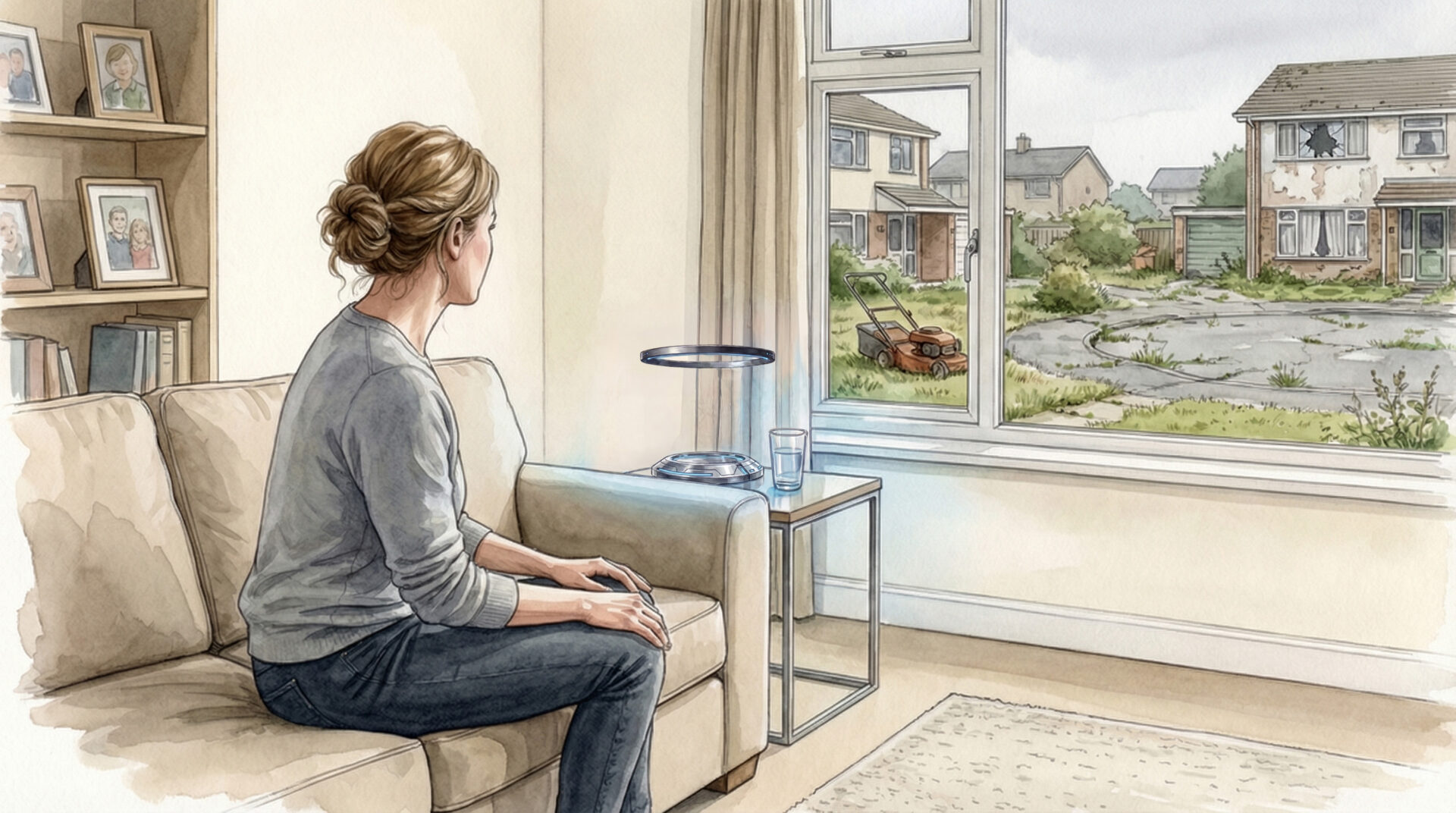
The living room looked the way it was supposed to look. The sofa, the armchair, the bookshelf Piers had ordered from a catalog. The rug they’d chosen together, five years ago, before Hugo was born, when choosing a rug still felt like something two people did because they wanted to. The Halo sat on its stand in the corner by the window, silver-white, on its charging cradle. Next to it, a small table with a glass of water and a box of tissues.
She’d changed. Twice. The first time into a blouse that was too much, the second into a sweatshirt that was too little. She’d settled on a grey pullover and dark jeans, which was what she would have been wearing anyway. She brushed her teeth. Put her hair up. Took it down. Put it up again. She didn’t know why she was doing any of this for a technician. She did it when the gas man came too. She did it when anyone came. No one came very often.
She went to the kitchen and put the kettle on. The view from the kitchen window: the cul-de-sac, the six houses in a half-circle around the turning point. Number twelve had a lawn mower sitting in the front garden that hadn’t moved since spring. Number sixteen had its curtains drawn. They’d been drawn for two years. The Novaks had gone in together — first him, then her a month later. Their son had moved to the Warrens. Nobody had mowed the lawn since.
The kettle boiled. She made herself a cup of tea she didn’t drink.
On the fridge, beside the children’s drawings, the weekly schedule in Piers’s handwriting. Monday through Friday, his commute times, the children’s activities, Kate’s dentist appointment from three weeks ago that she hadn’t updated. At the bottom, in a different pen: Kate: Halo service, Tues 10-12. He’d written it when she’d mentioned the malfunction.
At ten-twelve, the doorbell rang.
She checked her reflection in the hallway mirror. She opened the door.
The man on the step wore the Bliss Technologies uniform. Navy jumpsuit, logo on the chest, a tool case in one hand and a diagnostic tablet tucked under the other arm. He was looking at the tablet when the door opened, and he looked up, and stopped.
“Kate.”
The air was cool. September. The light was flat, the way Ashfield’s light was always flat, filtered through clouds that never quite committed to rain.
“Tomás,” she said.
He looked different. Thirteen years. The hair was shorter. The face thinner, harder, the softness of his twenties gone. His hands were the same. Square, capable, a scar on the right knuckle she didn’t recognize.
He was standing on her step in a Bliss Technologies uniform with a tool case.
“I didn’t —” he said. “The name on the ticket said K. Lindgren.”
“That’s me.”
“Right.” A pause. “Right.”
She smoothed the front of her pullover. “Come in.”
He came in. He wiped his shoes on the mat, and she saw him glance at the row of shoes by the door. Two pairs of children’s shoes, small, one pink and one blue, lined up against the wall. Ella’s had the laces tucked in because Ella was neat. Hugo’s had the Velcro half undone because Hugo was Hugo.
Tomás looked at the shoes. Looked away.
“The Halo’s in the living room,” she said.
She led him through the hall. He followed. His boots were loud on the wood floor.
“Through here.”
The living room. She could feel him taking it in. The photos on the shelf: Kate and Piers at a wedding. Kate with the children at a beach. A family portrait, everyone in white. Piers’s arm around her shoulder in the portrait, his hand resting there the way hands rest on armchairs.
“Nice place,” he said.
“Thanks. It’s — we’ve been here five years.”
“Five years.”
“Since before Hugo.”
He nodded. Set the tool case on the floor by the Halo stand. Unclipped the diagnostic tablet. His eyes passed over the small table next to the stand, the water glass, the tissues. He didn’t say anything.
“So,” he said. “The Halo.”
He worked the way she remembered. Not the Halo work, she’d never seen him do this particular thing, but the quality of attention. The way he held the device, turned it, looked at the seam where the neural band met the temple nodes. His fingers finding the diagnostic port by feel. He’d always been like this with anything mechanical. At the university, he’d taken apart her desk lamp to fix the switch and put it back together in six minutes. She’d timed him. He’d grinned.
“How long has it been doing this?” he said. He’d connected the tablet and was running the calibration scan.
“Three days. It started with the visual sync. There’s a flutter, like the image drops for half a second.”
“On entry or during?”
“During. About twenty minutes in.”
He looked at the tablet. Numbers she couldn’t read, a signal map in blue and green. He tilted the Halo and pressed a point on the underside of the band, and something clicked.
“Calibration drift on the left neural array. The sync band is losing coherence with the sensory feed.” He looked at her. “Common issue on the Mark Three. They fixed it in the Four, but —”
“I have the Three.”
“You have the Three.” He reached into the tool case. A thin-handled screwdriver, a contact cleaner pen, a component she didn’t recognize. “I can recalibrate it here. Should take fifteen, twenty minutes.”
“Okay.”
He began working. She stood in the middle of her own living room.
“Tea?” she said.
“If you’re making some.”
She went to the kitchen. Filled the kettle. Her hands were steady, which surprised her. She set out two cups. The good ones, the ones from the set Piers’s mother had given them. She looked at them. Put them back. Took out two regular mugs.
She brought the tea in. He was sitting cross-legged on the floor beside the Halo stand, the band open in his lap, a penlight in his teeth. He took the mug without looking up.
“Thanks.”
She sat on the sofa. Held her own mug. The distance between the sofa and where he was sitting on the floor was about six feet.
“So,” she said. “A Bliss technician.”
“Seven years.”
“You were studying engineering.”
“I was.” He removed the penlight from his teeth. Adjusted something in the band with the screwdriver. “Didn’t finish.”
“Why not?”
He looked at her. Then back at the band. “Life.”
She drank her tea. He worked. The room settled around them.
She watched him work. His left hand held the band stable while his right made the adjustments. Small movements, no wasted effort. He’d rolled his sleeves to the elbow. The uniform was too new for him, she thought. Too clean. He looked like someone wearing a costume of the person he’d become.
“Do you like it?” she said. “The work.”
“I’m good at it.” He cleaned a contact point with the pen. “That’s not the same thing.”
“No.”
“But it’s close enough, most days.” He set the pen down. Picked up a smaller tool. “I can diagnose by ear now. There’s a sound the Mark Three makes when the array’s drifting. Like a high whistle. You probably heard it.”
“That’s what I called about.”
“Most people don’t notice it. They just notice the flutter.”
She looked at her mug.
“You always understood how things worked,” she said. “Remember the lamp?”
“Your desk lamp.”
“Six minutes.”
“The switch housing was cracked. It wasn’t complicated.”
“You were pleased with yourself.”
“I was nineteen.”
“You did a little bow.”
He looked at the screwdriver in his hand. “I didn’t do a bow.”
“You did a bow. A small one. Like a performer.”
“That doesn’t sound like me.”
“It was exactly like you.”
He went back to the band. The screwdriver moved. She held her mug and didn’t drink from it.
The minutes passed. He worked. She stayed on the sofa, drinking tea that was getting cold.
“You have two kids,” he said. Not a question. He’d seen the shoes, the photos.
“Ella’s eight. Hugo’s five.”
“Good names.”
“Piers chose Hugo. I chose Ella.”
“They’re at school?”
“Until three-fifteen. The school bus picks them up at the Last Stop. It’s the only route still running to this part of Ashfield.” She paused. “It’s fine. They have friends. The school’s in the Warrens. Good teachers.”
“Ella’s doing well. Hugo’s — he’s Hugo. He builds things and takes them apart. The teacher says he has good spatial reasoning, which I think means he’s destructive in an organized way.”
The corner of Tomás’s mouth moved. “I like him already.”
“He’d probably like you too. He asks everyone how things work.” She looked at her mug. “He asked me last week how the Halo works and I couldn’t explain it. I said it makes pictures in your brain. He said that’s what eyes do.”
“Smart kid.”
“He is.” She paused. “Piers said I should just tell him it’s like television.”
Tomás nodded. He was cleaning a contact point, his head bent over the band.
“It’s not like television,” he said.
“No.”
Neither of them looked at the other. He worked. She held the mug.
“And your husband,” Tomás said. “Piers.”
“He works in the Meridian. Investment management.” She paused. “He’s doing well. We’re —” She stopped. “He’s doing well.”
Tomás nodded. He didn’t look up from the band.
“What about you?” she said. “Are you — is there someone?”
“Noor. She’s a nurse. We’ve been together two years.”
“That’s great.”
“It is.”
“Is she — where does she work?”
“A clinic in the Warrens. Dr. Vasquez’s.”
“Two years,” she said. “That’s solid.”
“It’s good.” He set down the screwdriver. Picked up a smaller tool. “She’s good.”
He was running the neural signature scan. The tablet needed to read her baseline patterns to lock the calibration.
“I’ll need you to put it on for a minute,” he said. “Just to scan. You won’t enter.”
He held the Halo out. She took it. The band was warm from his handling. She fitted it over her head, settled the temple nodes, felt the familiar gentle pressure of the neural contacts against her skin.
“Hold still.”
He was close to her now, standing, adjusting the fit. His fingers on the band, near her temples. She could smell him. Not cologne, something simpler. Soap and the metallic scent of the tool case and underneath it something she recognized.
She closed her eyes. Opened them.
“How often are you using this?”
He was looking at the tablet.
“A couple hours a day. When the kids are at school.”
He said nothing. The tablet beeped.
“Is that a lot?” she said.
“It’s within the recommended range.” He paused. “The recommended range is generous.”
“My husband thinks it’s fine.”
“Sure.”
“He bought it for me, actually. For my birthday. He said I deserved something for myself. His words.”
Tomás adjusted a node on the band. His fingers near her left temple.
“That’s thoughtful,” he said.
“It was. It is.” She could feel the node pressing gently against her skin. “Lots of people use them. It’s relaxing.”
“Mmm.”
“You don’t approve.”
“I fix them for a living, Kate. I see the usage data on every unit I service.” He looked at the tablet, not at her. “I don’t have opinions.”
“You have an opinion.”
“I have a calibration to finish.”
“Tomás.”
He looked at her. Not at the tablet, not at the Halo. At her. The way he used to look at her when she was doing something she knew wasn’t a good idea and he was deciding whether it was his place to say so.
“I’m just calibrating,” he said. Quietly. “I’m not — I don’t get to have an opinion about how you use it.”
She felt the heat come into her face. He looked back at the Halo.
“Hold still,” he said. “Almost done.”
She took the Halo off. He took it from her, their fingers not touching, both of them careful about it.
He sat back on the floor and locked the calibration. She went to the kitchen to pour out the cold tea and make more, standing at the counter while the kettle heated, looking at the schedule on the fridge. Piers’s handwriting. Neat, small, the handwriting of a man who filled in forms correctly and never left the cap off the pen. Kate: Halo service, Tues 10-12. She wondered if he’d write the next one too. She wondered if she’d ask him to.
She brought the tea back. Sat on the sofa. He was on the floor, running the verification scan.
“You didn’t tell me what you’ve been doing,” he said. “Other than the kids.”
“What do you mean?”
“You studied art history. You were going to work in a gallery.”
“I remember what I was going to do.”
“So what happened?”
“I had children.”
“People have children and work in galleries.”
“Some people do. I live in Ashfield. The nearest gallery is forty minutes by train. Hugo was colicky for the first year. Piers was working eighty-hour weeks. It didn’t — the timing wasn’t right.”
“Is the timing right now?”
She looked at him. He was looking at the tablet, running the scan, his face neutral.
“The timing is fine,” she said. “I’m busy. The kids have schedules. The house needs managing.”
“You could still do it. When Hugo’s older. You were good.”
She put her mug down. Picked it up again.
“I’m not bored, if that’s what you’re asking.”
“I’m not asking anything.”
“You are, though.”
He looked up. Held her eyes for a moment. Then back at the tablet.
“The scan looks good,” he said.
He closed the access panel and tested the connectors. She watched him. His hands moved with certainty. She remembered those hands buttoning his shirt in the flat on Rue Vidal, the one with the window that stuck and the landlord who sang on Sundays. She remembered his hands on her back when she was sick, flat and warm and steady.
She remembered telling him she’d met someone. His face. The way his hands had gone to his knees and stayed there.
“Do you remember the place on Rue Vidal?” she said.
He didn’t look up. “The window that stuck.”
“The landlord.”
“Monsieur Deschamps. He sang Piaf.”
“Badly.”
“Terribly.” He was smiling now, or close to it. “The pipes in the bathroom.”
“God, the pipes.”
“The pipes and the singing. At the same time.”
She was laughing. The sound filled the room in a way that showed how quiet the room usually was. She pressed her hand to her mouth.
His hands kept working. He cleaned a contact point. Set the tool down and picked up another.
The room was quiet.
“That was a long time ago,” she said.
“Thirteen years.”
“Thirteen years.”
He picked up the verification tool. The silence had a different weight now.
“Do you miss it?” she said.
“Miss what?”
“I don’t know. Being that young. Being stupid.”
“We weren’t stupid.”
“We were a little stupid.”
“You weren’t stupid.” He said it simply, the way you say something you’ve thought about and settled. “You were the least stupid person I knew.”
She looked at the mug in her hands. The tea was cold again.
“Are you happy?” she said.
He looked at her.
“I’m asking,” she said.
“That’s a big question for a service call.”
“I know.”
He held the verification tool. His thumb moved on its casing.
“I’m okay,” he said. “Some days are better than others. Noor is patient. The work is steady.” He set the tool down. “I didn’t become what I was going to become. But I’m okay with that most of the time.”
“What about you?” he said.
“I’m fine.”
“Kate.”
“I’m fine. The kids are wonderful. The house is —” She gestured at the room. The clean room, the catalog bookshelf, the family portrait in white. “The house is here.”
He looked at her.
“I’m going to finish up,” he said.
He reassembled the Halo. Tested the standby mode. Checked the charging cradle. She made more tea. Standing in the kitchen, she pressed her palms flat on the counter and breathed. Through the doorway she could see the back of his head, his shoulders, the Bliss Technologies logo between the shoulder blades. He was putting tools away. Each one in its place in the case.
She brought the tea in. Two mugs. Set his on the floor beside him. He thanked her without looking up.
When he finished, he stood. He’d packed his tool case. The Halo was on its stand, the indicator light a clean, steady blue.
“All set,” he said. “The calibration should hold. If the flutter comes back, call the line and ask for a Level Two. They’ll send someone who can replace the array.”
“Not you.”
“Depends on the schedule.”
He closed the case. Clipped the tablet to his belt. He was buttoning up. Professional. Ready to leave.
“Can I test it?” she said. “Just to check.”
She picked up the Halo. He reached for it at the same time, a technician’s reflex, and their fingers met on the band.
Both of them stopped.
Her fingers on the cool outer surface. His on the temple node.
She felt it go through her. Something slow, heavier than she expected. An ache that started at the point of touch and spread inward, through her hand, her arm, her chest.
He felt it too. She could see it. The eyes going still, the breath that caught. His fingers tightened on the band. She tightened hers.
The Halo hung between them. The room was very quiet. Outside, a bird. A car passing on the arterial road, distant.
Neither of them moved. The seconds passed. She could feel his pulse in his fingertips, or thought she could. Her thumb shifted on the band. A centimeter. The pad of her thumb touching his knuckle.
“Kate,” he said. Quiet.
She didn’t let go. She could feel the heat of his hand through the band. She took a half-step toward him. Not dramatic. A shift of weight, her body tilting toward his by a degree that could still be an accident if you measured it from far enough away. But they were not far away.
“Do you think about it?” she said. “About before.”
“Don’t.”
“I’m asking.”
“I know you’re asking.”
He was still holding the band. His eyes were on hers and his jaw was set and his breathing had changed. She could see the effort in his neck, in the tendon above his collar. She moved her hand on the band so that her fingers overlapped his. The full touch now. Deliberate.
“I think about it,” she said quietly.
He closed his eyes. Opened them. She was close enough to see the colour.
“Kate.” Her name again. His voice had dropped and there was something in it she hadn’t heard in thirteen years, something that had been in bed with her in the flat on Rue Vidal when the pipes banged and the landlord sang and none of it mattered.
She leaned. A fraction. The space between them became something she could feel on her skin.
He released the Halo.
He stepped back. One step. She watched his hand go to the tool case and pick it up. The effort of the gesture was in his shoulders, in the way he squared them.
“The calibration will hold,” he said. “Six months. Maybe longer.”
“Good.”
“If you have any issues —”
“I’ll call the line.”
“Ask for Level Two.”
“Level Two.”
He walked to the hallway. She followed. At the door, the children’s shoes. He looked at them again. She saw him look. His eyes went to Ella’s tucked laces. Hugo’s open Velcro.
He turned to her.
“It was good to see you, Kate.”
“You too, Tomás.”
He opened the door. The cul-de-sac. The grey light. The lawn mower at number twelve. The closed curtains at number sixteen. The Bliss Technologies van at the curb, white, the logo on the side.
He walked to the van. Didn’t look back. She watched him open the door, set the tool case inside, stand for a moment with his hand on the frame. Then he got in and pulled the door shut.
She closed the door.
The living room was the same. The sofa, the bookshelf, the rug, the photos. The mug he’d used was on the floor beside the Halo stand, a pale ring of tea at the bottom. She picked it up and held it.
The Halo sat on its stand. The indicator was blue, clean, steady. Fixed. Working. Ready. The small table beside it with the water glass and the tissues.
She looked at it for a long time.
She washed the mugs. Both of them. Dried them. Put them away. She wiped the place on the floor where his tool case had been, though there was nothing to wipe.
At three-fifteen, she would drive to the school. Ella would tell her about her day. Hugo would show her something he’d built from paper. She would drive home and make dinner and run the bath and read the story and tuck them in.
At nine, Piers would come home. He would eat the dinner she’d saved. He would ask about her day. She would say: the technician came, the Halo’s fixed. He would say: good. He would ask if she needed anything. He always asked if she needed anything.
The Halo was on its stand. The light was blue.
She sat on the sofa. The house was quiet. The cul-de-sac was quiet. Through the window, the sky was the same grey it always was, and the lawn mower at number twelve hadn’t moved. The Halo was on its stand, waiting.
She sat with her hands in her lap and didn’t put it on.